



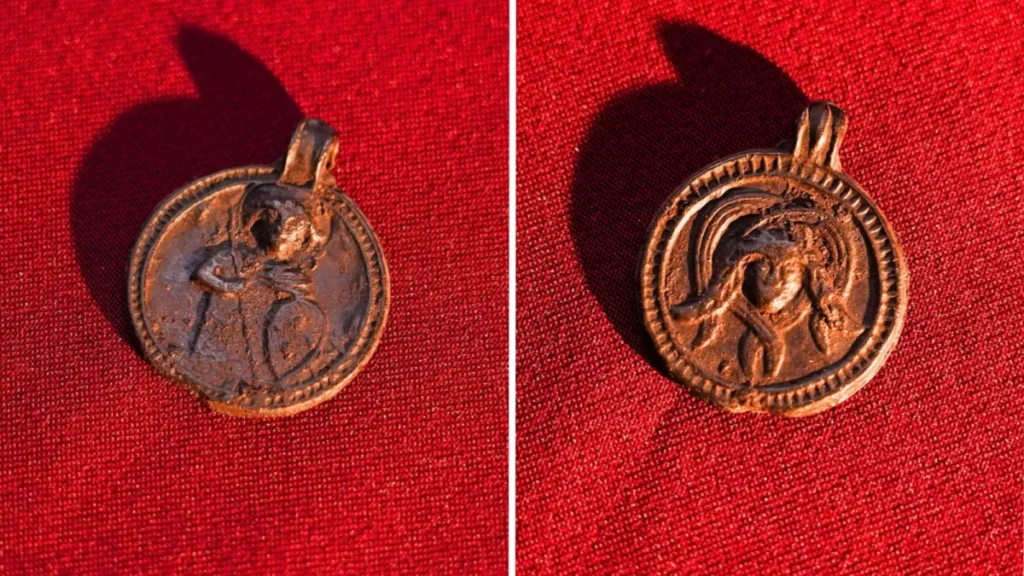
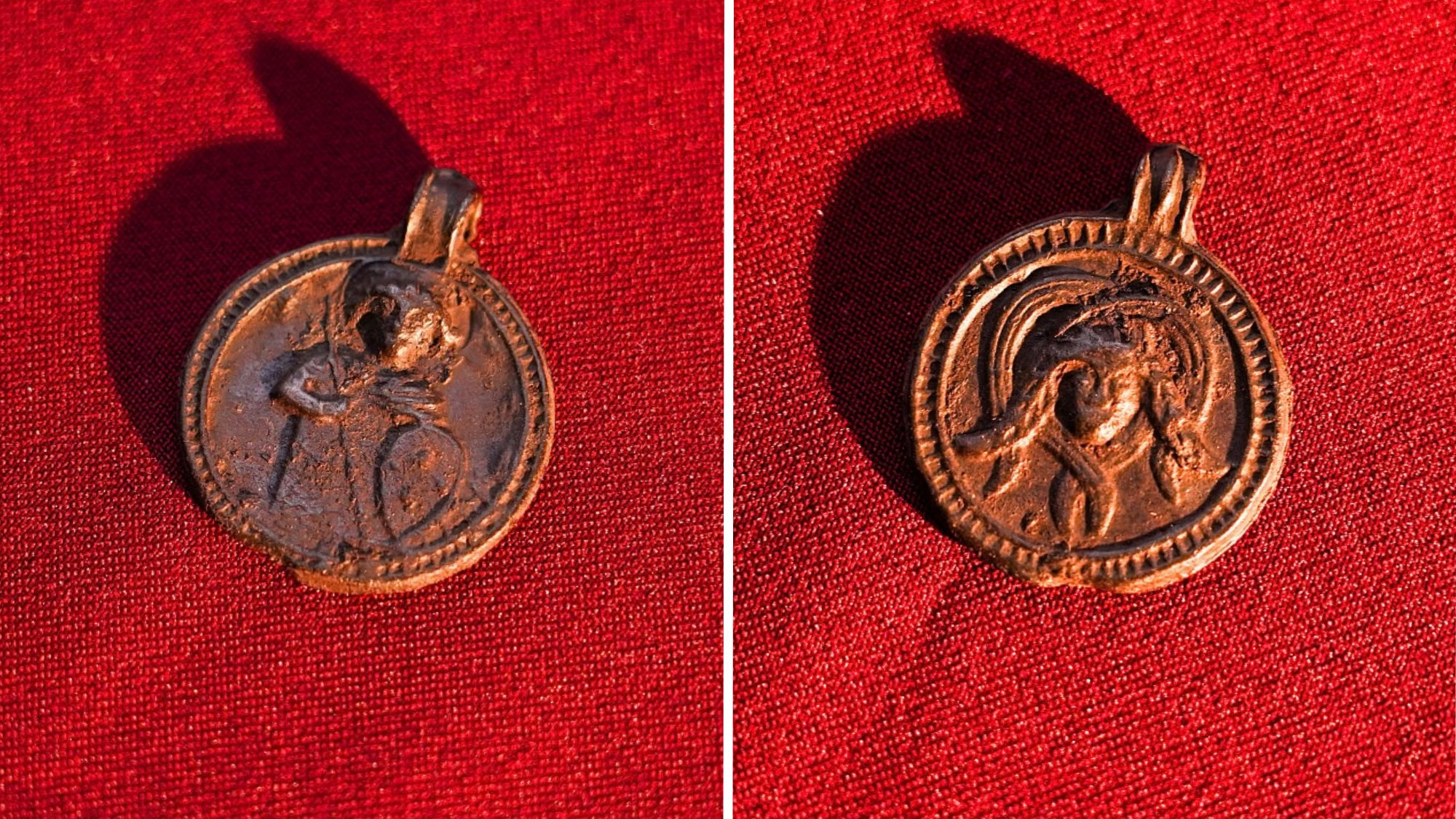
Archaeologists working in the historic region of Staraya, located approximately 400 miles southeast of St. Petersburg, have unearthed a rare 11th-century copper-alloy medallion that vividly captures a pivotal era of spiritual transition in medieval Russia. The double-sided pendant, discovered within the remains of an ancient urban estate, juxtaposes canonical Christian iconography with Greco-Roman mythology. On the front face, the artifact depicts a revered warrior saint, while the reverse side features the unmistakable, serpent-haired visage of Medusa from ancient Greek mythology.
This exceptional discovery provides researchers with tangible evidence of how early Russian society navigated the complex, often overlapping boundaries between newly introduced Christian theology and deeply rooted pre-Christian superstitions. As scholars continue to analyze the artifact, the medallion has emerged as a crucial historical touchstone for understanding religious syncretism, cultural diffusion, and the daily lives of citizens in early medieval Russian urban centers.
The Anatomy of a Zmeeviki: Blending Dogma and Folklore
The newly discovered artifact belongs to a rare and fascinating category of medieval Russian amulets known as Zmeeviki, or "coil images." These double-sided pendants are characterized by their deliberate and unorthodox pairing of orthodox Christian figures on the front with serpent-adorned mythological or pagan motifs on the back. While mainstream Christian dogma strictly forbade the veneration of pagan deities or non-Christian symbols, the existence of Zmeeviki demonstrates a pragmatic local adaptation where protective folk magic and official religion coexisted.
Traditionally, the front of a Zmeeviki featured major figures from the Christian pantheon, including Jesus Christ, the Virgin Mary, or the Archangel Michael. In the case of the Staraya pendant, archaeologists from Novgorod State University have identified the front-facing figure as likely representing Saint Theodore Stratelates. Born into the Roman Empire around 281 CE, Stratelates is celebrated in the Eastern Orthodox Church as a military martyr renowned for his steadfast faith and his legendary slaying of a giant serpent. He is typically depicted in medieval art wielding a spear and a protective shield—imagery that aligned neatly with the protective talismanic function of the pendant.
Conversely, the reverse side of the medallion features the head of Medusa, surrounded by writhing snakes. Rather than viewing the inclusion of the Gorgon as a direct worship of Greek deities, historians and archaeologists interpret the image as a generalized personification of evil, disease, and malevolent spiritual forces. In the worldview of 11th-century medieval Russians, pagan protective symbols were often repurposed as apotropaic devices—wards designed to ward off misfortune and deflect malevolence—operating concurrently with Christian prayers.
Chronology and Archaeological Significance
The excavation of the medallion in Staraya marks a significant milestone in Russian archaeology. Prior to this discovery, researchers had recovered only four other serpent amulets from the immediate Staraya region. However, those previously cataloged artifacts were dated considerably later, spanning the 12th through the 14th centuries.
This chronological discrepancy makes the Stratelates-Medusa pendant potentially the oldest Zmeeviki artifact ever discovered in the area, pushing the timeline of this cultural phenomenon back into the 11th century. The discovery offers a rare window into a specific transitional phase of East Slavic history, a period when Christianity had officially been adopted by Kievan Rus in 988 CE under Grand Prince Vladimir the Great, but had not yet entirely eradicated indigenous folk beliefs and regional superstitions.
Excavation directors note that the pendant was recovered from the stratigraphic layers of an ancient urban estate. Furthermore, evidence of a nearby medieval artisanal workshop discovered during the same general excavation campaigns suggests that the talisman may have been forged locally rather than imported from Byzantine trade centers. This points to a domestic demand for items that bridged official religious doctrine and popular folk magic.
Perspectives from the Archaeological Community
The excavation team from Novgorod State University has emphasized the profound historical implications of the find, highlighting the complex nature of early medieval belief systems.
Sergei Toropov, an archaeologist at Novgorod State University who led the analysis of the find, underscored the contradiction inherent in the artifact from the standpoint of strict medieval theology. "The main feature of the coil is a combination of images that are incompatible, from the point of view of strict dogma," Toropov explained in a university press release.
Despite this theological friction, Toropov noted that the artifact reflects a thriving multicultural and international network. "Most likely, this is not a specific mythological creature, but a collective image of dark forces. Together with other finds, this pendant indicates that already in the 11th century there was a Christian community in early Russia, and cultural ties with Byzantium were also developed."
Historians specializing in medieval religious syncretism point out that the blending of classical Greco-Roman motifs with Christian iconography was not entirely uncommon in regions touched by Byzantine cultural influence. Byzantium itself preserved a deep familiarity with classical antiquity, and motifs from Greek mythology frequently trickled into Slavic lands via trade routes, manuscripts, and diplomatic exchanges.
Socioeconomic Context and Daily Life in Early Russia
Beyond its religious and mythological significance, the medallion offers valuable insights into the socioeconomic stratification of 11th-century Russian towns. Based on the material composition of the artifact—a copper alloy rather than precious gold or silver—archaeologists have deduced the social standing of the pendant’s original owner.
The resident of the Staraya estate who commissioned or wore the amulet likely belonged to the emerging urban middle class or local administrative elite. While the wealthiest aristocrats and high-ranking clergy could afford luxury items crafted from precious metals, and impoverished peasants relied on inexpensive wooden or bone amulets, copper-alloy artifacts occupied a middle tier of prosperity. The owner was affluent enough to secure a custom-made or professionally crafted talisman, yet pragmatic enough to rely on syncretic folk magic for daily protection.
In an era characterized by high infant mortality rates, frequent epidemics, and agricultural vulnerability, daily life required every available spiritual safeguard. For the owner of the Staraya medallion, invoking both a Christian warrior saint and a potent mythological apotropaic symbol offered a double layer of supernatural security.
Broader Implications and Future Research
The recovery of the Staraya medallion reinforces a growing consensus among historians: cultural evolution is rarely a clean, monocultural replacement of old ideas with new ones. Instead, historical transitions are marked by prolonged periods of negotiation, adaptation, and syncretism where communities synthesize tradition and innovation.
As conservationists clean and preserve the artifact, researchers at Novgorod State University plan to conduct further metallurgical and stratigraphic analyses to pinpoint the exact manufacturing techniques used and to better understand the trade networks that supplied the copper alloy. Future excavations in the Staraya region will also focus on the surrounding estate structures to determine whether the workshop associated with the find produced other hybrid artifacts.
Ultimately, the 11th-century Zmeeviki amulet serves as a miniature historical canvas, capturing the complex spiritual identity of early medieval Russians as they stood at the crossroads of Christian orthodoxy and ancient myth.