

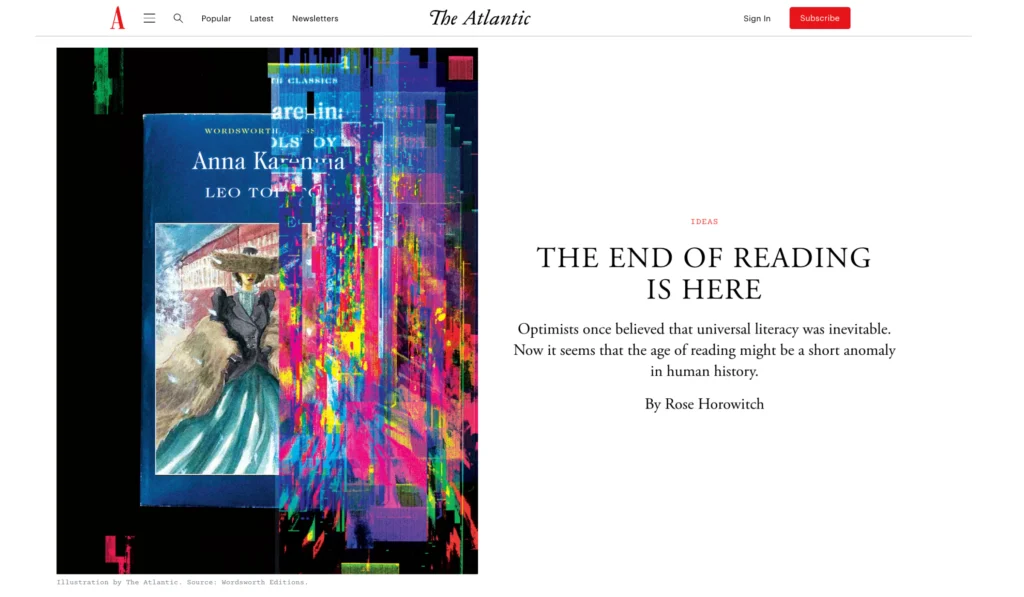
In an era defined by hyper-connectivity and endless digital streams, the foundational human habit of deep reading is facing an unprecedented existential threat. A sprawling, 8,500-word feature published recently in The Atlantic by Rose Horowitch, titled "The End of Reading is Here," has reignited a fierce global debate regarding the rapid decline of literacy in the post-literate age. Horowitch’s exhaustive piece synthesizes mounting cultural anxieties and empirical data pointing toward a radical, technology-driven retreat from the written word. This diagnostic of contemporary culture builds upon similar warnings issued by cultural critics like James Marriott, whose upcoming book, The New Dark Ages, explores the societal perils of a post-literate society. As digital distractions increasingly supplant sustained attention spans, educators, technologists, and cognitive scientists are grappling with a sobering question: Is the retreat from reading a benign evolution in human communication, or does it signal a catastrophic regression in human consciousness?
The debate transcends mere nostalgia for the physical book or the nostalgic lament of older generations observing the habits of the youth. At stake, according to a growing consensus among technology theorists and historians, is the very architecture of modern thought. Literacy is not merely one medium of communication among many; it is arguably the foundational technology that enabled the development of logic, human rights, institutional democracy, and the modern conceptualization of the independent self.
The Anatomy of a Cultural Shift: Chronology of the Reading Decline
The erosion of deep reading did not happen overnight. It represents the culmination of a multi-decade technological transition that systematically re-engineered the human information diet.
The early phases of the digital revolution in the late 1990s and 2000s promised democratization and expanded access to information through the widespread adoption of the internet. However, the subsequent smartphone boom of the late 2000s and the rise of algorithmic social media platforms in the 2010s fundamentally altered how humans interact with text. Long-form narrative and complex exposition were steadily replaced by micro-content: tweets, algorithmic feeds, short-form video platforms, and hyper-linked journalism optimized for scanning rather than studying.
By the early 2020s, educators and researchers began recording measurable drops in standardized reading comprehension scores across various demographics. Longitudinal studies tracking leisure reading habits among adolescents and adults revealed a steep, continuous downward trajectory. The publication of James Marriott’s essays on the dawn of a post-literate society in the mid-2020s brought acute academic and public attention to the phenomenon. This trajectory culminated in the mid-2026 publication of Horowitch’s Atlantic feature, which served as a comprehensive empirical and cultural ledger of a society actively unlearning the habit of sustained reading.
Empirical Evidence and Data on Falling Literacy Metrics
While the cultural symptoms of falling literacy are visible in everyday interactions—ranging from diminished attention spans in professional settings to the simplification of public discourse—quantitative data underpins the alarm raised by contemporary analysts.
Surveys tracking daily time allocation demonstrate a dramatic reallocation of leisure hours away from books, long-form journalism, and print media toward short-form, screen-based entertainment. According to statistical insights referenced in contemporary cultural analyses, the average daily time spent reading books for pleasure among younger demographics has plummeted to historic lows. Concurrently, metrics regarding deep reading stamina indicate that even among university students, the capacity to sit through an uninterrupted, multi-page academic text without experiencing cognitive fatigue has significantly deteriorated.
Furthermore, educational assessments highlight a parallel trend in reading proficiency. Schools worldwide report mounting difficulties in teaching students how to parse complex sentence structures, evaluate nuanced arguments, and retain multi-layered narratives. This data paints a picture of a population increasingly fluent in visual and interactive media, yet functionally unexercised in the rigorous cognitive demands of traditional literacy.
Theoretical Context: Walter Ong and the Roots of Modern Consciousness
To understand the gravity of this shift, technology theorists often look backward to understand how the adoption of literacy shaped human history in the first place. A central text in this analysis is Walter Ong’s classic 1982 work, Orality and Literacy, which explores the profound psychological transformations that occur when a culture transitions from an oral tradition to a literate one.
Ong demonstrated that writing and reading do not merely record thought; they restructure it. In oral cultures, knowledge must be formulaic and mnemonic to be remembered. The invention of the written word allowed for abstract, analytical, and objective thought. It gave rise to linear logic, historical consciousness, and sophisticated legal and political frameworks that require examining an argument detached from an immediate interpersonal context.
When society experiences a broad retreat from literacy back toward predominantly fragmented, audio-visual, and rapid-fire communicative modes, the reverse psychological transformation threatens to take place. As technology theorists note, the cognitive world we currently take for granted—characterized by critical thinking, self-reflection, and systematic empirical inquiry—is a conceptual child born from the mind-shaping power of the written word. Stepping away from intensive reading is, therefore, not a neutral technological pivot, but a cognitive regression.
Official Responses and Expert Analyses
The alarm sounded by journalists and theorists has prompted responses from diverse sectors, including education, public health, and technology policy.
Educational leaders have increasingly called for curricular reforms that reintegrate analog, distraction-free reading environments into classrooms. Some school districts have enacted strict bans on smartphones during instructional hours to restore basic attention capacities required for deep reading. However, these institutional measures often face pushback from a culture deeply entrenched in digital dependency.
Cognitive scientists and public intellectuals have increasingly drawn parallels between the physical health crises of the late 20th century and the cognitive health crises of the 21st century. Just as sedentary lifestyles and the proliferation of ultra-processed foods necessitated a cultural reckoning with physical fitness and nutrition—spawning the modern fitness and dietary wellness movements—the digital age requires a parallel movement for mental fitness.
In recent high-profile commentaries, experts have argued that society must begin treating highly distracting digital media and algorithmic feeds with the same wariness applied to nutritional junk food. Just as a healthy lifestyle requires deliberate, sustained physical exertion—such as jogging, swimming, or weightlifting—maintaining a healthy, agile mind in the twenty-first century demands deliberate, structured periods of analog reading, writing, and deep self-reflection.
Broader Impact and Implications for the Future
The societal implications of a post-literate or semi-literate future extend far beyond individual intellectual enrichment; they touch upon the stability of democratic institutions, cultural memory, and the future of human empathy.
Democracy relies heavily on the citizenry’s ability to evaluate complex policy arguments, discern nuance, consume investigative journalism, and engage in sustained, rational debate. A populace habituated to algorithmic micro-content, outrage loops, and headline-skimming is inherently more vulnerable to misinformation, demagoguery, and emotional manipulation.
Moreover, narrative reading has long been recognized as a primary engine for developing empathy. Stepping inside the consciousness of a literary character for hundreds of pages allows readers to inhabit emotional landscapes radically different from their own. The decline of this practice risks producing a more insular, fragmented society less capable of understanding diverse perspectives.
As Rose Horowitch observed in the concluding remarks of her seminal article, humanity has been bequeathed an astonishing wealth of information, literature, and wisdom from preceding generations. How contemporary society chooses to manage this intellectual inheritance—whether it allows the foundational technology of literacy to atrophy or actively preserves and champions it through intentional habit-building—remains one of the defining questions of the twenty-first century. The tools to reverse this trend exist, but implementing them will require a deliberate, counter-cultural commitment to the quiet, demanding, and transformative power of the written word.