


The modern enterprise is currently grappling with a paradox of deployment: while investment in artificial intelligence has reached record highs, the actual utility of these tools remains siloed within organizations. A chief learning officer’s mandate—to roll out AI across three major business units, build a comprehensive enablement curriculum, certify managers, and track completion rates—often results in a successful check-box exercise. Yet, 18 months post-deployment, the reality is frequently bifurcated. Some teams have successfully integrated the tool, fundamentally altering how they draft, review, and finalize work, resulting in measurable efficiency gains. Conversely, other teams treat the technology as a dormant mandate, leaving the software unclicked and relying on legacy workflows.
The critical failure in these environments is not a lack of adoption, but a systemic absence of circulation. Knowledge remains trapped within the individuals who have successfully navigated the tool, while those struggling to adapt remain silent to avoid appearing incompetent or "going rogue." This lack of cross-pollination ensures that by the time a formal refresher course is scheduled, the technology has already evolved, rendering the outdated curriculum obsolete.
The Chronology of an AI Rollout Failure
The lifecycle of these stalled initiatives often follows a predictable trajectory. In the first quarter, enthusiasm is high, supported by leadership mandates and robust training modules. By the second quarter, initial "early adopters" begin to find workarounds and productivity hacks. However, without a mechanism for peer-to-peer knowledge sharing, these insights remain anecdotal.
By the fourth quarter, the "cascade model"—a top-down approach where knowledge is pushed downward in static intervals—begins to fracture. Because the organization lacks a feedback loop, leadership remains unaware that a significant portion of the workforce has disengaged. Research from the 2026 Global Learning and Skills Trends Report by Udemy indicates that while 88 percent of employees view effective leadership as the linchpin for AI success, fewer than half believe their direct managers possess the necessary readiness to guide them through this transition. This leaves a significant void between executive intent and frontline execution.
The Data Landscape of Modern AI Adoption
The pressure to achieve "organizational nimbleness" has become the primary competitive strategy for business leaders through 2029, as noted in the Deloitte Global Human Capital Trends report. Despite this priority, 59 percent of organizations continue to rely on a strictly tech-centric approach to AI. The implications of this are stark: firms that prioritize technical deployment over human-centered design are 1.6 times more likely to fall short of their projected return on investment.
These figures underscore a growing divide between institutional investment and actual capability. With 72 percent of CEOs now personally directing AI strategy—a significant increase from previous cycles—the pace of shifting requirements has moved far beyond the capacity of traditional, periodic curriculum updates. Organizations are effectively doubling their AI investment as a share of revenue, yet the "sensing infrastructure" required to track whether that capital is generating value is often nonexistent.
The Psychological Barrier to Knowledge Circulation
The primary obstacle to effective AI utilization is not technical, but psychological. In many corporate environments, admitting to a lack of understanding regarding a new tool is perceived as a career liability. When employees cannot discuss their struggles or their unofficial "workarounds" without fear of retribution, the organization loses the ability to iterate.
This environment necessitates a move from single-loop learning—where errors are corrected without addressing the underlying assumptions—to double-loop learning. In a double-loop framework, the organization actively questions its governing logic. When a team encounters a hurdle, they do not simply look for a workaround; they examine why the workflow is failing and how the AI tool can be reconfigured to solve the root problem.
The most effective leaders are those who model "not-knowing." By publicly admitting to their own struggles with complex AI prompts, these leaders dismantle the culture of performative competence, creating the psychological safety required for others to share their progress.

Systems Thinking: Turning AI into a Listening Partner
Rather than viewing AI merely as a productivity tool, forward-thinking organizations are beginning to use it as an "early-warning system." By deploying Agentic AI to analyze workflow data and detect where standard practices diverge, companies can identify teams that are struggling or those that have developed innovative, undocumented workflows.
However, this approach carries a significant ethical caveat: the distinction between "sensing" and "surveillance." If employees feel that AI is being used to monitor their individual output or identify who is "behind," the very candor required for institutional learning will vanish. To succeed, these listening mechanisms must be transparent, opted into by the workforce, and focused on system improvement rather than individual performance metrics.
Redefining the Role of L&D: From Curriculum to Architecture
The traditional role of the chief learning officer is undergoing a fundamental transformation. As AI tools increasingly provide on-demand, procedural training, the focus of Learning and Development (L&D) must shift toward the development of "judgment" as the core curriculum.
In an era where a machine can draft a financial model or a strategic plan in seconds, the human capacity to interrogate the output, identify potential bias, and determine the ethical implications of a decision becomes the most valuable asset. The "soft skills"—reflexivity, critical thinking, and the ability to operate within ambiguity—are now the load-bearing components of professional competence.
To operationalize this, organizations are moving toward "trait-mapping" rather than rigid job descriptions. By mapping specific human strengths—such as interpersonal sensitivity, future-focused ideation, and rapid execution—to active projects, companies can assemble fluid, reconfigurable teams that exist outside the traditional org chart. This approach treats the team as a dynamic unit of production, allowing for the integration of human judgment and machine-driven speed.
Practical Steps for the Next Two Quarters
For organizations looking to bridge the gap between deployment and utility, the following steps are recommended:
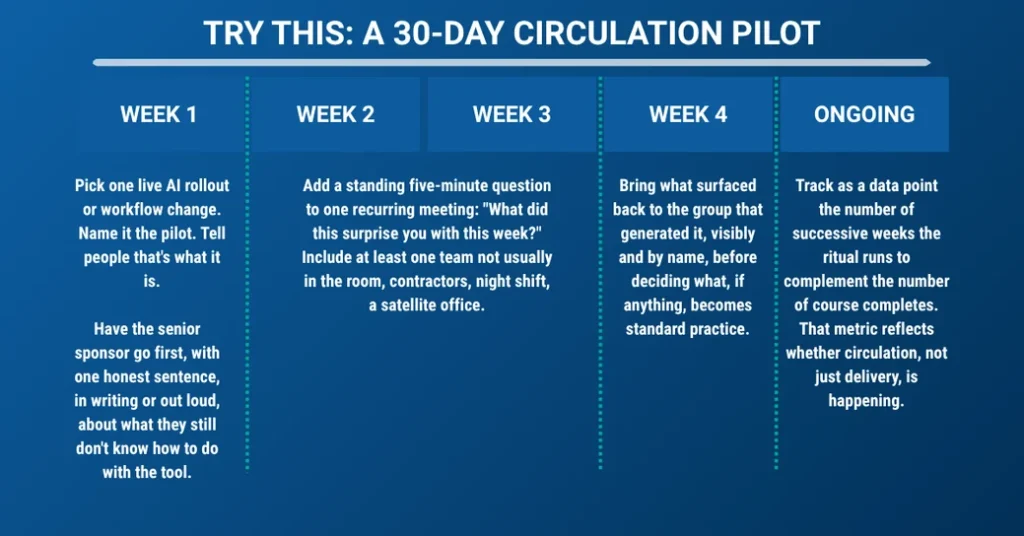
- Implement Standing Inquiry Slots: Dedicate five minutes in standing meetings to "inquiry sessions" where team members discuss how the tool surprised them, rather than simply reporting on task completion.
- Model Vulnerability: Senior leadership must publicly share their own technical fumbles. This establishes a baseline of trust that encourages others to disclose their own bottlenecks.
- Widen the Sensing Net: Ensure that feedback loops include frontline staff, contract workers, and night-shift teams. These individuals often possess the most direct, practical insights into how tools function in real-world scenarios.
- Shift from Cascade to Circulation: Replace the unidirectional "push" of information with a multidirectional loop. View the frontline not as the end of the chain, but as the primary source of innovation and design input.
The Competitive Advantage of Adaptive Intelligence
The organizations that will thrive in the coming decade are those that view learning as core infrastructure. When an organization successfully transitions from a cascade model to a circulation model, it creates a self-reinforcing loop of improvement.
This requires a departure from the "set-it-and-forget-it" mentality that has plagued digital transformations for years. The goal is to build an environment where knowledge is not just documented, but actively moved through the organization to keep pace with technological change. In this climate, the most important metric is not the completion rate of a certification module, but the speed and quality with which a team can share what they have learned, admit what they do not know, and reconfigure their work accordingly.
By treating the organization as a living, learning system rather than a static hierarchy, leaders can move beyond the limitations of standard dashboards. In an era of constant volatility, the ability to facilitate the rapid circulation of knowledge is no longer a soft skill—it is the defining competitive advantage for the modern enterprise. Those who master the art of organizational sensing and trust-building will be the only ones capable of sustaining growth as the technological landscape continues to shift beneath them.