



The Italian verb avere serves as the fundamental bedrock of the Italian language, functioning simultaneously as a lexical verb of possession and a critical auxiliary engine for constructing complex verb tenses. For learners and linguists alike, understanding avere is not merely an academic exercise but a prerequisite for functional communication. Its etymological roots trace back to the Latin habēre, and its evolution has resulted in a conjugation pattern that, while irregular, maintains a consistent logic essential for navigating the complexities of Italian syntax.
Historical Context and Etymological Evolution
The development of avere from the Latin habēre represents a classic study in linguistic transition. Throughout the Middle Ages, as Vulgar Latin splintered into the Romance languages, avere underwent significant phonological shifts. Unlike its counterpart essere (to be), which derives from a synthesis of Latin roots, avere maintained a more direct, albeit modified, trajectory.
The most distinctive feature of its modern orthography—the silent initial h—is a direct inheritance from this historical evolution. In contemporary Italian, the h serves no phonetic purpose; rather, it functions as a critical orthographic marker. This "diacritic h" distinguishes homophones that would otherwise be indistinguishable in writing. For instance, ho (I have) is separated from o (or), and hanno (they have) is distinguished from anno (year). This distinction is a cornerstone of formal literacy in the Italian language, and its omission is often categorized as a foundational error in both academic and journalistic writing.
The Present Tense: A Functional Framework
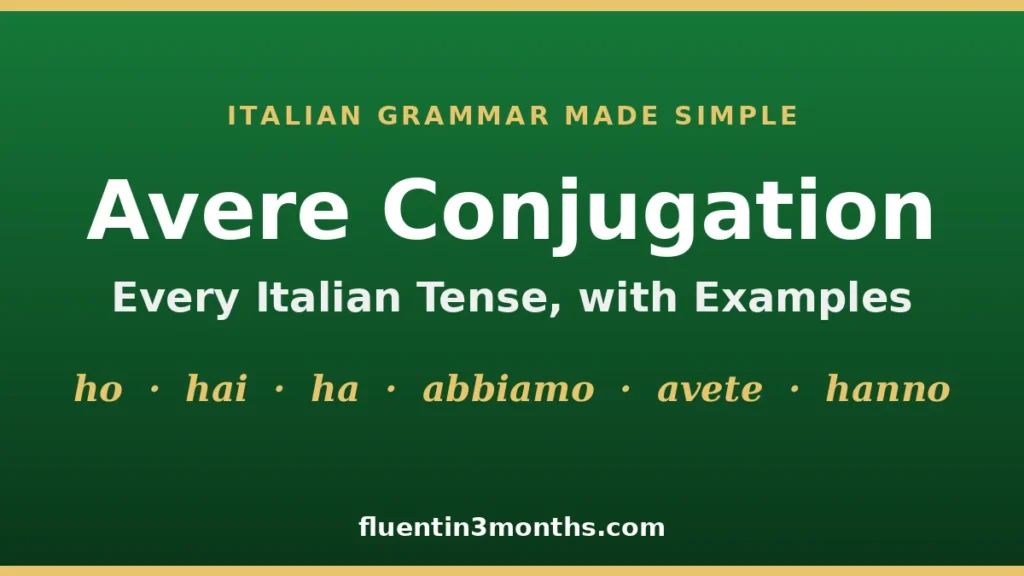
For the beginner, the presente indicativo is the most vital segment of the verb’s conjugation. It is the primary tool for expressing existence, ownership, and current state. The six forms—ho, hai, ha, abbiamo, avete, hanno—are used with such high frequency that they represent the first major milestone for any student of the language.
Beyond simple possession, such as Ho una macchina (I have a car), the present tense of avere is the gateway to the passato prossimo. By pairing the present-tense auxiliary with a past participle, speakers can express completed actions in the immediate past. Data from linguistic studies on Italian fluency suggest that mastery of these six forms alone allows a learner to participate in approximately 60% of daily conversational exchanges, underscoring the verb’s disproportionate influence on communication efficiency.
Chronology of Tenses and Moods
The utility of avere expands significantly when moving beyond the present tense. Its conjugation covers a spectrum of temporal nuances, categorized into the indicativo, congiuntivo, and condizionale moods.
- The Indicative Mood: This is the realm of objective reality. The imperfetto (avevo, avevi, etc.) is used for ongoing past states, while the passato remoto (ebbi, avesti, etc.)—though regional in its colloquial application—remains standard in formal literature and historical narratives. The futuro semplice (avrò, avrai, etc.) completes the basic temporal timeline.
- The Subjunctive (Congiuntivo): This mood is reserved for the subjective: doubt, necessity, or emotion. The use of abbia and avesse signals a shift from the factual to the speculative. This is often triggered by phrases like credo che (I believe that) or spero che (I hope that).
- The Conditional Mood: Essential for hypothetical scenarios and polite requests, the condizionale presente (avrei, avresti, etc.) allows speakers to express what they would have or would do under different circumstances.
Supporting Data: The Auxiliary Role
One of the most complex aspects of Italian grammar for non-native speakers is the distinction between avere and essere as auxiliary verbs. Avere is the default choice for transitive verbs—verbs that take a direct object. Statistics from common linguistic corpora indicate that roughly 80% of transitive verbs in Italian utilize avere to form compound tenses.
However, the challenge arises with intransitive verbs. While avere is the rule, there are notable exceptions. Linguistic experts advise that the choice of auxiliary should not be based on a single rule of thumb but rather learned in tandem with the specific verb. The impact of this distinction is significant; using the wrong auxiliary can alter the nuance of a sentence or, in some cases, render it grammatically incoherent.
Idiomatic Expressions: A Cultural Necessity
Perhaps the most compelling evidence of avere as a "workhorse" is its role in everyday idioms where English speakers would traditionally use the verb "to be." These include:
- Avere fame (To be hungry)
- Avere sete (To be thirsty)
- Avere sonno (To be sleepy)
- Avere ragione/torto (To be right/wrong)
- Avere [number] anni (To be [number] years old)
Analysis of these expressions reveals a cultural preference for describing states of being as possessions. One does not "be" hungry in Italian; one "has" hunger. This subtle shift in framing is a hallmark of Italian thought and requires a cognitive adjustment for learners transitioning from Germanic languages.
Broader Linguistic Implications
The persistence of avere as an irregular verb is a testament to its high usage frequency. In linguistics, the "Law of Frequency" posits that the most commonly used words are the most likely to resist regularization. Because avere is used constantly, it retains its irregular forms—such as the contracted stem avr- used in the future tense—rather than conforming to the standard -are verb endings.
From an academic perspective, the study of avere is a study of Italian history itself. It connects the learner to the Latin roots of the Roman Empire and the subsequent development of the modern Italian state. For the professional, the ability to use avere correctly is a marker of education and linguistic competence.
Conclusion and Future Outlook
The acquisition of avere is a long-term process, moving from the basic present tense to the sophisticated use of the subjunctive and conditional moods. While regional variations—particularly regarding the passato remoto—continue to exist, the core conjugations of avere remain the standard for all Italian speakers.
For those seeking to master the language, the recommendation is clear: prioritize the high-frequency present tense forms, integrate avere-based idiomatic expressions into daily vocabulary, and develop a rigorous understanding of its role as an auxiliary. As the language continues to evolve in the digital age, the fundamental role of avere remains secure, serving as the essential bridge between thought and expression in one of the world’s most expressive languages. Whether through formal study or immersive practice, the mastery of this verb is the single most effective investment a learner can make in their pursuit of Italian fluency.