


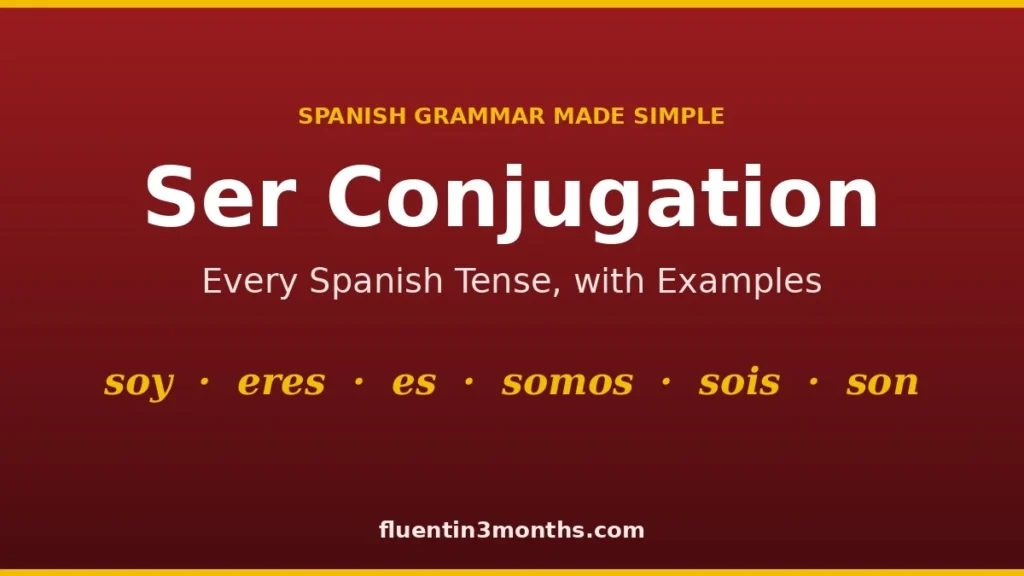
The verb ser serves as a primary pillar of the Spanish language, representing one of the two distinct translations for the English verb "to be." For the estimated 591 million Spanish speakers worldwide, ser is not merely a grammatical tool but a foundational element used to define identity, origin, and inherent characteristics. Despite its utility, it remains one of the most complex verbs for students to master due to its highly irregular nature. Unlike regular Spanish verbs that follow predictable patterns based on their endings, ser is a "suppletive" verb, meaning its various forms are derived from multiple distinct Latin roots. This linguistic evolution has resulted in a conjugation chart that appears chaotic to the untrained eye, featuring forms as diverse as soy, fui, and era.
Understanding ser requires more than a simple memorization of tables; it necessitates an appreciation of the verb’s historical development, its semantic distinction from its counterpart estar, and a strategic approach to its various moods and tenses. This report provides an exhaustive analysis of the verb’s mechanics, its pedagogical challenges, and its essential role in Hispanic communication.
The Etymological Evolution of Ser
The irregularity of ser is an inheritance from its Latin ancestors. Linguists note that the verb is a hybrid of three separate Latin verbs: esse (to be), sedere (to sit), and stare (to stand). Over centuries of linguistic drift, these roots merged to form the modern Spanish paradigm. For instance, the present tense forms like soy and es trace back to esse, while the imperative form sed and the gerund siendo originate from sedere.
One of the most notable quirks of this evolution is the total overlap between the preterite (past) tenses of ser and the verb ir (to go). In Spanish, the phrase fui a la tienda (I went to the store) uses the exact same verb form as fui profesor (I was a teacher). According to data from the Real Academia Española (RAE), this convergence rarely causes confusion among native speakers, as the syntax and context—specifically the use of the preposition a for movement—clearly distinguish the two meanings.
The Indicative Mood: The Backbone of Daily Communication
The indicative mood is utilized to state facts, descriptions, and certainties. For a beginner, the present indicative is the most critical hurdle. Academic studies in second-language acquisition suggest that learners who achieve 90% accuracy with the present tense of ser can navigate basic social introductions and professional identifications with relative ease.
Simple Tenses of the Indicative
The simple tenses are comprised of a single word and represent the most frequent iterations of the verb in literature and speech.
- Present Tense: Used for current facts (e.g., Soy estudiante).
- Yo soy
- Tú eres
- Él/Ella/Usted es
- Nosotros/as somos
- Vosotros/as sois
- Ellos/Ellas/Ustedes son
- Preterite Tense: Used for completed actions or states in the past (e.g., Fue una gran fiesta).
- Yo fui, Tú fuiste, Él fue, Nosotros fuimos, Vosotros fuisteis, Ellos fueron.
- Imperfect Tense: Used for ongoing past states, descriptions, or habits (e.g., Era un niño tímido).
- Yo era, Tú eras, Él era, Nosotros éramos, Vosotros erais, Ellos eran.
- Future Tense: Used for what will be (e.g., Será un éxito).
- Yo seré, Tú serás, Él será, Nosotros seremos, Vosotros seréis, Ellos serán.
- Conditional Tense: Used for hypothetical situations (e.g., Sería mejor esperar).
- Yo sería, Tú serías, Él sería, Nosotros seríamos, Vosotros seríais, Ellos serían.
Compound Tenses and the Role of the Past Participle
The compound tenses of ser are formed using the auxiliary verb haber (to have) followed by the past participle sido. Unlike the simple tenses, the past participle sido remains static, regardless of the subject. This structural consistency makes compound tenses statistically easier for learners to produce once they have mastered the conjugations of haber.
The Present Perfect (he sido), Pluperfect (había sido), and Future Perfect (habré sido) allow speakers to express complex temporal relationships, such as actions that began in the past and continue to have relevance, or actions that will have been completed by a certain point in the future.
The Subjunctive Mood: Navigating Subjectivity
The subjunctive mood represents a significant shift in Spanish grammar, moving away from objective facts toward the realm of doubt, desire, emotion, and necessity. The present subjunctive of ser (sea) is frequently used in common expressions such as espero que sea verdad (I hope it is true).
A unique feature of the Spanish subjunctive is the existence of two interchangeable forms for the imperfect subjunctive: the -ra endings (fuera) and the -se endings (fuese). While both are grammatically correct and recognized by the RAE, linguistic data shows a strong preference for the -ra form in Latin American dialects and modern journalism, whereas the -se form retains a presence in formal Peninsular Spanish (Spain) and classical literature.
Command Forms and the Imperative Mood
The imperative mood is used to give orders or advice. The most notable form is the informal singular command, sé (be). It is crucial for students to distinguish this from the first-person present of saber (to know), which is also sé, and the reflexive pronoun se. Orthographically, the accent mark on sé (from ser or saber) is the only distinguishing factor from the pronoun.
The Semantic Divide: Ser vs. Estar
Perhaps the most challenging aspect of Spanish for English speakers is the existence of two verbs for "to be." While ser defines the essence of a subject, its counterpart, estar, describes states, locations, and temporary conditions. To assist learners, educators frequently employ the "DOCTOR" mnemonic for ser:
- Description: El cielo es azul. (The sky is blue – as a characteristic).
- Occupation: Ella es ingeniera. (She is an engineer).
- Characteristics: Juan es inteligente. (Juan is intelligent).
- Time/Date: Hoy es lunes. (Today is Monday).
- Origin: Somos de México. (We are from Mexico).
- Relationship: Es mi hermano. (He is my brother).
In contrast, estar is used for positions, locations, actions in progress, conditions, and emotions (often remembered by the mnemonic "PLACE"). The choice between ser and estar can fundamentally change the meaning of a sentence. For example, Soy aburrido means "I am a boring person" (essence), whereas Estoy aburrido means "I am bored" (temporary state).
Chronology of Acquisition in Language Education
Educational frameworks, such as the Common European Framework of Reference for Languages (CEFR), typically structure the learning of ser across several levels of proficiency:
- Level A1 (Breakthrough): Focus on the present indicative for personal identification, nationality, and telling time.
- Level A2 (Waystage): Introduction of the preterite and imperfect to describe past events and personal histories.
- Level B1 (Threshold): Mastery of the future and conditional tenses, alongside the introduction of the present subjunctive for expressing wishes and basic doubts.
- Level B2 (Vantage): Integration of compound tenses and the imperfect subjunctive to handle hypothetical "if" clauses (e.g., si fuera rico…).
- Level C1/C2 (Proficiency): Nuanced use of ser in passive voice constructions and the recognition of archaic or literary forms like the future subjunctive.
Institutional Responses and Pedagogical Analysis
The Cervantes Institute, the global authority on the Spanish language, emphasizes that the mastery of ser is a non-linear process. In their annual reports on Spanish language teaching, researchers note that even advanced learners occasionally struggle with the ser/estar distinction in high-pressure communicative environments.
Linguists argue that the "permanent vs. temporary" rule often taught in introductory courses is an oversimplification that can lead to errors. Instead, modern pedagogy is shifting toward a "characteristic vs. state" model. For instance, the location of a building is permanent, yet it uses estar (El edificio está en la calle Mayor), because location is viewed as a "state" in the Spanish conceptual framework. This nuance highlights the deep philosophical differences embedded in the language’s grammar.
Broader Implications for Global Literacy
As Spanish continues to expand as a global language of business and diplomacy, the precise use of ser is increasingly vital. In legal and official contexts, the distinction between what something "is" (ser) and the "state it is in" (estar) can have significant implications for contract interpretation and diplomatic communication.
Furthermore, the study of ser offers a window into the history of the Romance languages. Its development from Latin into the diverse dialects of modern-day Spanish—from the voseo of the Southern Cone to the vosotros of Spain—showcases the adaptability and resilience of the language.
In conclusion, while the conjugations of ser may appear daunting, they represent a logical, if complex, evolution of human communication. By understanding the historical roots, mastering the key indicative forms, and respecting the semantic boundaries between essence and state, learners can unlock the full potential of the Spanish language. Success in this endeavor is not measured by the ability to recite a table, but by the ability to accurately define oneself and the world in a language shared by nearly 600 million people.