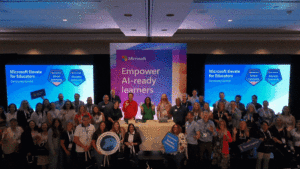



Microsoft has officially unveiled Microsoft Elevate Washington, a comprehensive state-specific initiative designed to democratize access to artificial intelligence technology and training for students and educators across its home state. The program represents a strategic expansion of the company’s global "Elevate" business unit and seeks to address a stark "opportunity gap" identified between the technologically dense Puget Sound region and the state’s more rural interior. By providing high-level AI tools, professional development, and financial grants to all 295 public school districts and 34 community and technical colleges in Washington, Microsoft aims to ensure that the next generation of the local workforce is prepared for an economy increasingly defined by generative AI.
The Historical Context of Innovation in Washington State
For over a century, Washington has served as a global epicenter for industrial and technological breakthroughs. The state’s economic identity was forged through the aerospace advancements of Boeing, the retail revolution led by Starbucks and Nordstrom, and the software and cloud computing dominance established by Microsoft and Amazon. This history of "punching above its weight" has historically relied on a symbiotic relationship between local industry and the educational institutions that feed it.
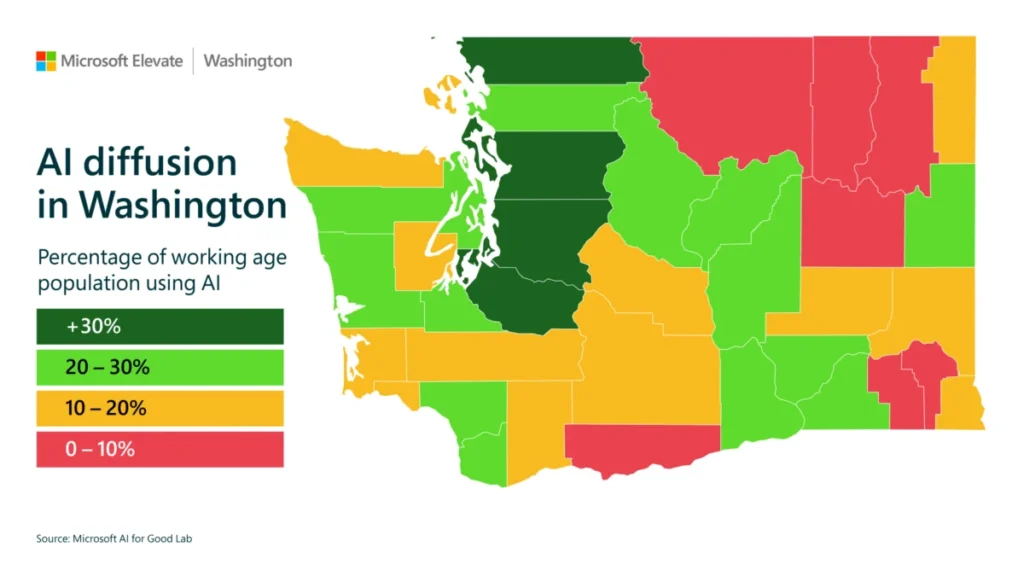
However, as the global economy transitions into the era of artificial intelligence, Microsoft leadership has expressed concern that the benefits of this transformation are not being distributed equitably within the state. The company’s "AI for Good Lab" recently conducted an extensive analysis of AI adoption rates, uncovering a significant disparity that threatens to leave rural communities behind. While the Puget Sound area remains a global leader in AI integration, many eastern and central counties are seeing significantly lower rates of technological diffusion.
Quantifying the AI Diffusion Disparity
The data released alongside the Microsoft Elevate Washington announcement highlights a "tenfold gap" in AI usage across different regions of the state. According to Microsoft’s findings, counties in the western corridor—specifically King, Snohomish, Pierce, and Whatcom—show AI usage rates exceeding 30 percent among the working-age population. Snohomish County currently leads the state with a 35 percent adoption rate.
In contrast, seven rural counties in eastern Washington report usage rates below 10 percent. The disparity is most pronounced in Ferry County, where only 2.5 percent of residents are currently utilizing AI tools. This data suggests that without intervention, the "digital divide" previously associated with broadband access could evolve into a more complex "AI divide," where the ability to leverage automated intelligence becomes a primary determinant of economic mobility and career success.
Microsoft’s leadership has noted that this initiative is informed by a decade of work on broadband accessibility. The company argues that providing the "pipes" for internet access is no longer sufficient; the focus must now shift to the "skills and tools" that allow individuals to utilize that connectivity for high-value economic activity.
A Strategic Roadmap for Implementation
The rollout of Microsoft Elevate Washington is structured across a multi-year timeline, ensuring that institutions have the necessary lead time to integrate these tools into their curricula and administrative workflows.
Phase One: Community College Integration (Late 2024 – 2025)
The immediate focus of the initiative targets community college students, who often represent non-traditional learners or those seeking rapid career pivots. Through November 15, 2025, all community college students in Washington are eligible for 12 months of free access to Microsoft 365 Personal. This package includes Copilot integration within standard productivity applications like Word, Excel, and PowerPoint, as well as one terabyte of OneDrive storage and advanced security features.
Phase Two: Administrative and Institutional Support (January 2026)
Starting in January 2026, Microsoft will provide Copilot Studio to all 295 school districts and 34 community colleges free of charge for a period of three years. Copilot Studio is a "low-code" platform that allows organizations to build custom AI agents. These agents are intended to assist school administrators with complex tasks such as scheduling, data-driven decision-making, and school year planning, effectively reducing the administrative burden on staff.
Phase Three: High School Rollout (July 2026)
By July 2026, the program will expand to include approximately 500,000 high school students (grades 9–12). These students will receive three years of free access to Copilot Chat, Teams for Education, and "Learning Accelerators." The latter are AI-powered tools specifically designed to improve reading fluency, comprehension, and information literacy by providing personalized feedback to students based on their individual learning pace.

Supporting the Educators: Professional Development and Grants
Recognizing that technology is only as effective as the people who manage it, Microsoft is placing a heavy emphasis on teacher support. The initiative includes a partnership with the Washington Office of Superintendent of Public Instruction (OSPI), the Washington Education Association (WEA), and the National Education Association (NEA).
Microsoft will fund and facilitate AI professional development for the state’s 100,000 educators. This training is designed to help teachers use generative AI to automate routine tasks—such as lesson planning and grading—allowing them to focus more on direct student engagement. Furthermore, Microsoft will support a statewide "AI Innovation Summit," an event intended to bring together over 1,000 education leaders to share best practices for AI implementation in the classroom.
To further catalyze this transition, Microsoft is offering $25,000 technology consulting grants to a select group of 10 school districts and 10 community colleges. These "early adopter" institutions will work with Microsoft consultants to build tailored AI agents, creating a blueprint that can be replicated by other districts across the state.
Collaborative Ecosystems and Global Strategy
The Washington-specific initiative is a key component of a larger global commitment. In July 2024, Microsoft announced the formation of "Microsoft Elevate," a new business unit dedicated to supporting nonprofits and educational institutions worldwide. The company has pledged more than $4 billion over the next five years in cash and cloud services to advance this mission globally.
In Washington, the effort is bolstered by partnerships with third-party organizations such as Code.org. Together, they will promote the "Hour of AI," a program designed to introduce students to real-world applications of artificial intelligence. Microsoft is also mobilizing its 50,000-plus local employees to volunteer in workshops and mentorship programs, further embedding the company’s corporate social responsibility efforts within the local community.
Analysis: The Long-term Economic and Social Implications
The launch of Microsoft Elevate Washington comes at a critical juncture for the American education system. As generative AI continues to disrupt traditional notions of homework, testing, and skill acquisition, school districts have struggled to find a balance between preventing academic dishonesty and preparing students for a workforce where AI literacy is mandatory.
By providing standardized, high-quality tools free of charge, Microsoft is essentially setting a "floor" for AI competency across the state. This move is likely to have several long-term implications:
- Workforce Readiness: By the time the current cohort of high school students enters the job market, AI fluency will likely be a baseline requirement for entry-level professional roles. This initiative ensures that students in Ferry or Okanogan County have the same technological foundation as those in Seattle or Bellevue.
- Institutional Efficiency: If school districts successfully adopt "AI agents" for administrative tasks, it could lead to significant cost savings and a reduction in "burnout" among educational staff, a major issue in the post-pandemic era.
- Market Standardization: By embedding Microsoft’s specific AI ecosystem (Copilot, Azure, M365) into the educational fabric of the state, the company is also ensuring that the next generation of workers is native to its software environment, a strategic long-term move in the competitive landscape against Google and OpenAI.
Official Responses and Future Outlook
While official statements from state legislators are expected to follow the formal rollout, the initiative aligns closely with Governor Jay Inslee’s previous executive orders regarding the "ethical and transparent" use of AI in state government. Education advocates have tentatively praised the move, noting that the inclusion of community colleges is vital for social equity, as these institutions serve a higher percentage of low-income students and students of color.
Microsoft’s leadership emphasizes that the future of AI is "about people, not machines." By investing in the human infrastructure of Washington—its teachers and students—the company is attempting to ensure that the "launchpad" for the next century of innovation remains firmly rooted in its home state.
As the program moves toward its 2026 milestones, the focus will likely shift to measuring the efficacy of these tools in improving learning outcomes. For now, Microsoft Elevate Washington stands as one of the most significant private-sector investments in public education in the state’s history, signaling a new era where digital literacy and AI proficiency are treated as essential public goods.