




As enterprises transition artificial intelligence strategies away from localized pilot projects and isolated proofs of concept toward deeply embedded, autonomous operations, a massive operational bottleneck has emerged. According to the recently published 2026 State of Infrastructure in the Agentic AI Era report from Google Cloud, an overwhelming 83% of surveyed organizations have realized that their current technological infrastructure is insufficient to support production-grade agentic AI systems. This widespread readiness gap underscores a pivotal evolution in corporate technology stacks, shifting the focus from static generative text models to dynamic, multi-step autonomous agents capable of reasoning, executing, and modifying workflows across complex enterprise environments.
The findings highlight a fundamental mismatch between legacy enterprise architecture and the unique demands of agentic workloads. Unlike standard generative artificial intelligence tools—which typically respond to a single user prompt with a self-contained output—agentic systems are engineered to operate continuously, maintaining state and executing long chains of dependent actions. A single prompt directed at an advanced agent can spontaneously trigger hundreds of downstream API calls, database queries, and automated executions spanning multiple distinct software ecosystems, including enterprise resource planning (ERP) platforms and customer relationship management (CRM) suites. Consequently, organizations are discovering that standard cloud configurations and traditional data pipelines are ill-equipped to handle the sustained concurrency, persistent state management, and stringent security requirements demanded by autonomous business logic.
Deconstructing the Infrastructure Readiness Gap

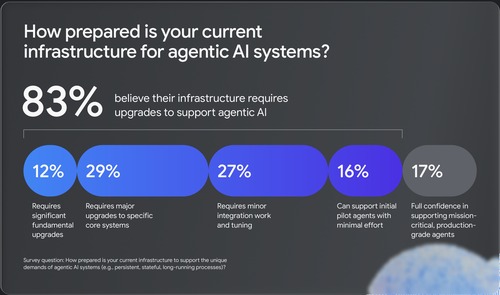
The empirical data compiled in Google Cloud’s 2026 research provides a granular breakdown of how enterprise leaders view their current technological footing. Rather than a binary divide between ready and unready organizations, the study illustrates a tiered spectrum of required remediation. Only a meager 17% of surveyed enterprises reported full confidence in their existing infrastructure’s ability to support mission-critical, production-grade autonomous agents without major intervention.
The remaining 83% of organizations fall into varying categories of necessary structural overhauls. At the most intensive end of the scale, 12% of respondents admitted that their underlying infrastructure requires significant, fundamental upgrades—implying that their foundational hardware, networking, or data layers must be entirely re-architected. A larger segment, representing 29% of the survey pool, reported that major upgrades are mandatory for specific core systems, such as legacy databases or authorization frameworks, before agents can be safely deployed at scale. Furthermore, 27% of organizations indicated that while their core architecture is sound, they still require substantial integration work and system tuning. Finally, a modest 16% stated that their infrastructure can successfully support initial pilot agents with minimal effort, though scaling those pilots to enterprise-wide production remains a daunting prospect.
These statistics paint a clear picture of an industry caught between the promise of autonomous productivity and the harsh realities of technical debt. Enterprise platform teams are rapidly learning that deploying an agent requires more than just high-performance compute clusters; it demands robust orchestration layers, comprehensive observability tools, and precise governance mechanisms capable of monitoring and controlling thousands of autonomous decisions happening simultaneously in real time.
Evolution of the Enterprise GenAI Discourse: A Chronological Retrospective
To fully comprehend the significance of the 2026 findings, it is essential to trace the rapid evolution of enterprise artificial intelligence strategy over recent years. The infrastructure conversation within corporate boardrooms has undergone a profound metamorphosis, moving from hesitant experimentation to mandatory operational overhaul.
In the early phases of the generative AI boom, which gained ferocious momentum following the public introduction of advanced large language models in late 2022 and throughout 2023, corporate initiatives were largely characterized by isolated experimentation. Organizations rushed to build internal chat interfaces, trial cloud-based APIs, and explore productivity enhancements for software developers and marketing teams. During this exploratory phase, infrastructure concerns were frequently sidelined in favor of rapid capability testing and user adoption metrics.
By 2025, however, the corporate consensus shifted dramatically. Google Cloud’s landmark 2025 infrastructure research crystallized a growing industry anxiety, identifying infrastructure as the glaring "missing piece" in enterprise generative AI strategies. That 2025 study revealed a landscape of near-universal experimentation, but warned that organizations were struggling to bridge the chasm between experimental pilots and secure, cost-effective production deployments. The core issues highlighted in 2025 centered heavily on foundational data governance, cross-platform integration, cost containment, hybrid cloud flexibility, and edge deployment strategies. Enterprises learned that feeding unstructured corporate data into large models without proper security boundaries created unacceptable risks.
Now, the 2026 research marks the next logical—and far more complex—step in this technological chronology. The conversation has decisively moved past simple generative capabilities. Enterprises are no longer merely asking how to store data efficiently or how to fine-tune a foundational model cost-effectively. Instead, the 2026 State of Infrastructure in the Agentic AI Era report addresses the specialized infrastructure needed for agents that continuously reason, adapt, and execute multi-system workflows without continuous human prompting. This progression reflects a maturation of the market: artificial intelligence is transitioning from a passive advisory tool into an active, autonomous workforce component.

Industry Perspectives and Expert Analysis
As organizations grapple with these sobering readiness statistics, industry leaders and software architects are speaking out about the operational realities of deploying autonomous systems. Nirav Mehta, Vice President of Product Management at Google Cloud, emphasized the practical utility of the recent findings during the publication of the report.
"This report isn’t just a survey of the landscape; it’s a roadmap for establishing the new standard for production-grade autonomous systems," Mehta stated, highlighting the urgency for enterprise technology leaders to proactively audit their digital environments rather than waiting for systemic failures to occur in live production environments.
Software engineers and database architects point out that the architectural demands of agentic AI diverge sharply from traditional enterprise software design patterns. In a conventional enterprise application, data flows are strictly deterministic, moving through predefined pathways governed by rigid business logic. By contrast, agentic AI introduces non-deterministic behavior. Because autonomous agents utilize probabilistic models to determine their next operational steps, their interactions with enterprise databases and third-party APIs cannot be mapped out entirely in advance.

This non-determinism places extraordinary pressure on infrastructure teams. Platform engineers must build fail-safes, sandboxes, and immutable audit trails that allow agents the freedom required to solve complex problems while strictly preventing unauthorized data access or catastrophic looping errors. Furthermore, the persistent and stateful nature of these workloads means that cloud environments must maintain high availability, low-latency memory caching, and seamless multi-region synchronization to ensure that an agent operating in one department does not lose context when querying data managed by another division.
Implications for Enterprise Architecture, Security, and Governance
The widespread infrastructure readiness gap identified by Google Cloud carries profound implications for Chief Information Officers (CIOs), Chief Technology Officers (CTOs), and enterprise security teams. As companies race to capture the efficiency gains promised by autonomous workflows, they must simultaneously address several critical architectural pillars.
First, data governance and data residency controls must be fundamentally modernized. Agentic systems frequently traverse multiple cloud environments, on-premises data centers, and edge locations to gather the information required to complete a task. Ensuring that sensitive corporate data or personally identifiable information (PII) is not improperly exposed or transferred across jurisdictional boundaries during an automated multi-step query requires advanced policy enforcement engines embedded directly into the infrastructure fabric.

Second, the hardware selection criteria for enterprise data centers are undergoing a radical shift. While specialized graphics processing units (GPUs) and tensor processing units (TPUs) remain essential for model training and high-throughput inference, the operational profile of agentic AI places a heavy premium on continuous inference management. The sheer volume of computational requests generated by autonomous agents means that power consumption, thermal management, and energy efficiency are now primary considerations in hardware procurement. Organizations can no longer view data center power usage as a secondary operational metric; it is rapidly becoming a bounding constraint on how many concurrent autonomous agents an enterprise can sustainably run.
Third, developer tooling and observability platforms must evolve to accommodate "human-in-the-loop" oversight mechanisms. Because agents can execute long chains of actions independently, developers require advanced tracing tools that allow them to inspect the exact reasoning path an agent took to arrive at a specific business decision. If an agent initiates an incorrect transaction or misinterprets a policy document within a CRM system, platform teams must possess the real-time observability needed to intercept the workflow, reverse the action, and inject corrective guidance without crashing the entire system.
Conclusion: Preparing for the Agentic Era
The transition from generative experimentation to agentic execution represents one of the most significant architectural shifts in the history of enterprise computing. The revelation that 83% of organizations require infrastructure upgrades should not be viewed merely as a warning sign of technological inadequacy, but rather as a clear indicator of the profound transformation currently underway in the global economy.

As enterprises continue to pilot and deploy autonomous agents throughout 2026 and beyond, success will heavily favor those organizations willing to make the necessary foundational investments in modernizing their data architectures, security frameworks, and orchestration tools. Those that attempt to force production-grade agentic workloads onto aging, legacy infrastructure risk encountering severe operational bottlenecks, security vulnerabilities, and system failures. Ultimately, bridging the infrastructure gap is no longer an optional optimization; it is the absolute prerequisite for participating in the next generation of autonomous enterprise productivity.