


The research, conducted by a collaborative team from the University of Oulu, the University of Helsinki, and the University of Turku, presents a compelling insect-world parallel to the classic "box-and-banana" experiment. More than a century ago, psychologist Wolfgang Köhler famously observed chimpanzees stacking boxes to reach a suspended treat, establishing a benchmark for what researchers termed "insight." For decades, this capacity to combine objects in novel ways to reach a specific, inaccessible goal was considered a hallmark of high-level intelligence, typically attributed to mammals or birds. The Finnish research team has now extended this cognitive boundary to the humble Bombus terrestris, or buff-tailed bumble bee.
The Experimental Framework: A Novel Challenge
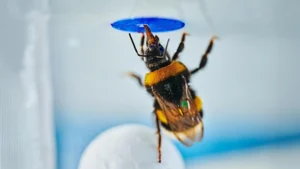
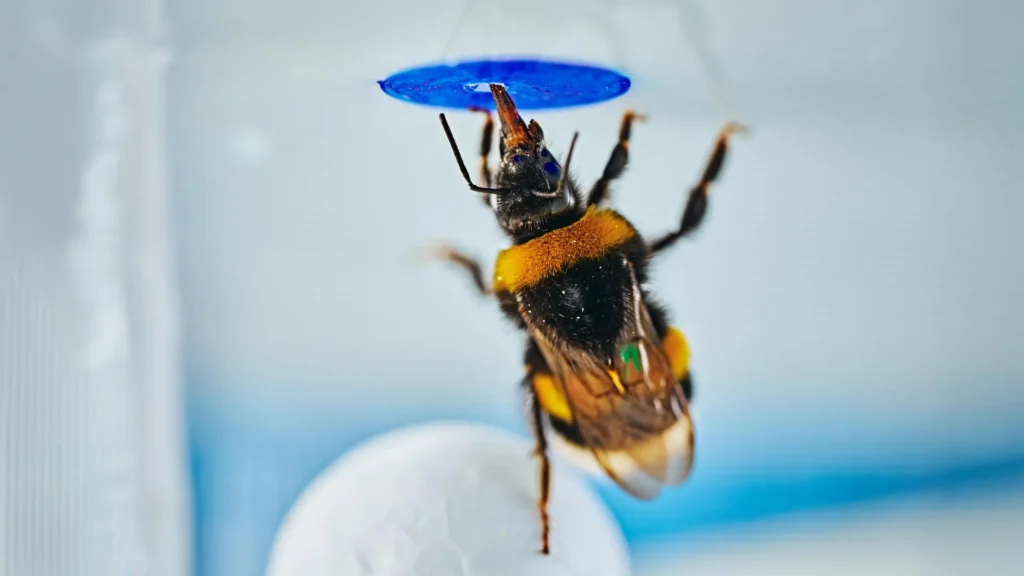
To test for spontaneous problem solving, researchers developed a highly controlled environment. The experiment began by familiarizing bees with two distinct, unrelated facts: that a blue artificial flower contained a sugar-water reward and that a small, neutral ball could be moved. Crucially, the bees were never trained to associate the ball with the flower, nor were they given any instruction on how to use the ball to bridge the gap between their position and the reward.
During the testing phase, researchers suspended the blue flower on the ceiling of a transparent arena, rendering it physically inaccessible to the bees. For an insect to succeed, it had to demonstrate "insight"—the ability to perceive the ball not merely as an obstacle or a toy, but as a tool that could be repositioned to create a platform. Successful bees were observed rolling the ball directly beneath the suspended flower, climbing onto it, and then accessing the reward.
This behavior is categorized as "goal-directed," as opposed to trial-and-error, because the bees exhibited directed movement patterns toward the specific location required to solve the spatial problem. The researchers noted that the transition from aimless exploration to an efficient, goal-oriented sequence of actions was instantaneous, a classic marker of the "aha!" moment in cognitive science.
Eliminating Alternative Explanations
A critical component of the study involved rigorous control experiments designed to rule out simpler explanations, such as accidental success or instinctive play. One primary concern was that the bees might have been following visual cues—essentially steering toward the bright blue color of the flower while pushing the ball randomly.
To address this, the team performed trials where the flower was completely obscured from view while the bees moved the ball. Despite the lack of direct visual guidance, a significant number of subjects continued to roll the ball to the correct coordinates. This finding suggests that the bees were operating based on a cognitive map or a mental representation of the goal, rather than a simple reactive feedback loop.
Furthermore, the "naïve" nature of the subjects was paramount. Unlike many studies on animal cognition where subjects are "pre-trained" or have extensive exposure to laboratory equipment, these bumble bees had zero prior experience with the specific problem-solving task. By removing the possibility of past reinforcement, the researchers confirmed that the behavior was a spontaneous application of logical reasoning rather than an expression of learned habits.
A Century of Comparative Cognition
The history of animal intelligence research has long been dominated by the study of primates and corvids (crows and ravens). Köhler’s work in the 1920s established the standard for insight-based learning, leading to a long-standing academic bias that equated brain volume with problem-solving potential. For most of the 20th century, the small neural clusters of insects were viewed as "hard-wired" biological circuits—capable of complex navigation and communication, but limited to innate, repetitive behaviors.
However, the last two decades have seen a paradigm shift. Studies have increasingly shown that honey bees and bumble bees can count, categorize objects, learn to pull strings to obtain rewards, and even engage in socially transmitted tool use. The current study in Science builds upon this body of work by moving beyond social learning—where one bee watches another—to individual, spontaneous innovation.
Implications for Neuroscience and Evolution
The finding that a brain the size of a pinhead can manage such high-level executive function has profound implications for neuroscience. Traditionally, it was thought that the high-energy demands of abstract thought required a massive, complex neocortex. If a bumble bee can perform a "box-and-banana" task, it implies that the fundamental building blocks of intelligence are more efficient and more widely distributed across the animal kingdom than previously assumed.
"We are not claiming that bees think like humans or possess human-like consciousness," said Olli Loukola, senior author and Docent at the University of Oulu. "However, our findings demonstrate that miniature brains can generate flexible, highly efficient solutions to novel problems in ways we are only beginning to understand."
This research invites a re-evaluation of the "cognitive ceiling" often placed on invertebrates. If the neural architecture of a bee can support this level of spatial reasoning, it suggests that intelligence may be a modular capability that evolved independently in diverse lineages, rather than a linear trait that scales with brain size.
Broader Impact and Future Directions
The scientific community is viewing these results as a wake-up call regarding the depth of insect intelligence. The ability to innovate—to solve a problem that has never been encountered before—is a key trait for survival in changing environments. As ecosystems face rapid shifts due to climate change and human impact, the cognitive flexibility of pollinators like bumble bees may be a vital factor in their resilience.
The research also opens new avenues for robotics and artificial intelligence. By understanding how small, low-power neural systems can achieve such sophisticated behavioral outputs, engineers might be able to develop more efficient algorithms for autonomous, small-scale drones that require high-level spatial reasoning without the power-intensive hardware associated with traditional computing.
Summary of Findings
The study, authored by Akshaye A. Bhambore, Ece N. Akmeşe, Emma Häkkinen, Milla K. Jussila, Juha-Heikki Kantola, and Olli J. Loukola, provides a detailed analysis of 150 individual bee trials. The statistical significance of the results, combined with the stringent control measures, makes a compelling case that spontaneous, goal-directed problem solving is a biological capability available to organisms far removed from the vertebrate lineage.
As we move deeper into the 21st century, the definition of "intelligence" continues to expand. While we may not equate the mind of a bee with that of a chimpanzee or a human, the ability to act with purpose in the face of a novel challenge proves that intelligence is not merely a product of size. Instead, it is a dynamic, functional capacity that allows even the smallest creatures to navigate, adapt, and succeed in a complex, ever-changing world. The "box-and-banana" problem, once a test reserved for our closest evolutionary cousins, has now become a testament to the unexpected brilliance of the insect world.