


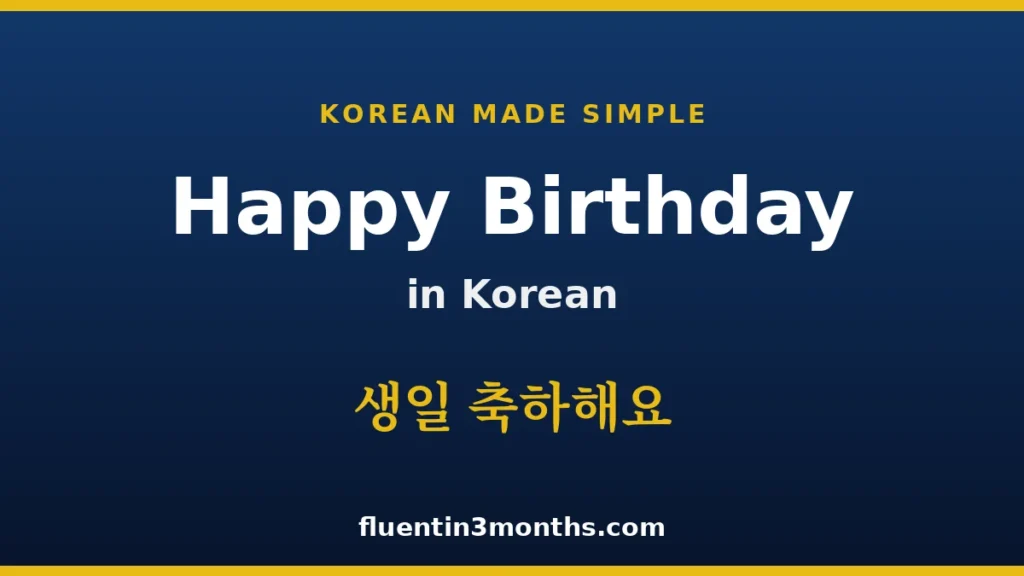
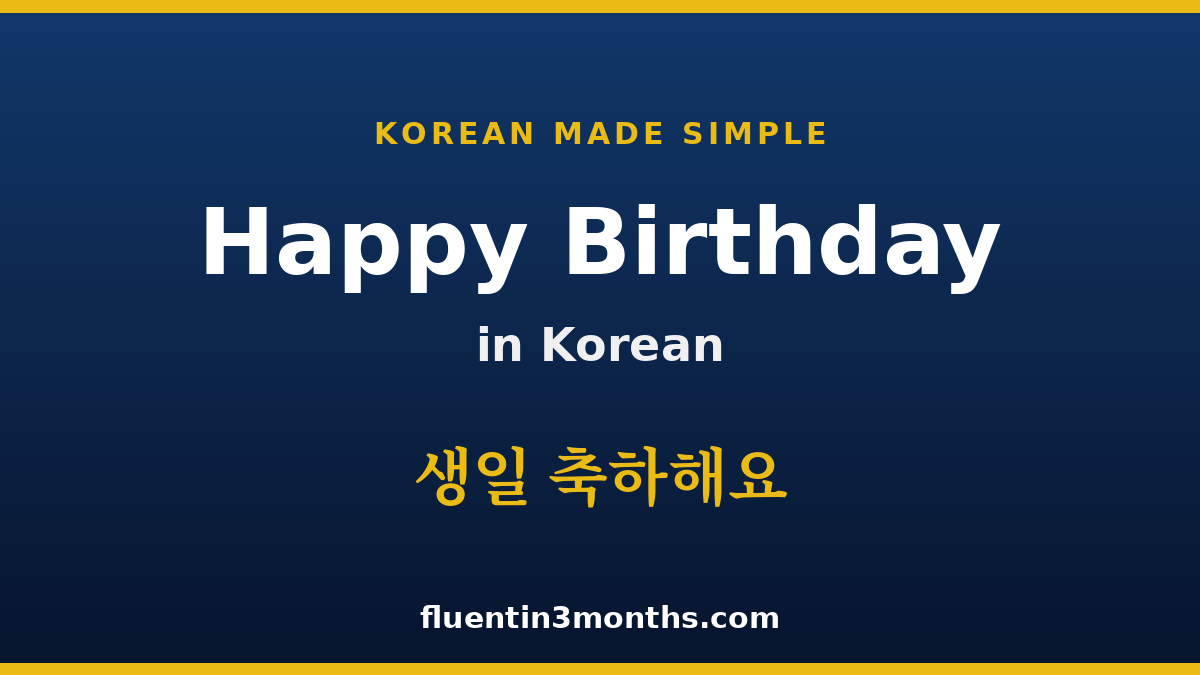
The most effective way to wish someone a happy birthday in Korean is to use the phrase 생일 축하해요 (saengil chukhahaeyo). While this expression serves as the standard, polite baseline for most social interactions, the Korean language necessitates a sophisticated understanding of honorifics, interpersonal relationships, and historical traditions to navigate social settings accurately. Mastering birthday greetings requires more than rote memorization; it demands an appreciation for the structural hierarchy embedded within the language itself.
The Linguistic Structure of Korean Birthday Greetings
In Korean, the construction of a birthday wish relies on a combination of specific nouns and verbal endings that dictate the level of formality. The word for "birthday" is 생일 (saengil). When paired with the verb 축하하다 (chukhahada), which means "to congratulate," the phrase becomes an acknowledgment of the milestone.
The ending -해요 (-haeyo) is the essential component for politeness. It is widely considered the "polite-informal" style, suitable for colleagues, acquaintances, or individuals with whom one does not share a deeply intimate, long-term bond. Using this specific ending allows the speaker to maintain a professional or respectful distance while remaining warm and approachable. By framing the greeting as a congratulation rather than a direct statement of age, the language subtly shifts the focus toward the celebration of the individual’s life.
Navigating Formality: A Hierarchy of Respect
Korean social etiquette is dictated by the relative status of the speakers. Unlike English, where a simple "Happy Birthday" suffices regardless of the recipient’s age or professional standing, Korean requires speakers to adjust their vocabulary based on the social dynamic.
There are four primary levels of speech, ranging from highly casual (banmal) to highly formal (honorifics). In a close, informal setting, one might use 생일 축하해 (saengil chukhae), dropping the polite suffix. This is reserved exclusively for peers or younger individuals with whom the speaker has established a deep, familiar connection.
Conversely, when addressing elders, superiors, or those in positions of high status, the vocabulary must shift entirely. In these instances, the word 생일 (saengil) is replaced with 생신 (saengsin), the honorific form of the word for birthday. Furthermore, the verb "to give" is elevated to 드리다 (deurida), a humble, respectful term. Consequently, the formal, respectful greeting becomes 생신 축하드립니다 (saengsin chukadeurimnida). This phrase is not merely a linguistic variation; it is a vital display of cultural deference that acknowledges the age and life experience of the recipient.
Cultural Traditions and Symbolic Practices
Korean birthday traditions are deeply rooted in historical practices, with seaweed soup, or 미역국 (miyeokguk), serving as the cornerstone of the celebration. The tradition of consuming seaweed soup on one’s birthday is a symbolic tribute to one’s mother. Because seaweed is rich in iodine and calcium, it was traditionally consumed by women during postpartum recovery. By eating this soup on a birthday, the individual acknowledges the physical toll of their birth and honors the maternal care they received.
The importance of life milestones is further evidenced by the doljanchi, or the first-birthday celebration. Historically, given the high rate of infant mortality in earlier centuries, reaching the one-year mark was a significant cause for communal celebration. During this event, the doljabi ceremony takes place. The child is presented with various objects—such as thread (symbolizing long life), money (symbolizing future wealth), and books or writing implements (symbolizing academic success)—and the object the child chooses is interpreted as a playful but culturally significant prediction of their future path.
Legislative Shifts in Age Calculation
The complexities of Korean social interactions were historically compounded by the traditional age-counting system, known as 세는 나이 (seneun nai). Under this system, an individual was considered one year old at birth, and everyone gained a year on the first day of the lunar New Year. This often resulted in an individual being two years older in "Korean age" compared to the international standard.
However, in a significant move toward international standardization, the South Korean government passed legislation that took effect in June 2023. This law mandates the use of 만 나이 (man nai), or the international age system, for all civil and administrative functions. While the traditional system persists in casual social conversation and cultural settings, the formal transition marks a turning point in how age is conceptualized in the public sphere. For those navigating birthday greetings, it is important to understand that while the administrative age may have changed, the cultural weight placed on birth dates and seniority remains a pillar of Korean society.
Pronunciation and the Mechanics of Hangul
For learners attempting to master these greetings, romanization is merely a starting point. The Korean writing system, Hangul, was developed in 1443 under the guidance of King Sejong the Great to improve literacy among the common people. The system is phonetic, with characters designed to mimic the shape of the speech organs used to articulate them.
To achieve native-level pronunciation of "saengil chukhahaeyo," one must pay close attention to the aspirated sounds. The "ch" in "chukhahaeyo" is heavily aspirated, meaning it requires a strong burst of air. Furthermore, the "g" in "saengil" is soft, and the "l" sound requires the tongue to touch the alveolar ridge. Relying on written romanization often obscures these nuances. Advanced learners are encouraged to utilize audio-based resources, such as language-learning platforms or digital flashcard systems like Anki, to bridge the gap between text and sound.
Broader Implications of Language Learning
The effort to learn these nuances has implications that extend beyond simple social courtesy. In the context of global business and international relations, the ability to correctly navigate honorifics and cultural traditions signals a high degree of cultural competence. When a foreigner uses the honorific "saengsin" for an elder, they are demonstrating an awareness of the values of filial piety and respect that underpin Korean society.
From a sociological perspective, the rigid structure of the language serves as a constant reminder of the importance of hierarchy and community cohesion in Korea. Every greeting acts as a social marker, reinforcing the relationship between the speaker and the listener. While the language can seem daunting to newcomers, the structure is designed to minimize friction by clearly defining the expectations of each participant in a conversation.
Conclusion and Summary of Usage
When selecting the appropriate birthday greeting, the primary consideration should always be the level of intimacy and the age difference between the parties involved.
- The Default: Use 생일 축하해요 (saengil chukhahaeyo) for colleagues, acquaintances, and strangers. It is polite, respectful, and safe for almost any professional or semi-formal situation.
- The Informal: Use 생일 축하해 (saengil chukhae) only with close friends or individuals significantly younger than yourself who have explicitly agreed to a casual relationship.
- The Formal: Use 생신 축하드립니다 (saengsin chukadeurimnida) for parents, grandparents, superiors, or any person for whom you wish to show profound respect.
As Korean continues to grow as a global language of interest, understanding these foundational customs provides more than just the ability to offer a greeting; it provides a window into the values of a culture that deeply prizes respect, memory, and the acknowledgment of life’s milestones. Whether one is singing the Korean version of the "Happy Birthday" song—which follows the familiar international melody but incorporates formal address terms—or participating in a traditional feast, the act of greeting is a vital component of the human experience in Korea. By respecting these linguistic boundaries, learners can participate more authentically in the social life of the country, ensuring that their well-wishes are received with the same sincerity with which they are offered.