


The Hellenic Republic remains one of the world’s premier travel destinations, with the Greek Ministry of Tourism reporting a record-breaking 32.7 million international arrivals in 2023. As the 2024-2025 travel seasons approach, linguistic experts and cultural ambassadors are emphasizing the importance of "philoxenia"—the ancient Greek concept of hospitality—and how even a rudimentary command of the Greek language can significantly enhance the visitor experience. Modern Greek, a descendant of the Independent Indo-European branch with a documented history spanning over 3,400 years, serves as the primary tongue for approximately 13 million speakers worldwide. For the modern traveler, navigating the nuances of this phonetic language is not merely a matter of convenience but a vital bridge to cultural integration.
The Foundational Lexicon: Essential Greetings and Etiquette
The Greek language is characterized by a distinct separation between formal and informal registers, a reflection of a society that values both traditional respect and Mediterranean warmth. Professional linguists suggest that mastering the distinction between "Yassas" and "Yasou" is the first step toward effective communication.
"Yassas" (Γεια σας) serves as the formal or plural version of "Hello," appropriate for addressing elders, professionals, or groups of people. Conversely, "Yasou" (Γεια σου) is the informal variant used among friends, peers, and children. This duality extends to the inquiry "How are you?" where "Ti kanete?" (Τι κάνετε;) is the formal standard and "Ti kanis?" (Τι κάνεις;) is the casual equivalent.
One of the most common phonetic traps for English speakers involves the words for "Yes" and "No." In Greek, "Ne" (Ναι) signifies "Yes," which frequently causes confusion as it sounds similar to the English "No." To indicate the negative, Greeks use "Ochi" (Όχι). Supporting these basics are the pillars of Greek politeness: "Parakalo" (Παρακαλώ), which means "Please" and also serves as "You’re welcome," and "Efcharisto" (Ευχαριστώ), meaning "Thank you." The latter finds its etymological roots in "charis," the Greek word for grace.
Chronology of Linguistic Evolution and Modern Usage
The transition from Ancient Greek to the "Demotic" or Modern Greek used today was a centuries-long process that culminated in the late 20th century. In 1976, the Greek government officially adopted Demotic Greek as the standard for education and administration, moving away from the archaizing "Katharevousa." This shift made the language more accessible to the general populace and international learners.
Today, the use of time-specific greetings is a cornerstone of Greek social life. "Kalimera" (Καλημέρα), or "Good morning," is typically used until midday. As the afternoon progresses, "Kalo apogevma" (Καλό απόγευμα) is used to wish someone a pleasant afternoon, though it is less common as a greeting than as a parting wish. "Kalispera" (Καλησπέρα) takes over in the late afternoon and evening, while "Kalinihta" (Καληνύχτα) is reserved strictly for saying "Good night" when retiring for the evening or leaving a social gathering late at night.
Navigating Daily Life: Commerce and Social Interaction
Economic data from the Bank of Greece indicates that tourism accounts for approximately 18% to 20% of the nation’s Gross Domestic Product (GDP). Consequently, the Greek service industry is highly attuned to international visitors. However, transactions in local markets (laiki) or remote villages are smoothed considerably when travelers use local phrasing.
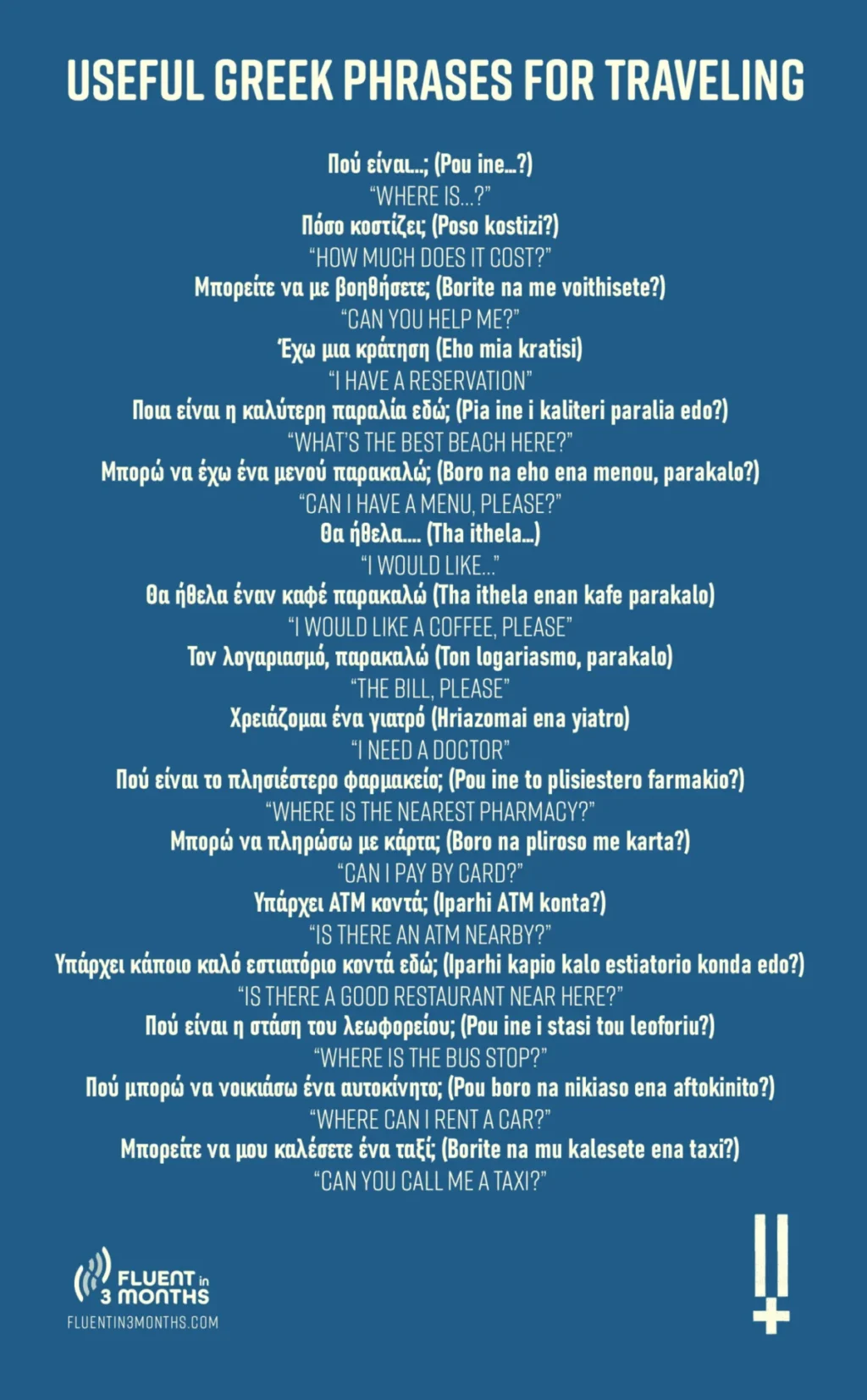
When inquiring about prices, "Poso kani?" (Πόσο κάνει;) is the standard phrase for "How much is it?" while "Poso kostizi?" (Πόσο κοστίζει;) is a slightly more formal alternative. In the context of Greece’s renowned culinary scene, "Kali orexi" (Καλή όρεξη) is the equivalent of "Enjoy your meal," and "Yamas!" (Γεια μας!), meaning "To our health," is the ubiquitous toast used during social drinking.
As digital payments have surged—with Greek law now requiring most businesses to accept cards—the phrase "Boro na pliroso me karta?" (Mπορώ να πληρώσω με κάρτα?), or "Can I pay by card?" has become essential. Despite the rise of fintech, ATMs remain vital in island regions, making the question "Iparhi ATM konta?" (Υπάρχει ΑΤΜ κοντά;) a frequent necessity for travelers.
The Traveler’s Survival Kit: Logistics and Emergencies
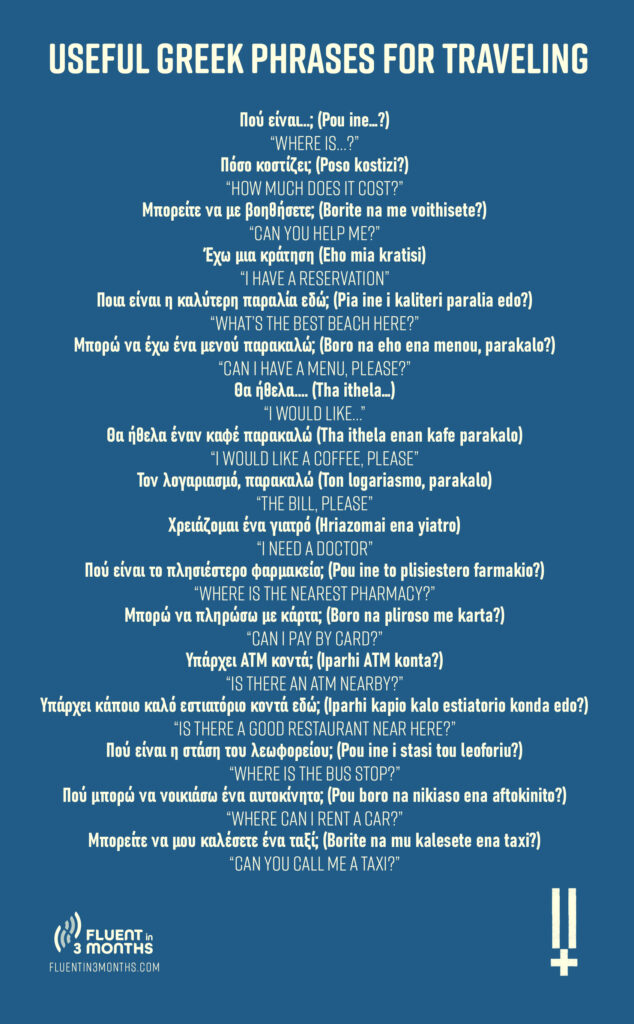
While English proficiency is high in urban centers like Athens and Thessaloniki, as well as on popular islands like Mykonos and Santorini, logistical challenges often require specific Greek phrases. Locating essential services involves the use of "Pou ine…?" (Πού είναι…?), meaning "Where is…?" This is most commonly applied to "i tualeta" (the bathroom) or "i stasi tou leoforiu" (the bus stop).
In the event of medical or legal necessity, the Greek healthcare system provides a network of public hospitals and private clinics. Travelers should be prepared to say "Hriazomai ena yiatro" (Χρειάζομαι ένα γιατρό) for "I need a doctor" or inquire about the "plisiestero farmakio" (nearest pharmacy). Greece has one of the highest numbers of pharmacists per capita in the European Union, and these professionals often serve as the first point of contact for minor ailments.
For transportation, while ride-sharing apps have a presence in major cities, traditional taxis remain a primary mode of transit. The request "Borite na mu kalesete ena taxi?" (Μπορείτε να μου καλέσετε ένα ταξί?) is a standard way to ask a hotel or restaurant staff member to arrange transport.
Personal Introduction and the Art of Connection
Language experts at institutions such as the Hellenic American Union note that Greeks respond with overwhelming positivity when foreigners attempt to speak the local tongue. Introducing oneself is a critical step in building rapport.
"Pos se lene?" (Πώς σε λένε;) asks for a name, to which the response is "Me lene…" (Με λένε…). Establishing one’s origin is equally important in a country that has seen centuries of migration. "Apo pou ise?" (Από πού είσαι?) asks "Where are you from?" with common answers including "Ime apo tin Ameriki" (I am from America) or "Ime apo to Inomeno Vasilio" (I am from the United Kingdom).
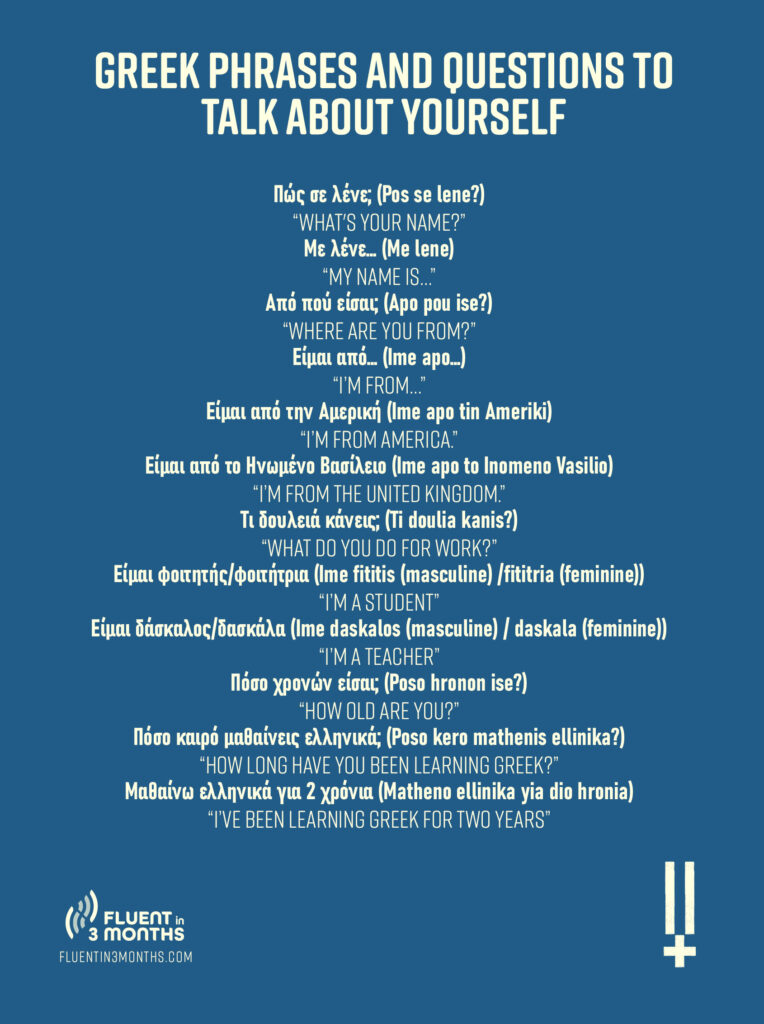
The nuances of gender in the Greek language appear even in basic introductions. A male student would say "Ime fititis," while a female student would say "Ime fititria." Similarly, a male teacher is "daskalos" and a female teacher is "daskala." These distinctions, while minor to a beginner, demonstrate a deeper respect for the linguistic structure of the language.
The Nuances of Vernacular: Slang and Informal Greek
To truly sound like a local, one must understand the informal "slang" that permeates daily conversation. Perhaps the most famous—and infamous—word in the Greek vocabulary is "malaka" (μαλάκα). While technically a swear word, its usage among friends is nearly constant, acting as a synonym for "dude" or "friend." However, linguistic experts caution travelers against using it with strangers, as it can be perceived as highly offensive depending on the tone and context.
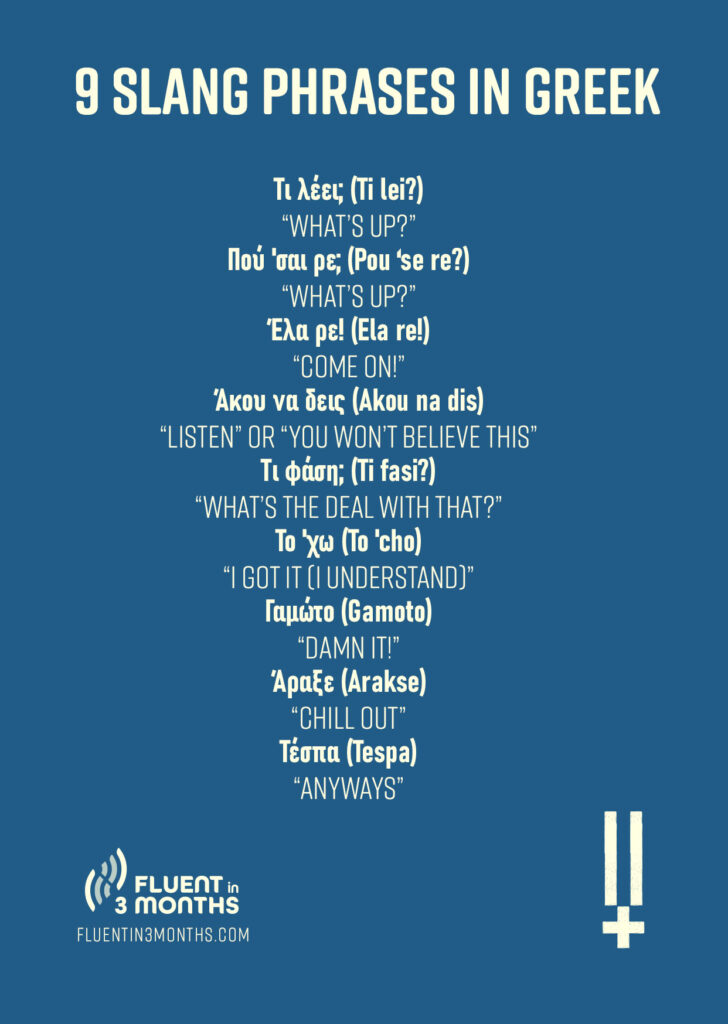
More safe but equally local phrases include "Ti lei?" (Τι λέει?), a casual "What’s up?" and "Ela re!" (Έλα ρε!), an exclamation used to express surprise, disbelief, or to urge someone to "come on." When a conversation is coming to a close or a topic is being dismissed, "Tespa" (Τέσπα)—a shortened version of "telos panton" (anyway)—is frequently employed.
Cultural Wisdom: Proverbs and Their Modern Applications
Greek proverbs, many of which find their origins in Aesop’s fables or Socratic philosophy, offer a window into the national psyche. These phrases are more than just linguistic exercises; they are moral compasses.
- "Kathe empodio gia kalo" (Κάθε εμπόδιο για καλό): Translated as "Every obstacle is for the best," this phrase reflects the Greek resilience in the face of economic or personal hardship.
- "I poli logia ine ftochia" (Τα πολλά λόγια είναι φτώχεια): "Too many words are poverty," suggesting that actions speak louder than words or that one should get straight to the point.
- "Mathe techni ki astine, ki an pinasis piastine" (Μάθε τέχνη κι άστηνε, κι αν πεινάσεις πιάστηνε): "Learn a craft and leave it aside, and if you starve, take it up." This emphasizes the importance of education and versatile skills.
- "Opios viazete skontaftei" (Όποιος βιάζεται σκοντάφτει): "He who hurries, trips," a reminder to embrace the slower pace of Mediterranean life.
- "Ton filon sou ton dialegis, ton signeni sou ton kleronomis" (Τον φίλο σου τον διαλέγεις, τον συγγενή σου τον κληρονομείς): "You choose your friend, you inherit your relative," highlighting the profound importance of chosen social circles in Greek culture.
Broader Impact: Linguistic Preservation and Tourism Growth
The effort to learn Greek phrases has a measurable impact on the sustainability of Greek tourism. According to a 2022 study on "Cultural Tourism and Language" published in the Journal of Heritage Tourism, travelers who engage with the local language are 30% more likely to visit non-traditional tourist sites, thereby distributing economic benefits to rural communities.
Furthermore, the Greek Ministry of Education has recently expanded its "Study in Greece" initiative, promoting the Greek language to international students as a means of preserving one of the world’s "critical languages." By learning these phrases, travelers are not just facilitating their own journey; they are participating in the active preservation of a linguistic heritage that has shaped Western civilization.
In conclusion, while the Greek alphabet may initially appear daunting to those familiar with the Latin script, the language is phonetic and logical. Starting with basic greetings like "Yassas" and "Kalimera," and progressing to practical phrases for travel and dining, allows visitors to move beyond the role of a mere spectator. In the words of the great Greek writer Nikos Kazantzakis, "Since we cannot change reality, let us change the eyes which see reality." Seeing Greece through the lens of its own language is the first step toward that transformation.