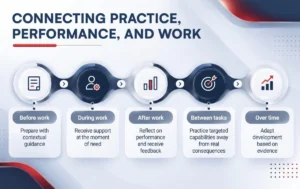




The rapid integration of artificial intelligence into the professional landscape has revealed a widespread misconception: many users treat AI as a sophisticated vending machine, expecting optimal results from minimal input. This "click, prompt, and hope" approach, however, often leads to disappointment, with users frequently attributing mediocre output to the tool itself rather than their own management practices. Experts argue that generative AI, unlike traditional software, functions more akin to a high-potential employee, demanding a nuanced management strategy to unlock its full capabilities. This paradigm shift from tool user to AI manager is crucial for organizations aiming to leverage AI effectively.
The core of this argument rests on a fundamental misunderstanding of AI’s operational nature. If a human employee were managed with the same lack of direction and feedback that many apply to AI, the predictable outcomes would be confusion, inconsistency, and underperformance. The same holds true for AI. This realization positions generative AI not as a standalone technological project, but as a critical component of workforce capacity, capable of analysis, synthesis, challenge, and creation at unprecedented speed and scale. However, its efficacy is intrinsically linked to the quality of its management.
The Misconception: AI as a Black Box
For many professionals, AI operates as a black box. They input a query, receive an output, and if it’s unsatisfactory, the tool is deemed flawed. This perspective overlooks the learning and adaptation mechanisms inherent in advanced AI models. Unlike a calculator that performs a fixed operation, or a word processor with predefined functions, generative AI models are designed to interpret context, adapt to feedback, and refine their responses based on iterative interaction. The current approach often involves a single, unqualified prompt, akin to hiring an employee and expecting them to perform optimally without any onboarding or initial guidance.
This "vending machine" analogy is problematic because it absolves the user of responsibility. It creates a passive relationship with a powerful technology, limiting its potential and fostering a cycle of frustration. The emergence of AI as a significant force in the global economy, projected to contribute trillions of dollars to global GDP in the coming decade according to various economic forecasts, underscores the urgency of mastering its application. For instance, PwC’s 2023 AI predictions estimate AI could contribute up to $15.7 trillion to the global economy by 2030. This massive economic potential hinges on effective human oversight and direction.
AI as a Workforce Asset: The Management Imperative
The assertion that "AI is now part of your headcount" is a critical reframing. Generative AI is not merely a software solution; it represents an expansion of workforce capacity, a digital colleague with the potential to augment human capabilities significantly. However, just like any new hire, its performance is not innate but cultivated. If an AI system is underperforming, the problem is rarely the underlying model itself, but rather the management strategies—or lack thereof—being employed.
This perspective is gaining traction within leading technology and business circles. Companies that have successfully integrated AI into their operations, such as those highlighted in reports by Gartner and Forrester, emphasize the importance of strategic prompting, continuous refinement, and clear performance standards. These organizations are moving beyond simple tool utilization towards a more sophisticated model of AI governance and management.
Three Levers for Effective AI Management
To transition from a passive tool user to an active and effective AI manager, three core levers are essential: onboarding, standards, and coaching.
1. Onboarding: Context Sets the Ceiling
The initial interaction with an AI model is akin to onboarding a new employee. Handing a new hire a laptop and expecting them to "figure it out" is a recipe for failure. Similarly, a one-line prompt to a generative AI is the equivalent of giving an employee no brief whatsoever. The quality and specificity of the input directly determine the potential quality of the output.
Effective AI onboarding involves providing comprehensive context. This includes defining the objective, specifying the target audience, dictating the desired tone, and outlining non-negotiable requirements. For high-stakes tasks, investing time in detailed upfront context significantly reduces the need for subsequent corrections and refinements. This intentionality ensures that the AI understands the business logic, success metrics, and organizational nuances relevant to the task. For example, when requesting a market analysis report, a manager would not simply ask for "a report." Instead, they would specify the industry, geographical focus, competitive landscape to be analyzed, key performance indicators to track, and the format and depth of insights required. This detailed directive acts as a robust onboarding process, establishing a clear understanding of expectations from the outset.
The implications of poor onboarding are far-reaching. It can lead to the generation of irrelevant information, biased outputs, or reports that fail to meet critical business needs. In a professional environment, this translates to wasted resources, missed opportunities, and a loss of confidence in AI’s capabilities. The success of AI-driven initiatives, therefore, is directly proportional to the clarity and depth of the initial contextual input.
2. Standards: You Get What You Tolerate
Just as unclear expectations in human teams lead to scope creep and rework, vague prompts for AI result in mediocrity at scale. Professionals already possess an understanding of what constitutes "great work" within their respective fields—the level of insight, structure, and polish that garners trust and drives impact. If this standard cannot be articulated to the AI, it is unreasonable to expect it to deliver anything exceptional.
The output generated by AI is a direct reflection of the management standards set by the user. The AI does not inherently understand "good" within a specific organizational context until that standard is defined. It learns from the direction provided and, crucially, from what the user is willing to accept. Accepting "decent" output will inevitably lead to a consistent stream of decent results. Conversely, demanding precision, depth, and accuracy will prompt the AI system to rise to that elevated bar.
This principle is observable in various fields. For instance, in content creation, if an AI is consistently fed generic prompts and its less-than-stellar output is accepted without revision, it will continue to produce similar content. However, if the user begins to refine prompts, demand more specific language, challenge the AI’s assertions, and insist on higher levels of detail and originality, the AI will adapt and its output quality will improve. This iterative process of setting and enforcing standards is fundamental to maximizing AI’s potential. Organizations are beginning to develop internal style guides and quality checklists specifically for AI-generated content, mirroring best practices for human content creators.
3. Coaching: Iteration is the Differentiator
High-performing human employees are not left to operate in isolation; they receive coaching and feedback. Yet, many AI users stop after the initial response, treating the AI’s first output as a final product, akin to accepting a raw draft from an untrained individual. This approach is fundamentally flawed.
Imagine reviewing a junior analyst’s first attempt at a complex report, offering no constructive feedback, and then expecting a polished, final document. This scenario is unthinkable in a professional setting with human employees. The same logic must be applied to AI. The true value of AI lies not in the first interaction, but in the iterative process of refinement.
Effective AI coaching involves a continuous cycle of prompting, evaluating, and refining. This means challenging the AI’s assumptions, pushing for alternative perspectives, testing its reasoning, and providing specific feedback on areas for improvement. Each prompt is an instruction, and every correction contributes to building the AI’s capability over time. The goal is not merely to obtain a single answer but to develop a system that compounds in quality and accuracy with ongoing interaction. This iterative development process is where significant efficiency gains and innovative solutions emerge. For example, in software development, a programmer might use AI to generate initial code snippets. However, the real value comes from the subsequent prompts that debug the code, optimize its performance, and ensure it adheres to specific architectural standards. This back-and-forth dialogue is the essence of AI coaching.
From Tool User to AI Manager: A New Skillset
The differentiator in the modern workforce will not be access to AI, as this technology is becoming increasingly ubiquitous. Instead, it will be the ability to direct, critique, and scale AI effectively. This transition demands a new set of competencies, moving beyond basic technical proficiency to encompass strategic thinking, critical evaluation, and iterative development.
The core competencies required for AI management include:
- Strategic Prompt Engineering: The ability to craft precise, context-rich prompts that align with specific business objectives. This involves understanding the nuances of language and how they influence AI outputs.
- Critical Evaluation: The skill to assess AI-generated content for accuracy, relevance, bias, and adherence to established standards. This requires a discerning eye and a deep understanding of the subject matter.
- Iterative Refinement: The capacity to engage in a continuous feedback loop with the AI, refining prompts and outputs to achieve optimal results. This is about building a collaborative relationship with the AI.
- Ethical Oversight: Understanding and mitigating potential ethical risks associated with AI, such as bias, privacy concerns, and misinformation.
The Amplification Effect: Standards and Scale
In leadership, the adage "the standard you walk past is the standard you accept" holds profound truth. With AI, this principle is amplified. The standard of output that a user accepts from an AI becomes the standard that is instantly, repeatedly, and across all applications scaled. This means that any deficiencies in quality, accuracy, or rigor will be replicated at an unprecedented pace.
Conversely, establishing high standards for AI interaction and output leads to the exponential scaling of quality. AI does not just scale your work; it scales you—your standards, your efficiency, and your capabilities. If a manager demands high-quality, well-researched, and insightful outputs from an AI, and consistently provides the necessary context and feedback, the AI will become a powerful engine for amplifying those qualities across numerous tasks. This could range from generating sophisticated marketing copy that reflects a brand’s voice and values, to producing detailed financial reports that meet rigorous analytical requirements.
The implications for businesses are immense. Organizations that embrace this proactive AI management approach will likely see significant gains in productivity, innovation, and competitive advantage. Those that continue to treat AI as a passive tool risk falling behind, as their AI-driven outputs will inevitably be less refined and less impactful than those produced by more sophisticated management strategies. The future of work is not just about using AI, but about skillfully managing it to achieve extraordinary outcomes. The transformation from a passive user to an active manager is no longer an option but a necessity for navigating the evolving professional landscape.