


The acquisition of numerical literacy in the Turkish language serves as a fundamental pillar for effective communication, economic participation, and social integration within the Republic of Turkey and among the global Turkic-speaking diaspora. For the approximately 80 to 90 million native speakers and the millions of international residents and tourists who visit the country annually, the ability to navigate numbers is not merely a linguistic exercise but a vital tool for daily survival. From the bustling corridors of Istanbul’s Grand Bazaar to the formalized digital interfaces of the Turkish "e-Devlet" (e-government) portal, numbers dictate the flow of commerce, the scheduling of transportation, and the exchange of personal identifiers.
The Turkish numerical system is noted by linguists for its exceptional regularity and logical structure. Unlike many Indo-European languages that feature irregular forms for numbers like "eleven" or "twelve," or complex systems like the French "four-twenty-ten" for ninety, Turkish follows a strictly additive and mathematical progression. This consistency is a hallmark of the Turkic language family, which is agglutinative by nature, meaning it relies on the systematic addition of suffixes to root words.
Historical Evolution and the 1928 Alphabet Reform
To understand the modern Turkish numerical system, one must look at the historical transition of the Turkish language. Prior to the early 20th century, the Ottoman Empire utilized the Ottoman Turkish script, a version of the Arabic alphabet. This included the "Abjad" system, where letters of the alphabet were assigned numerical values.
A pivotal shift occurred in 1928 under the leadership of Mustafa Kemal Atatürk, the founder of the modern Republic. As part of a broader series of "Language Reforms" (Dil Devrimi), Turkey transitioned from the Arabic script to a modified Latin alphabet. This reform was designed to increase literacy rates—which stood at less than 10% at the time—and to align the nation more closely with Western administrative and scientific standards. The adoption of the international Arabic numeral system (1, 2, 3…) alongside the Latin-script phonetic spellings of numbers revolutionized Turkish education. Today, the Turkish literacy rate exceeds 97%, a testament to the success of these early structural changes.
The Foundation: Cardinal Numbers from 1 to 10
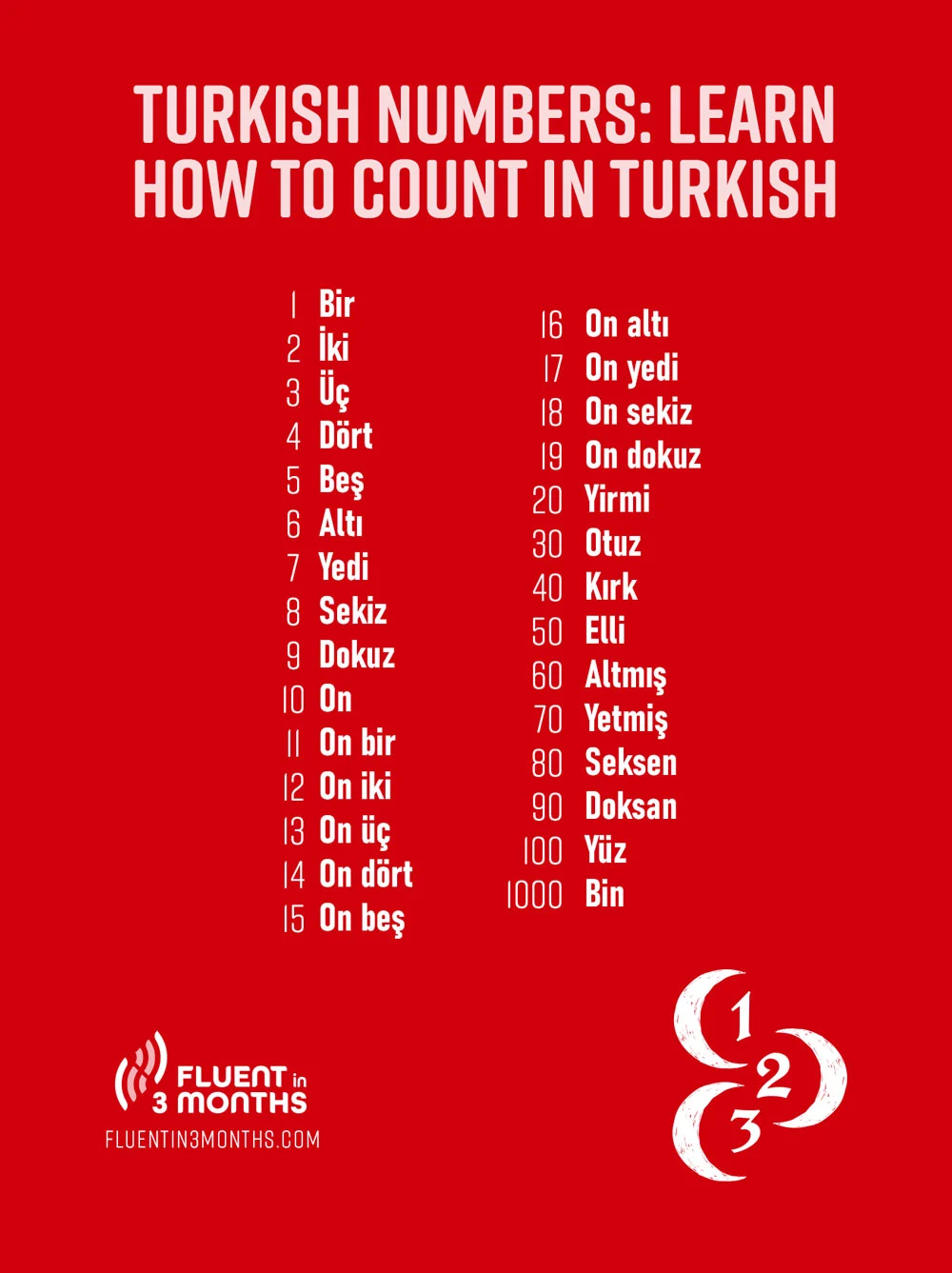
The mastery of Turkish numbers begins with the first ten digits. These monosyllabic or disyllabic words form the basis for every subsequent number in the language. The cardinal numbers from one to ten are:
- Bir (One)
- İki (Two)
- Üç (Three)
- Dört (Four)
- Beş (Five)
- Altı (Six)
- Yedi (Seven)
- Sekiz (Eight)
- Dokuz (Nine)
- On (Ten)
Phonetically, Turkish is a highly phonetic language; it is spoken exactly as it is written. For example, the "ü" in üç is pronounced similarly to the German "ü" or the French "u," requiring the speaker to round their lips. The "ı" in altı is a dotless "i," representing a close back unrounded vowel, similar to the "e" in the English word "the" when spoken quickly.
Logical Progression: 11 through 99
The Turkish system for numbers between 11 and 99 is remarkably intuitive. To form numbers in the teens, one simply places the word for ten (on) before the single digit. This eliminates the need for unique terms like "eleven" or "thirteen."
- 11: On bir (Ten one)
- 15: On beş (Ten five)
- 19: On dokuz (Ten nine)
When moving into higher decads, the speaker must memorize the specific terms for the multiples of ten. These terms are:
- 20: Yirmi
- 30: Otuz
- 40: Kırk
- 50: Elli
- 60: Altmış
- 70: Yetmiş
- 80: Seksen
- 90: Doksan
To create any number between these intervals, the additive rule applies. For instance, 42 is expressed as kırk iki (forty-two), and 87 is seksen yedi (eighty-seven). This mathematical transparency is often cited by educators as a reason why Turkish-speaking children may grasp basic arithmetic concepts more rapidly than those speaking languages with irregular numerical structures.
Scaling Up: Hundreds, Thousands, and Millions
As the scale of the number increases, the logic remains consistent, though the position of the multiplier shifts compared to the "teens" system.
The word for one hundred is yüz. To express multiples of a hundred, the multiplier is placed in front of the word yüz.
- 200: İki yüz
- 500: Beş yüz
The word for one thousand is bin. Similar to the hundreds, thousands are expressed by placing the digit before the word bin.
- 2,000: İki bin
- 10,000: On bin
In contemporary Turkish economic contexts, large numbers are frequently encountered due to the historical inflation of the Turkish Lira (TL). In 2005, the Turkish government performed a redenomination, removing six zeros from the currency (the "New Turkish Lira" transition). Despite this, the use of large numbers remains a daily reality in real estate and automotive transactions, where prices often reach into the millions (milyon) and billions (milyar).
Ordinal Numbers and the Rule of Vowel Harmony
Ordinal numbers—which indicate sequence (first, second, third)—introduce one of the most important aspects of Turkish grammar: Vowel Harmony. In Turkish, the suffix added to a word must harmonize with the vowels present in the root word.
To form an ordinal, the suffix -ıncı, -inci, -uncu, or -üncü is added. The choice depends on the last vowel of the number:
- Bir (ends in ‘i’) becomes Birinci (First)
- İki (ends in ‘i’) becomes İkinci (Second)
- Üç (ends in ‘ü’) becomes Üçüncü (Third)
- Dört (ends in ‘ö’) becomes Dördüncü (Fourth)
- Altı (ends in ‘ı’) becomes Altıncı (Sixth)
This linguistic feature ensures a melodic flow to the language, a characteristic that is highly valued in Turkish oratory and literature.
Practical Applications in Modern Turkish Society
The utility of Turkish numbers extends into several critical socio-economic domains. Understanding these contexts is essential for foreign nationals seeking residency or conducting business in Turkey.
1. The Economy and Shopping
The Turkish Lira is subdivided into 100 kuruş. In retail environments, prices are often written with a comma as a decimal separator (e.g., 10,50 TL). When asking for a price, the standard phrase is "Fiyatı ne kadar?" (How much is the price?). In traditional markets, or "Pazars," numbers are shouted by vendors in a rhythmic fashion, and the ability to recognize these numbers is the first step in successful price negotiation, a common cultural practice.
2. Temporal Measurements
Turkey utilizes the 24-hour clock for formal schedules, such as airline or intercity bus (Otobüs) departures. However, in daily conversation, the 12-hour clock is preferred, supplemented by the terms buçuk (half past) and çeyrek (quarter). For example, 10:30 is expressed as saat on buçuk. Mastery of time is essential for navigating the country’s extensive public transit network, which saw over 1.5 billion boardings in Istanbul alone in recent years.
3. Telecommunications and Identity
In Turkey, mobile phone numbers are 10 digits long (excluding the initial zero) and are typically dictated in a specific pattern: a three-digit area code followed by a three-digit group and two two-digit groups (e.g., 5xx-xxx-xx-xx). Furthermore, every Turkish citizen and legal resident is assigned an 11-digit "T.C. Kimlik Numarası" (Republic of Turkey Identity Number). This number is required for everything from opening a bank account to receiving medical treatment, making the clear verbalization of digits a vital skill for administrative compliance.
Analysis of Implications for Tourism and Business
The Turkish Ministry of Culture and Tourism reported that Turkey welcomed over 56 million visitors in 2023. For the tourism sector, the "numerical bridge" is a significant factor in service quality. While English is widely spoken in tourist hubs like Antalya or Cappadocia, the ability of a visitor to use Turkish numbers is often met with increased hospitality (misafirperverlik).
From a business perspective, Turkey’s position as a G20 economy and a bridge between Europe and Asia necessitates precise numerical communication. In manufacturing and logistics—sectors that account for a significant portion of Turkey’s GDP—the standardized use of the metric system and the logical Turkish counting system facilitate efficient operations and reduce the likelihood of clerical errors in international trade.
Conclusion: The Path to Fluency
Mastering Turkish numbers provides more than just the ability to count; it offers a window into the logical framework of the Turkic mind and the historical resilience of a nation that successfully modernized its entire linguistic identity in a single generation. By understanding the building blocks of 1 through 10, adhering to the additive rules of the decads, and respecting the melodic requirements of vowel harmony, learners can navigate the Turkish landscape with confidence. As the Turkish economy continues to evolve and its global influence expands, the importance of this foundational knowledge remains undisputed for diplomats, investors, and travelers alike. Utilizing resources such as linguistic podcasts, immersive mobile applications, and local community engagement remains the most effective strategy for achieving fluency in this robust numerical system.