
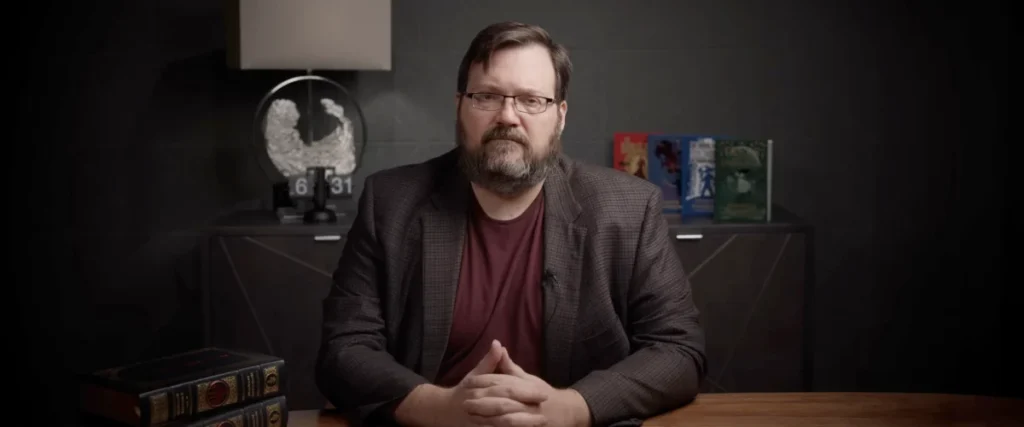
Late last year, acclaimed fantasy novelist Brandon Sanderson delivered a seminal address titled "The Hidden Cost of AI Art" at Dragonsteel Nexus, the annual conference orchestrated by his burgeoning media company. This event, a significant gathering for fans of epic fantasy and a showcase for Sanderson’s extensive literary universe, provided a powerful platform for a nuanced exploration of generative artificial intelligence’s rapidly expanding influence on creative fields. Sanderson, known for his prolific output, intricate world-building, and transparent engagement with his readership, approached the contentious subject not with outright condemnation, but with a stated intention to understand and learn from the unfolding technological revolution, even as his personal sentiments leaned towards a profound skepticism regarding its artistic applications.
The Emergence of Generative AI and the Creative Industries
The backdrop to Sanderson’s address is the meteoric rise of large language models (LLMs) and generative AI, which have rapidly transitioned from speculative technologies to practical tools capable of producing text, images, audio, and video with unprecedented speed and sophistication. The years 2022 and 2023 marked a significant inflection point, with models like OpenAI’s DALL-E and ChatGPT, Stability AI’s Stable Diffusion, and Anthropic’s Claude demonstrating capabilities that both captivated the public imagination and sent ripples of anxiety through creative industries. Artists, writers, musicians, and designers found themselves grappling with existential questions about originality, intellectual property, economic viability, and the very definition of human creativity. Conferences like Dragonsteel Nexus, which traditionally celebrate human imagination and artistic endeavor, became crucial forums for these urgent discussions.
Sanderson articulated his initial reaction to AI-generated art with candor: "The surge of large language models and generative AI raises questions that are fascinating, and even if I dislike how the movement is going in relation to writing and art, I want to learn from the experience of what’s happening." He confessed to a visceral disapproval, stating that "my stomach turns" at the sight of AI-generated art, yet he embarked on an intellectual journey to discern the fundamental reasons for this discomfort, systematically examining and ultimately dismissing a series of common objections that permeate current public discourse.
Deconstructing Common Objections to AI Art
In his talk, Sanderson implicitly, and by extension, the broader creative community, grapples with several widely cited concerns about AI-generated art. While not explicitly detailed in the excerpt, these typically include:
- Lack of Originality and Soul: A prevalent argument suggests that AI, by its very nature, cannot create truly original works. Its output is seen as a sophisticated pastiche or remix of its training data, devoid of genuine human insight, emotion, or "soul." Critics argue that true art stems from lived experience, consciousness, and intention, elements that AI, as a computational system, cannot possess.
- Copyright Infringement and Unethical Training Data: A significant legal and ethical battle centers on the vast datasets used to train generative AI models. These often comprise billions of images, texts, and other media scraped from the internet, frequently without the consent or compensation of the original creators. This raises questions of intellectual property rights, fair use, and the potential for AI to profit from the uncredited labor of human artists. Numerous lawsuits have been filed by artists and content owners against AI developers, alleging mass copyright infringement.
- Devaluation of Human Skill and Labor: Many artists fear that the ease and speed with which AI can generate content will devalue the years of dedication, practice, and unique skill required to master a craft. The concern is that clients and consumers might opt for cheaper, faster AI alternatives, leading to job displacement and economic precarity for human creators. A 2023 survey by the Artists’ Guild found that over 70% of professional artists expressed concerns about AI’s potential to reduce their income and opportunities.
- Ethical Misuse and the Erosion of Trust: Beyond economic concerns, there are anxieties about AI’s capacity for misuse, such as generating deepfakes, propaganda, or hyper-realistic but fabricated content that blurs the lines between reality and simulation. This erosion of trust in digital media poses significant societal risks.
Sanderson, in his contemplative journey, acknowledged these objections but sought a deeper, more personal truth, indicating that while valid, they did not fully encapsulate the core of his unease.
Sanderson’s Revelation: The Transformative Power of Creation
The crux of Sanderson’s argument, and the "hidden cost" he ultimately identified, lies in the profound personal transformation an artist undergoes during the creative process. Drawing from his own struggles with early, unsuccessful book manuscripts, he underscored that the true value of art is not merely in its final product, but in the journey of its making.
"Maybe someday the language models will be able to write books better than I can," Sanderson conceded. "But here’s the thing: Using those models in such a way absolutely misses the point, because it looks at art only as a product. Why did I write [my first manuscript]?… It was for the satisfaction of having written a novel, feeling the accomplishment, and learning how to do it. I tell you right now, if you’ve never finished a project on this level, it’s one of the most sweet, beautiful, and transcendent moments. I was holding that manuscript, thinking to myself, ‘I did it. I did it.’"
This perspective reorients the debate from external factors like copyright or market disruption to the internal, intrinsic reward of human endeavor. The act of creation, with its inherent challenges, failures, and eventual triumphs, shapes the artist, hones their skills, and provides a unique sense of accomplishment that AI, as a tool, cannot replicate for a human user. The "cost" of AI art, in this view, is the potential forfeiture of this profound human experience of self-actualization through creation.
Art as Deep Human Communication: A Complementary Perspective
This profound emphasis on the artist’s internal journey finds resonance with another emerging viewpoint: that art is fundamentally an act of deep human communication. This perspective posits that an artist uses a tangible medium—be it prose on a page, paint on a canvas, or notes in a melody—to transmit a complex internal cognitive state, an emotion, an idea, or a vision, from their mind directly to that of their audience. It is, in essence, a form of "telepathy," a uniquely human connection that transcends the limitations of verbal language.
From this vantage point, the notion of engaging with a book written by a language model or watching a film generated by an algorithmic prompt becomes intrinsically problematic, if not "anti-human." If the essence of art is the communication of human experience, then an output generated without a conscious, sentient human experience behind it fundamentally misses the mark. It becomes a simulation, perhaps aesthetically pleasing, but devoid of the genuine emotional or intellectual transfer that defines true artistic engagement. The value lies not just in the aesthetic outcome, but in the knowledge that another human being poured their heart, mind, and soul into its creation, and that the audience is now participating in that shared humanity.
The Power of Definition: A Call to Agency
What particularly struck many about Sanderson’s address was its empowering conclusion. If art’s essence is deeply human, then it is humanity’s prerogative to define it. "That’s the great thing about art — we define it, and we give it meaning," he declared. This assertion challenges the prevailing narrative of technological determinism, which often portrays AI’s advancement as an unstoppable force to which humanity must simply adapt.
Sanderson’s powerful exhortation — "The machines can spit out manuscript after manuscript after manuscript. They can pile them to the pillars of heaven itself. But all we have to do is say ‘no’" — serves as a rallying cry for agency. It suggests that despite the unprecedented capabilities of AI, humans retain the ultimate power to delineate what constitutes authentic art, what deserves their attention, and what contributes to their collective cultural heritage. This perspective stands in stark contrast to a perceived "nihilistic passivity" that has, at times, characterized commentary on AI’s impact, where authors often present grim scenarios of AI’s destructive potential without offering a path forward or emphasizing human capacity for resistance and redefinition.
Sanderson’s message reminds the creative community, and indeed society at large, that the future of art is not solely dictated by the whims of tech magnates like Sam Altman of OpenAI or Dario Amodei of Anthropic. Instead, it is shaped by collective human choice. The decision to value human-made art, to support human artists, and to resist the temptation of purely algorithmic creation is a powerful act of self-determination.
Broader Implications and Future Outlook
Sanderson’s talk at Dragonsteel Nexus contributes significantly to an ongoing, multifaceted global dialogue about the role of AI in creative fields. His emphasis on the intrinsic value of the artistic process and the human capacity for definition provides a philosophical anchor for artists grappling with these disruptive technologies.
The implications extend beyond individual artists to broader industry practices, intellectual property law, and cultural policy. As AI capabilities continue to advance, the distinction between human and machine creativity will become increasingly blurred, necessitating robust ethical frameworks, transparent attribution standards, and potentially new legal precedents to protect human creators. Organizations representing artists, writers, and musicians are actively advocating for regulations that ensure fair compensation, consent for data usage, and clear labeling of AI-generated content. Governments and international bodies are also beginning to explore legislative responses to these challenges.
Ultimately, the debate over "The Hidden Cost of AI Art" is not merely about technology; it is a profound societal reflection on humanity’s relationship with creativity, purpose, and self-definition. Brandon Sanderson’s contribution serves as a potent reminder that in an era of unprecedented technological change, the most valuable commodity might not be what machines can create, but what humans choose to preserve and celebrate. His call to agency is a powerful affirmation that the future of art, in its most meaningful sense, remains firmly in human hands.
Correction: Clarification on Anthropic’s LLM Vulnerability Report
In a recent episode of the "AI Reality Check" podcast, the following statement was made: "If you go back and look at the release notes for Anthropic’s earlier, less powerful opus 4.6 LLM, they say the following: their researchers used Opus to find, quote, ‘over 500 exploitable zero-day vulnerabilities, some of which are decades old.’ And let’s stop for a moment because that note, which was hidden in the system card for opus 4.6, is almost word for word what anthropic said about Mythos."
This wording contained inaccuracies and has been clarified to ensure factual precision. The reference was to a report published by Anthropic concerning Opus 4.6, released concurrently with the model. While not technically a "system card," it functions as a form of release notes or supplementary documentation.
The report stated: "Opus 4.6 found high-severity vulnerabilities, some that had gone undetected for decades." It further noted in a separate section: "So far, we’ve found and validated more than 500 high-severity vulnerabilities." Both the title and conclusion of the report categorized these vulnerabilities as "0-day."
However, the specific quote provided in the podcast ("over 500 exploitable zero-day vulnerabilities, some of which are decades old") was not found verbatim within Anthropic’s official report. This particular phrasing was, in fact, a summary of the report’s findings presented in a tweet by Daniel Sinclair. While the summary accurately conveyed the essence of Anthropic’s findings regarding Opus 4.6’s capability to identify numerous high-severity, decades-old zero-day vulnerabilities, the podcast’s wording inadvertently implied that this exact quote was directly from Anthropic’s official documentation.
We thank the AI researcher who brought these points to our attention. Accuracy in reporting is paramount, and we appreciate all corrections that help us maintain the highest standards of journalistic integrity. Concerns or notes can always be directed to [email protected].