



Unveiling Microsoft Discovery: A New Paradigm for R&D
The announcement, made at the Build 2026 conference, underscores Microsoft’s broader and aggressive initiative to embed agentic AI capabilities across its entire product portfolio. This reflects a burgeoning interest within both academic and industrial sectors to harness sophisticated AI systems for unprecedented acceleration in innovation. At its architectural core, Microsoft Discovery operates around a sophisticated graph-based knowledge engine. This engine is designed to seamlessly integrate proprietary research data—often siloed within institutions—with vast troves of external scientific information, including published literature, public databases, and experimental results. The synergy between these data sources allows specialized AI agents to reason across complex interrelationships, rigorously evaluate competing findings, and support the iterative, often circuitous, processes inherent in scientific research.
The General Availability (GA) release signifies that Microsoft Discovery is now deemed robust and scalable enough for enterprise-level deployments, catering to the stringent demands of major research institutions, pharmaceutical companies, energy firms, and advanced manufacturing organizations. This move is not merely an incremental update; it represents Microsoft’s assertion of agentic AI as a mature and reliable tool for the scientific community, capable of moving beyond experimental phases into core operational workflows.
The Evolution of Agentic AI and Microsoft’s Vision

Agentic AI, a concept that underpins the Discovery platform, represents a significant evolution beyond traditional AI models. Unlike static machine learning algorithms that primarily perform pattern recognition or prediction based on predefined datasets, agentic AI systems are designed to be proactive. They can plan sequences of actions, reason through problems, utilize external tools (like simulation software, laboratory automation systems, or statistical packages), and work autonomously through multi-step processes to achieve a specified goal. This aligns perfectly with the iterative nature of scientific R&D, where hypotheses are formed, experiments are designed and executed, data is analyzed, and conclusions lead to new hypotheses—a cycle that often demands significant time and resources.
Microsoft’s commitment to agentic AI is evident across its diverse ecosystem, from Azure’s foundational cloud services to developer tools like GitHub, specialized platforms like Microsoft Foundry, and productivity suites like Microsoft 365. The Discovery platform is a direct extension of this strategy, tailoring the power of intelligent agents to the specific, high-stakes challenges of scientific inquiry. The company envisions a future where AI agents act as intelligent co-pilots for researchers, augmenting human intellect rather than replacing it, thereby freeing up scientists to focus on higher-level conceptualization and critical interpretation.
Addressing the Bottlenecks in Scientific Research
Scientific research and development is notoriously expensive, time-consuming, and data-intensive. For instance, the average cost of bringing a new drug to market can exceed $2 billion and take over a decade, with high rates of failure at various stages. Similarly, breakthroughs in materials science, energy storage, or advanced manufacturing often require exploring vast design spaces, conducting countless experiments, and synthesizing information from diverse fields. These challenges are exacerbated by the ever-increasing volume of scientific literature and experimental data, making it nearly impossible for human researchers to keep pace with the knowledge explosion.
Microsoft Discovery directly addresses these bottlenecks by:
- Accelerating Data Analysis: AI agents can process and synthesize massive datasets from experiments, simulations, and external sources far more rapidly than human researchers.
- Automating Hypothesis Generation: By reasoning across integrated knowledge graphs, agents can identify novel correlations, predict potential outcomes, and propose new hypotheses that might be overlooked by human intuition alone.
- Optimizing Experimentation: Agents can assist in designing more efficient experiments, simulating outcomes, and even interfacing with laboratory automation systems for "self-driving" scientific workflows.
- Enhancing Knowledge Management: The platform provides a structured environment to capture, organize, and retrieve scientific knowledge, ensuring reproducibility and facilitating collaborative research.
The Microsoft Discovery Engine stands at the core of this functionality, specifically supporting the fundamental loop of scientific work: moving from evidence to hypotheses, then through execution, analysis, and additional iteration. Its GA release as a "production-ready platform" indicates Microsoft’s confidence in its ability to withstand the rigor and demands of real-world R&D environments.
Governance, Reproducibility, and the Human Element
For enterprise IT departments and research organizations, the deployment of such a powerful AI system raises critical questions of governance, data security, and ethical use. Microsoft has proactively positioned Discovery as a system designed with these concerns in mind. The platform is engineered to connect seamlessly with an institution’s proprietary knowledge bases, domain-specific experimental data, advanced simulation tools, and external scientific information, all while maintaining rigorous controls over outputs and ensuring workflows are transparent and reproducible.
A cornerstone of Microsoft’s messaging is that the platform is designed to keep "human judgment" firmly at the center of research decisions. This implies that while AI agents can generate hypotheses, analyze data, and even suggest experimental designs, the ultimate validation, interpretation, and strategic direction remain within the purview of human scientists. This "human-in-the-loop" philosophy is crucial for fostering trust, ensuring ethical research practices, and mitigating potential biases or errors that could arise from fully autonomous AI systems. The platform’s architecture supports reviewable outputs and auditable workflows, which are essential for scientific integrity and regulatory compliance, particularly in fields like drug development or advanced materials.
Lowering the Barrier: The Microsoft Discovery App Preview

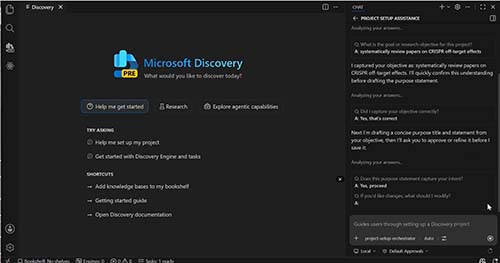
Recognizing that not all research teams or academic labs are immediately ready for a full enterprise deployment, Microsoft has also launched a preview of the Microsoft Discovery app. This local desktop experience is specifically tailored for individual researchers, students, and smaller scientific teams. The app aims to democratize access to agentic AI capabilities, providing an accessible entry point for exploring its potential.
The Discovery app can be easily downloaded from GitHub, leveraging the ubiquitous developer platform, and operates in conjunction with a GitHub Copilot account. This integration further solidifies Microsoft’s "Copilot" strategy, extending intelligent assistance from code development to scientific inquiry. For smaller groups, the app provides a practical way to begin exploring core functionalities such as automated literature review, initial hypothesis generation, fundamental scientific reasoning, and iterative experimentation in a more contained environment. This tiered approach allows researchers to familiarize themselves with the agentic AI paradigm and experience its benefits firsthand before considering a broader integration with the full Microsoft Discovery platform. This strategy not only fosters adoption but also allows Microsoft to gather valuable feedback from a diverse user base, refining the platform based on real-world scientific needs.
Early Adopters Paving the Way: Diverse Use Cases
Microsoft highlighted several compelling early use cases that demonstrate the platform’s versatility and potential impact across various sectors:
- Yale Engineering: Researchers at Yale utilized the Discovery Engine in their work related to small molecule design for grid-scale aqueous organic redox flow batteries. Professor David Kwabi emphasized how the platform effectively combines human-led experimentation with the AI’s unparalleled ability to explore vast chemical design spaces. This is critical for discovering novel compounds with specific electrochemical properties, a task that would be prohibitively slow and expensive through traditional methods.
- Pacific Northwest National Laboratory (PNNL): PNNL is actively deploying Microsoft Discovery in critical areas such as energy storage and biosystems engineering. A particularly innovative application involves "self-driving scientific workflows," where AI agents are seamlessly connected with laboratory automation systems. This allows for closed-loop experimentation, where agents can propose experiments, direct robotic systems to execute them, analyze the results, and then iteratively refine the next experimental step—all with minimal human intervention, significantly accelerating discovery cycles.
- Ginkgo Bioworks: A leader in biological discovery and synthetic biology, Ginkgo Bioworks is collaborating with Microsoft to leverage specialized agents for analyzing complex biological datasets, generating novel biological hypotheses, and designing intricate experiments. This partnership underscores the platform’s applicability in cutting-edge biotechnological research, where the scale and complexity of data (genomic, proteomic, metabolomic) often overwhelm human capacity.
Beyond academic and national laboratory settings, Microsoft Discovery is also making inroads into commercial and industrial sectors:

- BHP: The global mining giant BHP is employing Discovery to study advanced copper leaching methods. Optimizing mineral extraction processes has immense economic and environmental implications, and AI agents can help model complex chemical reactions and material interactions to improve efficiency and reduce waste.
- Syensqo: A high-performance materials company, Syensqo is using agentic AI in its work tied to next-generation heat transfer fluids for semiconductor manufacturing. As semiconductor devices become smaller and more powerful, efficient heat dissipation is crucial. AI can accelerate the design and testing of novel fluid compositions with superior thermal properties.
- GSK: The pharmaceutical giant GSK is exploring Discovery for various drug development workflows. This could span early-stage target identification, lead compound optimization, predicting drug efficacy and toxicity, and even streamlining aspects of clinical trial design and data analysis, potentially dramatically shortening the drug development timeline.
Broader Implications and the Future of Scientific Discovery
The general availability of Microsoft Discovery comes at a time when Microsoft is aggressively expanding its agent strategy across its entire ecosystem, including Azure, Microsoft Foundry, GitHub, and Microsoft 365. With Discovery, the company is strategically targeting a highly specialized but immensely high-value audience: organizations where research cycles are inherently expensive, data-heavy, and subject to rigorous regulatory or scientific review. The potential economic impact is staggering, with the global R&D market valued in trillions of dollars annually. Even marginal improvements in efficiency or acceleration of discovery can translate into significant competitive advantages and societal benefits.
Analysts are likely to view this as a pivotal moment, signaling a maturation of agentic AI from theoretical concept to practical, deployable technology in the scientific domain. The competitive landscape in AI for scientific discovery is heating up, with other tech giants and specialized startups also investing heavily. Microsoft’s strong position in enterprise software, cloud infrastructure, and developer tools, combined with its "human-centric" AI approach, gives it a unique advantage in this emerging market.
Looking ahead, the widespread adoption of platforms like Microsoft Discovery could fundamentally reshape the landscape of scientific research. It could foster greater interdisciplinary collaboration, enable researchers to tackle previously intractable problems, and democratize access to advanced computational tools. The symbiotic relationship between human intelligence and agentic AI holds the promise of ushering in an unprecedented era of scientific breakthroughs, addressing some of humanity’s most pressing challenges in health, energy, and sustainability at an accelerated pace.
Microsoft Discovery is generally available now, marking a new chapter in AI-powered scientific exploration. The Microsoft Discovery app, currently in preview, offers a glimpse into the future of localized, accessible agentic AI for researchers, though preview features may evolve before final release. For more comprehensive information and technical details, interested parties are encouraged to visit the official Microsoft blog.