



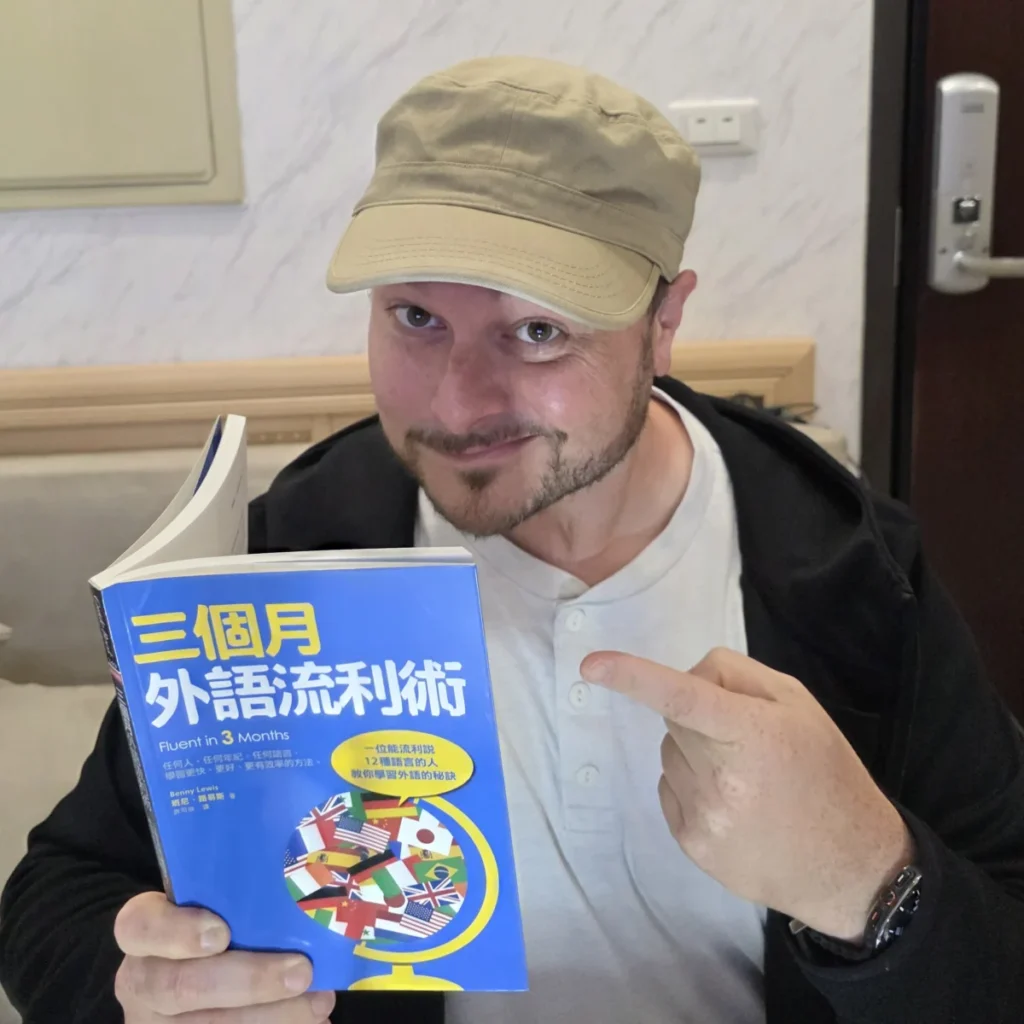
Benny Lewis, the Irish polyglot and founder of the globally recognized "Fluent in 3 Months" platform, has officially returned to Taipei, Taiwan, to initiate a high-intensity Mandarin Chinese language reacquisition project. This move marks a significant return to the city where Lewis first embarked on his Mandarin journey 14 years ago. The current project aims to restore Lewis’s proficiency to at least a B1 (lower intermediate) spoken level, following a period of linguistic attrition where the language had largely "slipped away" due to lack of consistent use. Lewis’s return to Taiwan follows a two-month period of travel through Malaysia, where interactions with the Chinese diaspora and tourists served as the primary catalyst for his renewed focus on the Sinitic language family.
The project is structured as a two-month intensive immersion, combining traditional study methods, modern technological tools, and real-world social integration. Following the initial phase in Taipei, Lewis plans to expand his efforts through a "deep travel" initiative across the various provinces of Taiwan, moving beyond the metropolitan hub of the capital to test his linguistic capabilities in environments where English proficiency is significantly lower.
A Chronology of Linguistic Development: 2012 to 2024
The trajectory of Lewis’s Mandarin studies began in 2012 with a highly publicized three-month intensive project in Taiwan, followed by two months of travel across mainland China. This original mission remains one of the most discussed case studies in the online language-learning community. At the conclusion of the 2012 project, Lewis’s spoken Mandarin was independently evaluated at a B1 level on the Common European Framework of Reference for Languages (CEFR). During this period, he successfully navigated complex social situations, including learning Kung Fu in a rural fishing village and conducting interviews with native-speaking media professionals.
In the decade following his initial success, Lewis’s engagement with Mandarin became sporadic. The primary exception occurred during the co-authoring of the instructional text Language Hacking Mandarin, published by Teach Yourself. Outside of that intensive period of revision and content creation, his use of the language was relegated to brief exchanges at international language events. This pattern of intermittent use led to a significant decline in fluency, a phenomenon common in polyglots who manage multiple active and passive languages.
The decision to re-engage with Mandarin in 2024 was influenced by a two-month expedition through Malaysia. According to industry data, Malaysia is home to one of the largest overseas Chinese populations, with Mandarin serving as a lingua franca among various dialect groups in urban centers. Lewis noted that the frequency of Mandarin in the Malaysian social landscape made it a more practical priority than Malay, prompting a strategic shift in his linguistic focus.
Methodological Framework and Daily Routine
To facilitate rapid reacquisition, Lewis has implemented a structured daily regimen that balances cognitive study with physical activity and social immersion. The methodology represents a synthesis of traditional pedagogical resources and 21st-century digital tools.
Pedagogical Resources and Grammar Focus
Unlike his recommendations for absolute beginners, which typically prioritize speaking over formal rules, Lewis has integrated a central focus on grammar for this intermediate-level project. He is currently utilizing specialized grammar texts that accommodate the nuances of Taiwanese Mandarin while providing examples in both Simplified and Traditional Chinese characters. The objective of this focus is to move beyond basic communication toward more natural, syntactically correct sentence structures.
Digital Spaced Repetition Systems (SRS)
A cornerstone of the project involves the use of Anki, a digital flashcard application utilizing spaced repetition. Lewis has recovered and updated his original 2012 vocabulary decks, which contain thousands of entries derived from past in-person lessons. The recovery process required significant technical adaptation, as the legacy files were incompatible with modern versions of the software. By prioritizing vocabulary that was personally relevant during his first immersion, Lewis aims to accelerate the "reactivation" of dormant neural pathways associated with Mandarin.
Online Instruction and Artificial Intelligence
Lewis has supplemented his self-study with frequent online lessons via platforms like Preply. These sessions, conducted with a variety of tutors to ensure exposure to different accents and speaking styles, are designed to build conversational momentum. Additionally, the project utilizes AI-driven conversation tools, which serve as a cost-effective alternative for supplementary practice. This reflects a broader trend in the language-learning industry, where AI is increasingly used to simulate low-stakes speaking environments.
Social Immersion and Environmental Challenges
The project incorporates regular attendance at local social events found through platforms like Meetup.com. However, Lewis has reported that the "sit-down" nature of many Taipei social gatherings presents a significant challenge for intermediate learners. In noisy, multi-participant environments, native speakers are less likely to adjust their speed or vocabulary for non-native participants. Lewis has identified this as a critical threshold to overcome, noting that his current strategy involves balancing these difficult group interactions with one-on-one exchanges.
Data and Trends in Mandarin Language Acquisition
The global demand for Mandarin Chinese remains high, driven by China’s economic influence and the cultural reach of the Sinosphere. According to data from the Center for Language Education and Cooperation, there are currently over 25 million people learning Chinese as a foreign language outside of China.
Taiwan has positioned itself as a premier destination for traditional character study and linguistic immersion. The Ministry of Education in Taiwan has actively promoted the "Huayu Enrichment Scholarship" and other initiatives to attract international students. Lewis’s choice of Taipei as a base aligns with these trends, as the city offers a high density of language schools and a linguistic environment that maintains traditional script, which is essential for historical and formal literacy in the region.
The challenge of language maintenance, as highlighted by Lewis’s experience, is supported by linguistic research into "attrition." Studies suggest that while receptive skills (listening and reading) tend to remain stable, productive skills (speaking and writing) decline rapidly without regular use. However, the process of "re-learning" is statistically faster than initial acquisition, as the learner can leverage existing mental frameworks and familiar phonemes.

The "Deep Travel" Initiative and Geographic Expansion
A pivotal component of the 2024 project is the "Deep Travel" phase. Lewis intends to spend several weeks exploring the rural and less-populated regions of Taiwan. This follows his previous large-scale travel projects, such as visiting every state in Brazil and all 48 contiguous states in the U.S., as well as every province in South Korea.
The shift toward travel outside major urban hubs is a strategic linguistic move. In Taipei, while English is not as ubiquitous as in some European capitals, it remains a common fallback in high-end retail and international chains. Lewis recounted a specific instance at a Starbucks in Taipei where a lack of specific Mandarin vocabulary for "espresso" led to a communication breakdown, illustrating the necessity of precise linguistic output even in international environments. By moving into the "rest of the country," Lewis anticipates a "no-exit" scenario where Mandarin becomes the sole medium for survival and social interaction.
Analysis of Content Strategy in the Age of Artificial Intelligence
The announcement of the Mandarin project also serves as a pivot in Lewis’s editorial strategy for the "Fluent in 3 Months" brand. For over a decade, the blog focused on SEO-driven content—articles designed to answer specific search queries such as "how to learn X language." However, Lewis has signaled a return to personal, narrative-driven blogging.
This change is a direct response to the evolution of search engine algorithms and the rise of Generative AI. Lewis noted that Google’s integration of AI-generated snippets often extracts information directly from expert blogs, reducing click-through rates and making it difficult to sustain a professional writing team. By returning to "human-centric" storytelling and personal adventure logs, Lewis aims to provide value that cannot be easily replicated by AI models. He emphasizes that while AI tools may be used for grammatical refinement, the core content will remain grounded in actual human experience and "boots-on-the-ground" exploration.
Broader Implications for the Language Learning Community
Lewis’s return to Mandarin highlights several key themes in the modern language-learning landscape:
- The Re-learning Economy: As more people learn multiple languages, the focus is shifting from "zero-to-fluency" to the sustainable maintenance and recovery of languages.
- Hybrid Methodologies: The successful modern learner is increasingly one who can balance traditional textbooks with AI tools and physical immersion.
- The Value of Immersion: Despite the rise of digital tools, physical presence in a target-language environment remains the gold standard for reaching intermediate and advanced levels of "naturalness" in speech.
- The Human Element in Digital Content: In an era of automated content, there is a growing niche for authentic, experiential reporting from the field.
As Lewis continues his journey through Taipei and beyond, the project will likely serve as a benchmark for other polyglots and language enthusiasts looking to revive dormant skills. His progress, documented through social media and personal updates, continues to provide a real-time look at the challenges and rewards of long-term linguistic commitment in an increasingly interconnected yet technologically complex world.