



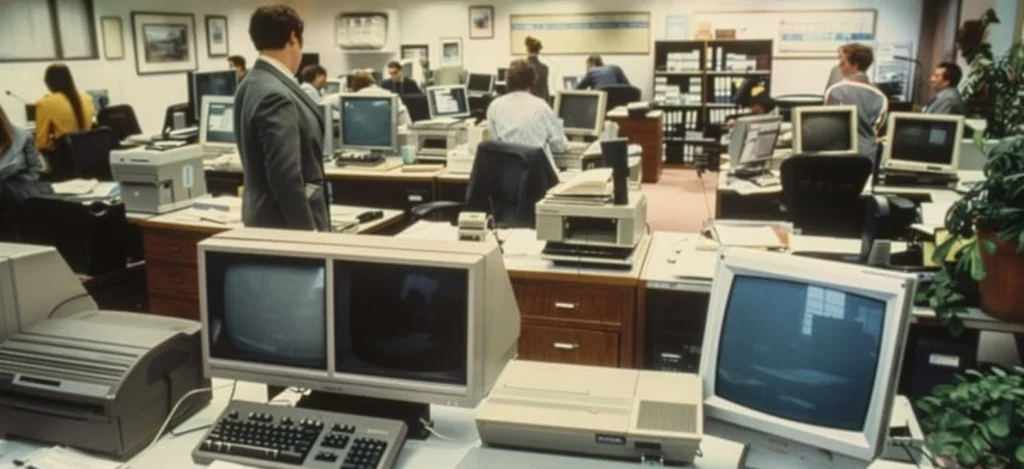
Few recent technological innovations were better poised to become a productivity slam dunk than the personal computer. Emerging in earnest in the late 1970s and truly exploding into workplaces in the 1980s and 1990s, the PC promised a revolution in efficiency. With the advent of groundbreaking software applications—spreadsheets like VisiCalc and Lotus 1-2-3, robust word processors such as WordStar and WordPerfect, sophisticated database management systems, intuitive presentation software like PowerPoint, and the revolutionary immediacy of email—the list of programs that could vastly simplify common tasks seemed endless. The expectation was clear: a rapid, dramatic surge in worker output and overall economic productivity. However, as history unfolded, the reality proved far more intricate than these initial projections suggested, leading to what economists famously termed the "productivity paradox." This historical precedent now serves as a crucial lens through which to examine the current fervor surrounding artificial intelligence (AI), prompting a vital question: will AI deliver on its immense productivity promise, or will it, too, present a more complicated reality?
The Dawn of the Personal Computer: A Promise Unfulfilled?
The 1980s heralded a new era of computing. Early adopters envisioned a future where tedious manual calculations, laborious typing, and cumbersome filing systems would be relics of the past. The personal computer, initially an expensive and niche tool, rapidly became an indispensable fixture in offices worldwide. Spreadsheets empowered financial analysts to model complex scenarios in minutes, word processors transformed document creation and editing, and databases offered unprecedented capabilities for data organization and retrieval. The arrival of email in the 1990s further cemented the PC’s role, promising instantaneous communication that would eliminate geographical barriers and streamline collaborative efforts.
Despite this profound technological shift and the palpable sense of increased activity in offices, aggregate economic data failed to show the expected corresponding surge in productivity. Robert Solow, the Nobel laureate economist, famously quipped in 1987, "You can see the computer age everywhere but in the productivity statistics." This observation encapsulated the core of the productivity paradox: significant investment in information technology (IT) seemed to yield disproportionately small gains in measured productivity. While individual tasks undoubtedly became easier and faster, the broader impact on the economy remained stubbornly elusive for many years.
Understanding the "Productivity Paradox" of the Digital Age
The Solow Paradox spurred decades of research and debate among economists and technology scholars. Several factors were identified as contributing to this perplexing phenomenon:
- Measurement Challenges: Traditional productivity metrics, often designed for manufacturing economies, struggled to accurately capture the qualitative improvements and new services generated by information technology. How does one quantify the value of faster communication, better decision-making, or enhanced customer service enabled by PCs and the internet?
- Learning Curves and Implementation Lags: Adopting new technology is not merely about plugging in a machine. It requires significant organizational restructuring, employee training, and the development of new workflows. This process is often slow and costly, meaning the full benefits of a new technology may not materialize for years, or even decades, after its initial introduction. Firms had to learn how to integrate PCs effectively into their operations, a process that involved trial and error and significant investment in human capital.
- The "J-Curve" Effect: Initial adoption of new technology can actually lead to a temporary decrease in productivity as organizations grapple with new systems, encounter bugs, and retrain staff. Productivity then dips before eventually rising, creating a "J-curve" shape.
- The Cost of "Digital Overhead": While PCs streamlined many tasks, they also introduced new forms of inefficiency. The proliferation of email, for instance, led to information overload, constant interruptions, and the need for employees to spend significant time managing their inboxes rather than focusing on core tasks. Meetings, once constrained by logistics, could now be scheduled with greater frequency, sometimes without a clear objective, further eroding productive time. This phenomenon was explored in detail by author Cal Newport in his 2021 op-ed for WIRED, which highlighted how tools like email and Slack, while intended to boost productivity, often created a "productivity paradox" of their own by fragmenting attention and increasing cognitive load. Newport’s subsequent New York Times bestselling book, A World Without Email, delved deeper into the uneven impact of computing and network technology on knowledge work, arguing for a reimagining of communication strategies to mitigate these digital drains.
It wasn’t until the mid-1990s, well over a decade after the widespread adoption of PCs, that a significant surge in productivity growth was observed in many developed economies, particularly in the United States. This surge was attributed not just to the technology itself, but to the mature integration of IT across industries, combined with complementary investments in organizational change, process re-engineering, and human capital development. This demonstrated that transformative technologies often require a period of profound adaptation before their full economic potential is realized.
AI’s New Frontier: Echoes of the Past?
Today, the world stands at a similar inflection point with artificial intelligence. From generative AI models capable of drafting complex texts and creating images, to advanced automation tools that streamline data analysis and customer service, the potential applications of AI across professional activities seem limitless. It is natural to assume that this technology, which clearly makes certain common professional tasks easier, faster, and more scalable, will inevitably lead to a substantial increase in overall productivity. Early studies and corporate pilots indeed show impressive gains in specific tasks, such as coding assistance, content generation, and data synthesis. For example, a recent report by McKinsey Global Institute estimated that generative AI could add trillions of dollars in value to the global economy annually, primarily through productivity improvements. Other research, such as a 2023 study by Stanford University, indicated that AI tools could significantly reduce the time spent on administrative tasks for knowledge workers, freeing them up for more complex and creative endeavors.
However, as the early years of desktop computing taught us, it’s not always so simple. The enthusiasm for AI must be tempered with a pragmatic understanding of the complexities involved in integrating truly transformative technologies into the fabric of work and society.
Navigating the AI Integration Challenge
The path to realizing AI’s full productivity potential is likely to be fraught with challenges that echo the PC era, alongside new considerations unique to AI:
- Organizational Re-engineering: Just as with PCs, integrating AI effectively requires more than just deploying software. It demands fundamental shifts in business processes, job roles, and organizational structures. Companies must rethink workflows, train employees in new AI-augmented skills, and manage the transition from traditional methods to AI-driven approaches. This is a costly and time-consuming endeavor.
- Ethical and Societal Concerns: The rapid advancement of AI brings with it a host of ethical dilemmas, including data privacy, algorithmic bias, job displacement, and the potential for misuse. Addressing these concerns through robust governance, regulation, and responsible AI development is critical but can also slow down adoption and diffusion. Public skepticism or resistance to AI, if not managed, could also impede its widespread integration.
- Skill Gaps and Workforce Adaptation: The nature of work is evolving rapidly due to AI. While some jobs may be automated, many others will be augmented, requiring workers to develop new skills in "prompt engineering," AI oversight, and human-AI collaboration. The pace at which the global workforce can acquire these new competencies will significantly influence the rate of productivity gains. Education and training systems need to adapt swiftly.
- The "AI Overhead" – Information Overload 2.0?: While AI promises to synthesize information and automate content creation, there is also a risk that it could exacerbate information overload. If AI can generate vast amounts of text, code, or data with ease, without proper human curation and discernment, it could lead to an even greater deluge of information that employees must sift through, potentially creating a new form of "digital drag" similar to the email problem.
- Measurement Difficulties Revisited: Quantifying the productivity gains from AI, especially in knowledge-intensive sectors, will again present challenges. How do we measure the value of more creative output, better strategic decisions, or enhanced customer experiences driven by AI? Standard metrics may fall short, leading to an initial underestimation of AI’s true impact.
Lessons from History: The Long Arc of Innovation
The history of technological innovation offers a consistent pattern: truly transformative technologies, like the steam engine, electricity, or the internal combustion engine, did not deliver their full economic benefits overnight. The steam engine, for example, took decades to move beyond pumping water out of mines to powering factories and transportation, requiring extensive infrastructure development and industrial re-organization. Similarly, it took roughly fifty years for electricity to fully revolutionize manufacturing processes after its initial widespread availability, as factories had to be completely redesigned from central power shafts to individual electric motors.
Most of us would not want to go back to a time before PCs; we’ve become accustomed to their conveniences and the capabilities they unlock. But it’s also true that their aggregate impact on our output was never as tremendous or as clear-cut as that of prior, more foundational innovations in their initial phases, and that integrating them effectively into the workforce took a long time. The journey from invention to widespread, productivity-enhancing adoption is complex, marked by adaptation, learning, and often, unexpected side effects.
Expert Perspectives and Future Outlook
Economists like Erik Brynjolfsson of Stanford University, a leading researcher on the economic impact of IT and AI, have long highlighted the "implementation lag" and the need for complementary innovations (organizational changes, new skills) to fully unlock the potential of general-purpose technologies. He notes that while AI’s impact is already visible in specific tasks, its broader macroeconomic effects will likely take time to materialize, potentially following a similar J-curve trajectory as past innovations. Industry leaders, while optimistic, also acknowledge the significant investment and strategic planning required. Satya Nadella, CEO of Microsoft, has emphasized the need for "co-pilots" and "human-in-the-loop" systems, underscoring that AI is a tool to augment human capability, not entirely replace it, and that its effective use depends on human skill and judgment.
Similarly, it seems unlikely that AI is a technological genie that will be fully returned to its bottle. Much like early PCs, there is simply too much untapped convenience and potential to be ignored. From accelerating scientific discovery to personalizing education and healthcare, AI’s capabilities are profound. But as we struggle to figure out how to think about the promise of these tools, it’s worth remembering that in the digital world, productivity doesn’t always match our initial expectations. The journey from technological marvel to pervasive, productivity-boosting utility is often longer, more winding, and more complex than the initial hype suggests. The true measure of AI’s impact will not just be in its raw processing power, but in how intelligently and thoughtfully humanity chooses to integrate it into the intricate tapestry of work and life. The lessons from the personal computer’s long road to widespread productivity gains offer a crucial reminder for the AI era: patience, strategic adaptation, and a critical eye toward both benefits and unintended consequences will be paramount.