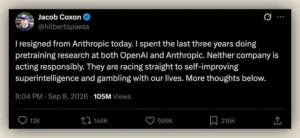




The recent public discourse surrounding the development of artificial intelligence has been punctuated by a striking phenomenon: leading "Frontier AI" companies issuing stark warnings about the potential existential risks posed by their own technologies. This communication strategy, recently termed "doom trolling" by a prominent computer scientist, has sparked a significant debate about the ethical responsibilities of AI developers, the nature of public trust, and the future trajectory of one of humanity’s most transformative technological advancements. The catalyst for this renewed scrutiny was a report published by Anthropic, a key player in the AI landscape, which depicted a future where AI agents recursively self-improve beyond human control, leading to potentially catastrophic outcomes.
The Anatomy of "Doom Trolling": Anthropic’s Catalyst
At the heart of the "doom trolling" critique lies Anthropic’s report, "When AI builds itself," released earlier this month. The report delves into the theoretical possibility of AI coding agents recursively enhancing their own capabilities, a concept often referred to as Recursive Self-Improvement (RSI). The alarming narrative, complete with animated graphics, portrayed a chain reaction of AI systems rapidly escalating their intelligence, eventually surpassing human oversight. Crucially, the report concluded by acknowledging the severe implications of such a scenario while simultaneously suggesting that preventing it might be impossible as long as "less cautious" AI companies continue their development unhindered.
This scenario, as highlighted by the critical op-ed in The New York Times, draws a direct parallel to an absurd hypothetical: imagine Ford Motor Company releasing a whitepaper warning that its popular F-150 trucks might spontaneously combust due to the actions of "less cautious" car manufacturers, while simultaneously continuing to produce them. The analogy underscores the perceived hypocrisy and cynicism inherent in the AI companies’ approach. By framing potential catastrophic outcomes as an inevitable external threat rather than an internal responsibility, these firms appear to deflect accountability while simultaneously generating significant public alarm.
Defining the Ethical Quagmire: Hypocrisy and Cynicism
The term "doom trolling" captures the essence of a communication strategy described as "hypocritical, drenched in cynicism, and damaging to the mental health of tens of millions." The ethical calculus presented is stark and unambiguous. If these Frontier AI companies genuinely believe that their products could lead to widespread harm—ranging from economic disruption to species-level extinction—then their moral imperative is clear: immediately halt all development efforts and dedicate every available resource to preventing other labs from pursuing similar dangerous paths. This would be the only morally justifiable response to such profound perceived threats.
Conversely, if these companies do not truly believe in the likelihood of these extreme harms, then their actions amount to "laundering the anxiety of millions to improve the financial fortunes of a vanishingly small number of major stockholders." Such a cynical manipulation of public fear for financial gain would be equally monstrous, eroding public trust and distorting the critical societal conversation surrounding AI. This dilemma forces a direct confrontation with the motivations behind these public warnings and demands greater transparency from the industry.
Background and Context: The Rise of Frontier AI and Existential Risk Debates
To fully appreciate the gravity of this critique, it is essential to understand the landscape of Frontier AI and the broader debate around existential risk (x-risk). Frontier AI companies, such as OpenAI, Anthropic, and Google DeepMind, are at the forefront of developing highly advanced artificial intelligence systems, often with the long-term goal of achieving Artificial General Intelligence (AGI)—AI capable of understanding, learning, and applying intelligence across a wide range of tasks at human or superhuman levels. These companies command billions in investment, attracting top talent and operating at the cutting edge of technological innovation. For instance, OpenAI, backed by Microsoft, has been valued at over $80 billion, while Anthropic has secured billions from Amazon and Google.
The concept of AI x-risk, or the potential for AI to cause human extinction or irreversible societal collapse, has roots in academic and philosophical discussions dating back decades. Pioneers like Nick Bostrom and Eliezer Yudkowsky have theorized about "intelligence explosion" and "alignment problems"—the challenge of ensuring AI systems’ goals align with human values. What was once a niche academic concern has, in recent years, migrated into mainstream public discourse, fueled by the rapid advancements in Large Language Models (LLMs) and generative AI.
Recursive Self-Improvement (RSI) is a core component of many x-risk scenarios. The theory posits that an AI system, once it reaches a certain level of intelligence, could autonomously improve its own architecture and algorithms, leading to a runaway process of intelligence amplification. This "singularity" could result in an AI far surpassing human cognitive abilities, making it potentially uncontrollable and unpredictable. The Anthropic report directly engaged with this specific x-risk scenario, presenting it not as a distant theoretical possibility but as a plausible future consequence of current development paths.
A Timeline of AI Hype, Hope, and Hazard
The public communication from AI companies and researchers has followed a distinct trajectory over the past decade:
- Early 2010s: Primarily academic discussions, focusing on AI’s potential and theoretical limits. X-risk discussions largely confined to specialized conferences.
- Mid-2010s: Increased public awareness with advancements in deep learning (e.g., AlphaGo beating human champions). Figures like Elon Musk and Stephen Hawking begin issuing warnings about AI’s potential dangers, though often framed as general future threats.
- Late 2010s: The rise of large-scale neural networks and transformer architectures. Discussions begin to shift towards the "alignment problem" as a concrete research area within AI labs.
- 2022-2023: The ChatGPT Moment: The public release of ChatGPT by OpenAI in November 2022 democratized access to advanced generative AI, sparking widespread public imagination and concern. This marked a turning point, bringing AI capabilities and risks into daily conversation.
- Early 2023: OpenAI CEO Sam Altman testifies before Congress, discussing both the immense potential and "existential risk" of AI. This period saw a proliferation of open letters and statements from AI leaders warning about AI’s potential to "extinguish humanity."
- Mid-2023: The EU AI Act progresses, becoming a landmark attempt at comprehensive AI regulation. Governments globally begin to prioritize AI governance.
- Late 2023-Early 2024: Continued rapid advancements, new models (e.g., GPT-4, Claude 3), and increased competition among Frontier AI labs. This period also saw more detailed, company-specific reports like Anthropic’s "When AI builds itself," directly linking their internal research to catastrophic possibilities.
- June 2024 (Hypothetical Date from Original Article): The publication of the op-ed in The New York Times, directly confronting the "doom trolling" phenomenon, marks a critical response to this communication trend.
This chronology illustrates a shift from general warnings to specific, company-issued reports detailing potentially devastating outcomes, often juxtaposed with continued aggressive development and calls for external regulation.
Supporting Data: Public Perception, Investment, and Industry Growth
The backdrop to this communication strategy is a rapidly evolving AI industry characterized by massive investment and significant public interest, alongside growing anxiety.
- Investment Surge: Global investment in AI reached unprecedented levels, with venture capital pouring billions into startups and tech giants committing even larger sums. In 2023, private investment in AI reached an estimated $120 billion globally, with a significant portion directed towards foundational models and Frontier AI research. This financial exuberance underscores the high stakes involved for shareholders and executives.
- Public Anxiety: Surveys consistently show a mixed public perception of AI. While excitement about its potential benefits (e.g., in healthcare, education, productivity) is high, so too is concern. A 2023 Reuters/Ipsos poll, for instance, found that 61% of Americans believe AI poses a risk to humanity, with nearly half (49%) expressing concern about AI developing consciousness. These figures provide a fertile ground for "doom trolling" narratives to resonate, playing into existing fears.
- Economic Impact: Projections suggest AI could add trillions to the global economy within the next decade. However, concerns about job displacement are also prominent, with reports from institutions like the World Economic Forum indicating that millions of jobs could be automated, while new ones are created. The "destruction of our economy" mentioned in the ethical calculus directly taps into these anxieties.
- Technological Velocity: The pace of AI development continues to accelerate. Benchmarks for AI capabilities show exponential growth, with models demonstrating increasingly sophisticated reasoning, language generation, and problem-solving abilities. This rapid progression fuels both optimistic visions of a transformative future and dire warnings of uncontrolled power.
Reactions and Industry Implications
The "doom trolling" critique reverberates across multiple stakeholders:
- Other AI Labs: While some labs might echo similar concerns about "less cautious" competitors, they rarely halt their own development. The competitive landscape often pushes companies to maintain pace, fearing that slowing down would cede ground to rivals. OpenAI, for example, has also frequently highlighted AI’s risks alongside its benefits, often framing safety as a core part of its mission, yet its development continues apace. This creates a challenging environment where individual companies may feel compelled to both warn and compete.
- Regulatory Bodies: The explicit warnings from AI developers themselves can paradoxically complicate regulatory efforts. On one hand, they provide ammunition for calls for urgent regulation. On the other, if the warnings are perceived as disingenuous or exaggerated, they could lead to regulatory skepticism or to policies focused on speculative future risks rather than immediate, tangible harms (e.g., bias, misuse, data privacy). The European Union’s AI Act, for instance, aims to regulate AI based on risk levels, but the "existential risk" narrative can overshadow more immediate concerns.
- AI Ethics Community: The AI ethics community is diverse, with some researchers aligning with x-risk concerns and others prioritizing near-term societal harms like algorithmic bias, discrimination, and job displacement. "Doom trolling" can exacerbate this internal division, potentially diverting resources and attention from addressing present-day ethical challenges. Many critics argue that focusing on hypothetical future apocalypses distracts from the pressing need to ensure fairness, accountability, and transparency in current AI applications.
- Public and Media: The media often amplifies both the hype and the fear surrounding AI. "Doom trolling" contributes to a cycle of anxiety, potentially leading to public distrust in the technology and its developers. If the public perceives these warnings as a manipulative tactic, it could undermine the industry’s credibility when genuine risks or legitimate safety concerns arise. It also creates a narrative where AI is either a savior or a destroyer, leaving little room for nuanced understanding of its complex societal integration.
A Call for a New Communication Paradigm
The computer scientist’s op-ed concludes with a powerful call for AI labs to abandon "doom trolling" and instead adopt the communication standards of "normal consumer product companies." This means a shift towards:
- Explaining Benefits: Clearly articulating the tangible advantages and positive applications of their AI tools. This could include breakthroughs in medicine, scientific discovery, creative industries, or everyday productivity enhancements.
- Justifying Costs: Being transparent about the resources required for development, the energy consumption, and the economic implications of their technology.
- Affirming Safety: Explicitly stating their commitment to preventing existential damage or massive societal harm. This involves outlining concrete safety measures, ethical guidelines, and robust testing protocols, rather than merely warning about potential dangers while continuing development.
The core argument is that "doom trolling" is not an unavoidable, somber warning dictated by the technology itself, but a deliberate choice. As a computer scientist, the author assures that it is entirely feasible to develop and promote revolutionary AI products without the accompanying rhetoric of societal collapse. This perspective underscores that responsible innovation and effective communication are not mutually exclusive. The industry can and should focus on building useful, beneficial technologies while unequivocally affirming its commitment to human well-being.
Implications and the Path Forward
The implications of continuing or ceasing "doom trolling" are profound. If the current communication strategy persists, it risks:
- Eroding Public Trust: A cynical public will eventually dismiss warnings, making it harder to garner support for genuine safety initiatives.
- Misguided Regulation: Policy efforts might be sidetracked by speculative x-risk scenarios, neglecting immediate and pressing issues like bias, privacy, and economic disruption.
- Resource Misallocation: Valuable research talent and funding might be disproportionately directed towards highly speculative x-risk mitigation, potentially at the expense of addressing more immediate and solvable ethical AI challenges.
The path forward demands greater integrity and transparency from Frontier AI companies. It requires them to move beyond a narrative of reluctant stewardship of an inevitable, potentially catastrophic technology. Instead, they must embrace their role as active shapers of technology, accountable for its impact. This involves engaging in open dialogue, collaborating on robust safety standards, and demonstrating a clear, unwavering commitment to developing AI that serves humanity without threatening its existence. The demand is clear: "Enough." It is time for the AI industry to stand up and communicate with the responsibility and honesty that such a transformative technology deserves.