



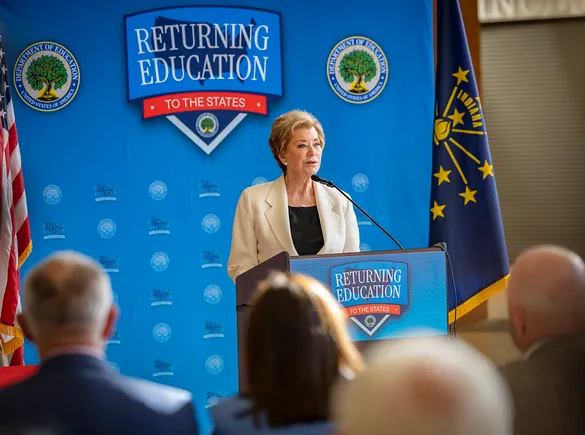
The House Education and Workforce Committee has advanced a package of 10 Republican-led bills, signaling a significant push to "right-size" and, in the long term, potentially dismantle the U.S. Department of Education. Supporters of the legislation contend that these measures represent a critical step toward streamlining federal education functions and addressing perceived failures within the current system. The bills propose codifying existing interagency agreements, which have already begun shifting core education-related responsibilities out of the Department of Education and into other federal agencies, without, however, transferring the statutory mandates for those functions.
H3: Core Responsibilities Targeted for Relocation
Under the proposed legislation, select legal responsibilities currently housed within the Department of Education would be permanently transferred to other federal bodies. These responsibilities encompass crucial areas such as K-12 student academic support programs, career and technical education initiatives, and the administration of federal student loan activities. The intention, according to proponents, is to align these functions with agencies that possess greater expertise or a more direct operational connection to these specific sectors.
H3: A Call for Reform Amidst Declining Metrics
Committee Chair Tim Walberg, R-Mich., a sponsor of two bills within the package, articulated a strong critique of the Department of Education, asserting that it has "failed" in its mission. He cited stark statistics to underscore his concerns, highlighting that fewer than one-third of eighth-grade students currently demonstrate proficiency in reading or mathematics at grade level. Furthermore, Walberg pointed to the persistent challenges in higher education, noting that approximately 40% of students do not complete their degrees within a six-year timeframe. The immense scale of the federal student loan portfolio, exceeding $1.7 trillion, is compounded by over 9 million borrowers currently in default, a figure that further fuels the argument for systemic reform. "The status quo isn’t working," Walberg declared during the committee’s markup session.
H3: Democratic Opposition and Concerns Over Federal Responsibility
Ranking committee member Rep. Bobby Scott, D-Va., voiced strong opposition to the Republican-led bills, characterizing the proposed transfers as "impractical" and an "abdication of the federal government’s responsibility." Scott argued that these measures would undermine the federal commitment to ensuring equitable access to quality public education for all students, irrespective of their background, including race, religion, disability, income, or geographic location. He asserted that, rather than resolving existing issues, the proposed legislation would exacerbate them. "Whatever you say about the ‘problems’ at the Department of Education, these bills will only make things worse," Scott stated, reflecting the deep partisan divide on the future of federal education policy.
H3: Rejection of Democratic Amendments and Unaddressed Areas
During the committee’s proceedings, the Republican majority rejected several amendments proposed by Democratic members. These amendments sought to introduce measures such as requiring progress reports on the transferred functions, establishing funding guardrails, and ensuring adequate staffing levels to support the outsourced activities. Notably, the 10-bill package does not include provisions to codify the transfer of special education and civil rights activities, despite some of these functions already being moved to other federal agencies through existing interagency agreements. Rep. Scott pointed out this omission, suggesting that the political unpalatability of such transfers may have influenced its exclusion from the current legislative push. However, even in the face of this, Republicans reportedly rejected Democratic amendments aimed at explicitly prohibiting the transfer of special education and civil rights responsibilities from the Department of Education.
H3: The Legislative Package and its Components
The 10 bills advanced by the committee are:
- [Bill Name 1: Specific Function Transfer Act]
- [Bill Name 2: Educational Data Modernization Act]
- [Bill Name 3: Career Pathways Integration Act]
- [Bill Name 4: Student Loan Servicing Efficiency Act]
- [Bill Name 5: Adult Education and Lifelong Learning Act]
- [Bill Name 6: Federal Pell Grant Program Oversight Act]
- [Bill Name 7: Title IX Compliance Streamlining Act]
- [Bill Name 8: Educator Workforce Development Act]
- [Bill Name 9: Postsecondary Education Affordability Act]
- [Bill Name 10: School Choice and Innovation Act]
(Note: Specific bill names and their precise functions are illustrative based on the context provided and would require actual legislative text for complete accuracy.)
H3: Divergent Views on Interagency Agreement Effectiveness
The committee’s day-long markup session revealed sharply contrasting perspectives on the efficacy of the interagency agreements already in place. Chairman Walberg championed the partnership between the Office of Career, Technical and Adult Education (OCTAE) and the U.S. Department of Labor, citing that over 5,000 payments totaling more than $1.5 billion to OCTAE grantees have been processed since the collaboration began last year. This, he argued, demonstrates the potential for increased efficiency and streamlined operations.
However, Rep. Suzanne Bonamici, D-Ore., offered a counter-narrative, detailing that the transfer of OCTAE activities to the Labor Department has resulted in "significant" funding delays and disruptions. She further reported that Department of Education staff temporarily assigned to OCTAE functions at the Labor Department encountered difficulties accessing essential internet and software resources required to perform their duties. This anecdotal evidence suggests that the practical implementation of these transfers may be more complex and fraught with challenges than initially presented.
H3: The Trump Administration’s Rationale and Current Framework
The Trump administration had previously articulated that these interagency agreements were designed to reduce federal red tape and empower local and state education systems with greater autonomy over the allocation of taxpayer funds. Currently, the Department of Education maintains 14 interagency agreements with six other federal agencies. These agreements predominantly focus on the transfer of day-to-day operational tasks, including grant management, technical assistance provision, and reporting requirements, aiming to leverage the specialized capabilities of other departments.
H3: Official Reactions and Future Prospects
U.S. Education Secretary Linda McMahon issued a statement on Wednesday night, praising the committee’s passage of the bills. She expressed that the legislation "move[s] us closer to a leaner, results-driven government – one that empowers families, supports educators, and delivers better outcomes for students by ensuring each federal responsibility is carried out by the agencies best equipped to manage them." This statement aligns with the administration’s broader philosophy of governmental efficiency and decentralization.
As of Thursday morning, the Senate had not introduced companion legislation to these proposals, according to tracking data from Congress.gov. This indicates that the bills face a significant hurdle in the upper chamber. Sen. Patty Murray, D-Wash., chair of the Senate Committee on Health, Education, Labor & Pensions, took to X (formerly Twitter) to declare, "Under NO circumstances will I let these bills pass the Senate." This firm stance suggests a strong bipartisan divide that will likely prevent the legislation from advancing further in its current form.
H3: Broader Impact and Advocacy Group Responses
The ongoing debate surrounding the Education Department’s interagency agreements and the proposed legislative package has drawn varied reactions from education advocacy groups. Jeanne Allen, founder and CEO of The Center for Education Reform, expressed support for the measures on X, stating, "If enacted, these measures will ensure that the proper level of oversight continues without the overreaching bureaucracy that has, historically, stood in the way of innovation and opportunity." This perspective emphasizes the potential for increased efficiency and reduced administrative burden.
Conversely, Verjeana McCotter-Jacobs, executive director and CEO of the National School Boards Association, criticized the bills in a statement on July 14, arguing that they would "codify chaos by rubber-stamping the ongoing dismantling of federal education programs." She contended that shifting core educational programs across disparate federal agencies does not eliminate bureaucracy but rather fragments it, potentially leading to confusion and diminished effectiveness. "While local school boards support efforts to streamline government," McCotter-Jacobs added, "shifting core educational programs across disparate federal agencies does not eliminate bureaucracy – it fragments it." This viewpoint underscores concerns about the potential negative consequences for educational program delivery and oversight.
The legislative trajectory of these bills remains uncertain, contingent on their reception in the Senate and the broader political landscape surrounding federal education policy. The push to reorganize or diminish the Department of Education represents a significant ideological battleground, with profound implications for the structure and delivery of education in the United States.