


The Greek language, with a recorded history spanning over 3,400 years, remains one of the most linguistically rich and emotionally expressive mediums of communication in the Western world. Beyond its foundational role in science, philosophy, and mathematics, Modern Greek possesses a sophisticated system of endearment that serves as a cornerstone for social cohesion, familial bonding, and romantic expression. Central to this system is the phrase Σ’ αγαπώ (S’agapo), meaning "I love you," which often acts as a prefix to a vast lexicon of affectionate nouns and diminutives. For linguists and cultural historians, these terms are not merely "cute" additions to speech; they represent a deep-seated cultural value known as filotimo—a complex concept involving honor, hospitality, and the love of one’s community.
The Historical Evolution of Hellenic Affection
To understand modern Greek endearment, one must look back at the classical foundations of the language. Ancient Greek philosophers identified eight distinct types of love, a categorization that continues to influence how Greeks express affection today. These include Eros (romantic or sexual passion), Philia (deep friendship), Storge (familial love), Agape (unconditional or selfless love), Ludus (playful or flirtatious love), Pragma (long-standing, committed love), Philautia (self-love), and Mania (obsessive love).
In the transition from Koine Greek to the Modern Greek vernacular (Demotic), these abstract concepts were distilled into daily speech through the use of the possessive pronoun μου (mou), meaning "my." In Greek syntax, the placement of this pronoun is strictly post-nominal. For instance, while English speakers say "my love," a Greek speaker says αγάπη μου (agapi mou)—literally "love mine." This linguistic structure emphasizes the object of affection before the possession, a nuance that scholars suggest highlights the importance of the person being addressed.
A Categorical Breakdown of Modern Endearments
The application of endearment in Greece is highly situational, dictated by the level of intimacy and the nature of the relationship. Modern usage can be broadly divided into three primary categories: romantic, familial, and social.
Terms for Romantic Partners
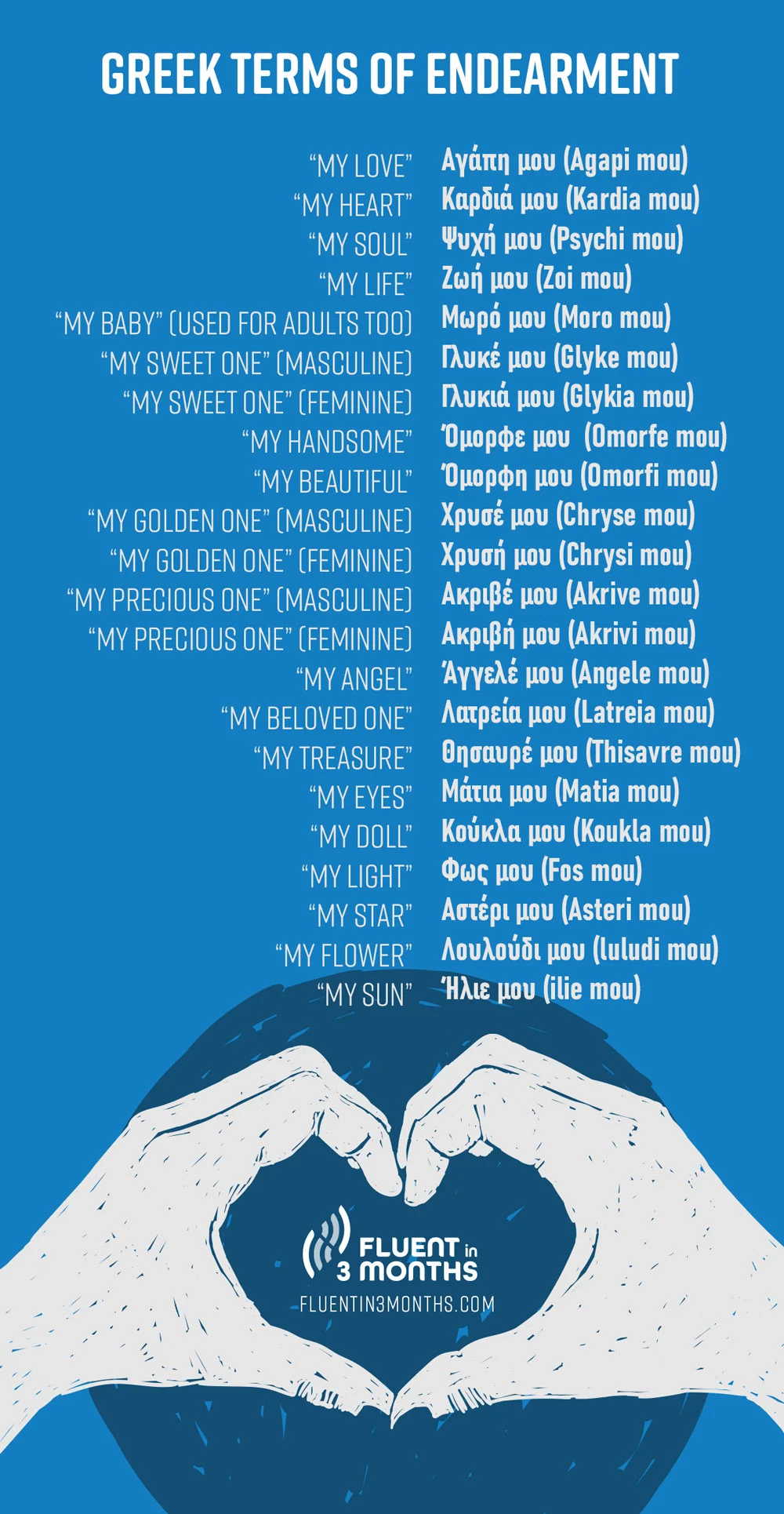
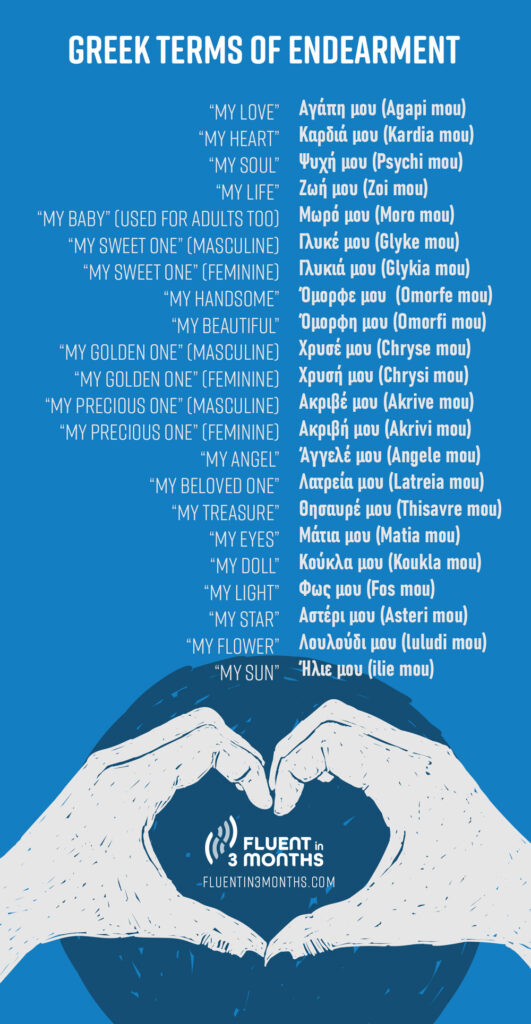
In romantic contexts, Greek speakers often employ metaphors involving vital organs or celestial bodies to signify the importance of their partner.
- Αγάπη μου (Agapi mou): Translated as "my love," this is the most versatile and common term. It is used by couples of all ages and signifies a deep, stable bond.
- Καρδιά μου (Kardia mou): Meaning "my heart," this term implies that the partner is essential for the speaker’s survival.
- Ζωή μου (Zoi mou): Meaning "my life," this is considered a high-intensity term of endearment.
- Ψυχή μου (Psychi mou): Meaning "my soul," often used to denote a spiritual or metaphysical connection.
- Μωρό μου (Moro mou): Meaning "my baby," this is used similarly to the English "babe" or "baby" and is common among younger generations.
For specific gendered address, Greeks use terms like αγόρι μου (agori mou – my boy) for boyfriends and κορίτσι μου (koritsi mou – my girl) for girlfriends.
Familial and Diminutive Expressions
The Greek family unit is traditionally tight-knit, and the language reflects this through "diminutives"—suffixes added to words to make them sound smaller, cuter, or more affectionate.
- Mother: Μητέρα (Mitera) becomes Μανούλα (Manoula).
- Father: Πατέρας (Pateras) becomes Μπαμπάκας (Babakas) or Πατερούλης (Pateroulis).
- Grandmother: Γιαγιά (Yiayia) becomes Γιαγιάκα (Yiayiaka).
- Grandfather: Παππούς (Pappous) becomes Παππούλης (Pappoulis).
These diminutives extend to children as well. A common term is παιδί μου (paidi mou), meaning "my child," which is often used not just by parents, but by elders speaking to any younger person as a sign of warmth and protection.
Social and Friendly Endearments
Unlike some Northern European cultures where endearments are reserved for the private sphere, Greeks frequently use affectionate terms with friends and even acquaintances.
- Κούκλα μου (Koukla mou): Meaning "my doll," frequently used between female friends.
- Φίλε μου / Φίλη μου (File mou / Fili mou): Meaning "my friend" (masculine/feminine).
- Μάτια μου (Matia mou): Meaning "my eyes." To call someone your "eyes" suggests they are the way you see the world, or that they are as precious as your sight.
The Mechanics of the Diminutive: Suffixes and Syntax
A unique feature of the Greek language is the ability to transform almost any proper noun or common noun into an endearing nickname using specific suffixes. This process is known as the diminutive form. According to linguistic data, the most common suffixes used in modern Greece include:
- -aki (-άκι): A neutral suffix used for both genders and objects (e.g., Γιώργος becomes Γιωργάκι).
- -oula (-ούλα): Typically used for female names (e.g., Άννα becomes Αννούλα).
- -oulis (-ούλης): Typically used for male names or adjectives (e.g., μικρός becomes μικρούλης).
- -itsa (-ίτσα): A feminine diminutive often used for names like Ελένη (Elenitsa).
The use of these suffixes is governed by the "Vocative Case," a grammatical case used specifically for addressing someone. In Greek, when you call someone’s name, the ending of the name often changes (e.g., "Georgos" becomes "George"). When an endearment is added, it must also conform to these grammatical rules.
Phonetic Considerations and Pronunciation
For non-native speakers, the effectiveness of these terms relies heavily on correct pronunciation. The Greek alphabet contains several sounds that do not have direct equivalents in English, which can alter the perceived warmth of the endearment if mispronounced.
- The Gamma (γ): In words like agapi, the ‘g’ is a soft, breathy sound, almost like a ‘y’ but further back in the throat.
- The Delta (δ): In words like kardia, the ‘d’ is pronounced like the ‘th’ in "this," not a hard ‘d’.
- The Chi (χ): In words like psychi, the ‘ch’ is a raspy sound similar to the ‘ch’ in the Scottish "loch."
Linguistic experts suggest that the melodic nature of Greek—characterized by its vowel-heavy structure—is what allows these endearments to sound inherently "musical" and "warm" to the listener.
Sociological Analysis: Why Endearment Matters in Greek Culture
The frequent use of endearment in Greece is more than a linguistic quirk; it is a sociological tool. In a study on Mediterranean communication styles, researchers found that "high-context" cultures, such as Greece, rely heavily on verbal cues of belonging and affection to maintain social harmony.
The inclusion of the word μου (my) is particularly significant. It creates a verbal "embrace." By calling a friend file mou (my friend), the speaker is claiming a level of responsibility and kinship with the listener. This reflects the historical importance of the parea—a group of friends who meet regularly to share life experiences. In the parea, everyone is "someone’s" (my friend, my soul, my eyes), reinforcing a sense of security and mutual support.
Furthermore, the use of endearments in professional or semi-formal settings—such as a shopkeeper calling a customer agapi mou—is a method of breaking down barriers and establishing a hospitable environment. This is a direct extension of Xenia, the ancient Greek concept of ritualized hospitality.
Implications for Language Learners and Expatriates
For the growing number of expatriates and digital nomads moving to Greece and Cyprus, mastering these terms is essential for integration. Data from language learning platforms indicates that students who utilize social endearments are perceived as more "fluent" and "personable" by native speakers, even if their technical grammar remains imperfect.
However, there is a boundary of "social intelligence" required. Using high-intensity terms like zoi mou (my life) with a stranger would be seen as eccentric or overly dramatic. Journalistic observation of Greek social norms suggests that a "ladder of intimacy" exists:
- Level 1 (Strangers/Acquaintances): Use of file mou or paidi mou.
- Level 2 (Friends): Use of koukla mou, omorfe (handsome), or diminutives of names.
- Level 3 (Intimate/Family): Use of agapi mou, kardia mou, and moro mou.
Conclusion: The Enduring Power of the Greek Word
The Greek system of endearment is a testament to the language’s ability to evolve while remaining rooted in its philosophical origins. From the "Eight Loves" of the ancients to the playful diminutives of the modern Athenian street, these words serve as the connective tissue of Hellenic society. They provide a framework for expressing the complexities of human emotion, ensuring that whether one is speaking to a partner, a child, or a lifelong friend, the message of "belonging" is clearly heard. As Greece continues to navigate the modern world, its language remains a steadfast guardian of the warmth and humanity that has defined the Mediterranean for millennia. For those looking to truly understand the Greek spirit, the journey begins not with a verb or a noun, but with the simple, heartfelt addition of the word "mou."