



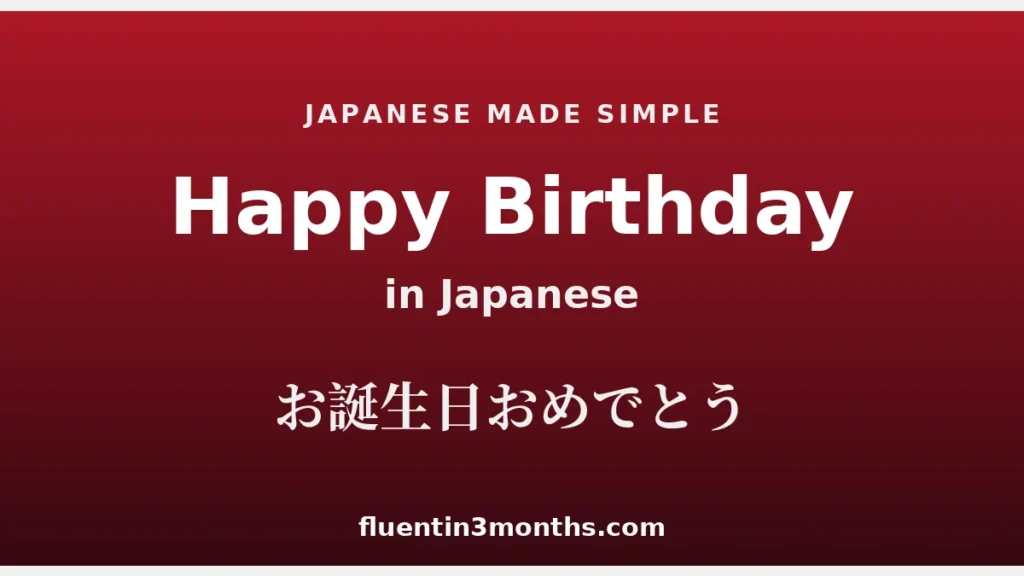
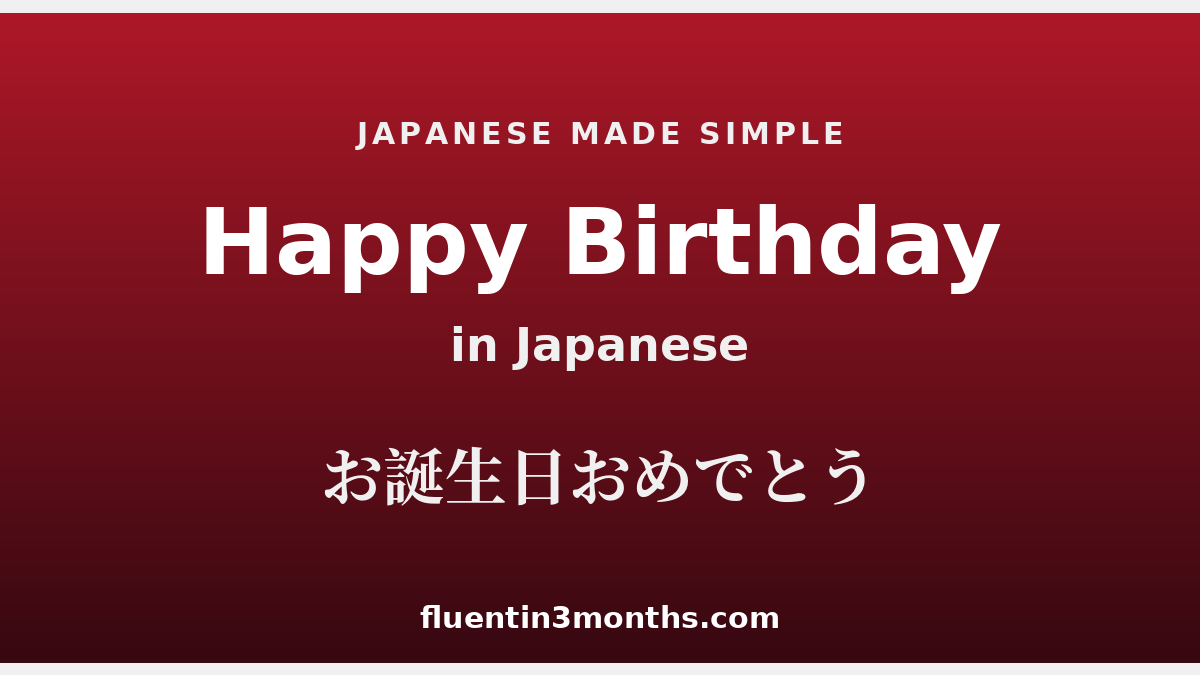
The phrase Otanjoubi omedetou gozaimasu serves as the standard formal greeting for celebrating an individual’s birth in Japan, a nation where linguistic precision and social hierarchy dictate the nuances of interpersonal communication. While the phrase translates directly to "Happy Birthday," its application varies significantly based on the relationship between the speaker and the recipient. In the Japanese linguistic framework, the addition of honorifics and polite verb endings is not merely a stylistic choice but a social requirement. The prefix "o" (お) functions as an honorific to elevate the status of the birthday (tanjoubi), while "gozaimasu" (ございます) provides the formal weight necessary for interactions with superiors, elders, or professional colleagues. Conversely, in casual settings among peers or family, the phrase is often shortened to "Otanjoubi omedetou" or simply "Omedetou" (congratulations).
Linguistic Anatomy of the Japanese Birthday Greeting
To understand the mechanics of the greeting, one must dissect its constituent parts. The term "Tanjoubi" (誕生日) is composed of three kanji characters: "tan" (誕生), meaning birth or creation, and "bi" (日), meaning day. When preceded by the honorific "o," it signifies respect for the occasion. The word "Omedetou" is the adverbial form of the adjective "omedetai," which translates to auspicious, joyous, or deserving of celebration.
In modern Japanese society, the use of English loanwords has become increasingly prevalent. The phrase "Happii Baasudee" (ハッピーバースデー), written in the katakana script reserved for foreign terms, is frequently used in informal settings and is the standard lyric used when singing the globally recognized birthday melody. However, linguists note that while the loanword is popular in pop culture and advertising, it has not supplanted the native "Otanjoubi omedetou" in formal or traditional contexts.
The Historical Evolution of Age Calculation in Japan
The contemporary practice of celebrating individual birthdays in Japan is a relatively modern phenomenon, resulting from significant legal and cultural shifts during the 20th century. Historically, Japan utilized the "kazoedoshi" (数え年) system, or "counted years," a method shared with many East Asian cultures influenced by Chinese tradition. Under this system, a child was considered one year old at the moment of birth, accounting for the time spent in the womb. Furthermore, everyone in the country aged simultaneously on New Year’s Day (Gantan), rather than on the anniversary of their specific birth date.
The transition to the Western-style "man’nenrei" (満年齢) system, where a person turns a year older on their actual birthday, began officially in 1902 with the "Act on Calculation of Age." However, the "kazoedoshi" system remained deeply embedded in the national consciousness for decades. It was not until the "Law Concerning Enumeration of Age" was enacted on January 1, 1950, that the government actively mandated the use of the Western system for all official and private transactions. This law was passed partly to modernize administrative record-keeping and partly to synchronize Japanese social practices with international standards during the post-war occupation period.
Significant Life Milestones and Traditional Rites of Passage
Despite the Westernization of birthday celebrations, Japan maintains several traditional milestones that carry deep cultural and spiritual significance. These celebrations often involve specific rituals and symbolic garments.
- Shichi-Go-San (7-5-3): Held annually in November, this festival celebrates the health and growth of children aged three, five, and seven. Boys aged three and five and girls aged three and seven visit Shinto shrines dressed in traditional kimono or hakama. This tradition dates back to the Heian Period (794–1185) when child mortality rates were high, and reaching these ages was considered a divine blessing.
- Seijin no Hi (Coming of Age Day): Held on the second Monday of January, this national holiday honors those who have reached the age of 20 (the age of adulthood in Japan until it was lowered to 18 in 2022). Local municipalities host ceremonies, and participants often wear elaborate traditional attire, such as furisode for women.
- Kanreki (60th Birthday): Perhaps the most significant adult milestone, the Kanreki marks the completion of five cycles of the 12-animal Chinese zodiac, returning the individual to their birth year’s zodiac sign. Symbolizing "rebirth," the celebrant traditionally wears a red hood and vest (chanchanko). Red is associated with infants and protection against evil in Japanese folklore.
- Koki (70th Birthday) and Beiju (88th Birthday): These milestones celebrate longevity. The 70th birthday, Koki, is derived from a Chinese poem suggesting that living to 70 has been rare throughout history. The 88th birthday, Beiju (Rice Age), is celebrated because the kanji for "88" resembles the character for "rice" (米), a staple of life and prosperity.
Modern Celebration Trends and Economic Impact
The commercialization of birthdays in Japan mirrors Western trends but retains unique domestic characteristics. The "Christmas cake" style—a light sponge cake with whipped cream and fresh strawberries—is the quintessential birthday dessert in Japan. According to data from the Japan Cake and Confectionery Association, the demand for high-end, aesthetically pleasing cakes spikes during the "Golden Week" holidays and individual birthday months, contributing significantly to the multi-billion yen domestic confectionery industry.
In the retail sector, the gift-giving culture, or "O-iwai," is highly formalized. While cash (goshuugi) is common for weddings and funerals, birthdays usually involve tangible gifts. Recent consumer surveys indicate a shift toward "experience-based" gifts, such as luxury hotel stays or high-end dining, particularly among the urban millennial and Gen Z demographics. The rise of social media platforms like Instagram and LINE has also transformed how birthdays are acknowledged; digital stickers and "gift coupons" sent via messaging apps have become a standard method for peers to exchange greetings.
Phonetic Nuances and Script Complexity
For non-native speakers, the pronunciation of "Otanjoubi omedetou" requires attention to Japanese phonology, specifically the concept of "mora" or rhythmic timing. Japanese is a mora-timed language, meaning each syllable is given roughly equal duration. A common error for English speakers is the mispronunciation of long vowels, such as the "o" in "tanjoubi" and "omedetou." In the Hepburn romanization system, these are often marked with a macron (ō), indicating that the vowel sound should be held for two beats rather than one.
The written representation of birthday greetings also illustrates the complexity of the Japanese writing system, which utilizes three distinct scripts:
- Kanji: Used for the core noun "Tanjoubi" (誕生日), conveying the semantic meaning of "birth day."
- Hiragana: Used for the honorific "o" (お) and the greeting "omedetou" (おめでとう), as well as the formal suffix "gozaimasu" (ございます).
- Katakana: Used for the loanword "Happii Baasudee" (ハッピーバースデー).
This tri-script system allows for subtle shifts in tone. A message written entirely in hiragana may appear childish or overly soft, while the inclusion of appropriate kanji demonstrates literacy and maturity.
Societal Implications and the Aging Population
The way Japan celebrates birthdays is increasingly influenced by the nation’s demographic crisis. With one of the highest life expectancies in the world and a shrinking birth rate, the focus of birthday celebrations is shifting toward the "silver market." Government data from the Ministry of Health, Labour and Welfare shows that the number of centenarians in Japan has surpassed 90,000. This has led to an increased societal emphasis on "Longevity Celebrations" (Chouju Iwai).
Public policy also plays a role in these celebrations. In many municipalities, citizens reaching the age of 100 receive a silver cup and a letter of congratulations from the Prime Minister. However, due to the sheer volume of recipients, the government recently transitioned from solid silver to silver-plated cups to manage costs, a move that highlights the economic pressures of an aging society.
Conclusion: A Synthesis of Tradition and Modernity
Japanese birthday customs represent a sophisticated synthesis of ancient East Asian philosophy, 20th-century legislative modernization, and contemporary global influence. While the phrase "Otanjoubi omedetou gozaimasu" remains the linguistic anchor for these celebrations, the rituals surrounding it continue to evolve. From the traditional red vests of the Kanreki to the strawberry sponge cakes of the modern era, birthdays in Japan serve as a vital marker of time, reflecting both the resilience of cultural heritage and the adaptability of a society in transition. Understanding these nuances is essential for navigating Japanese social life, as it demonstrates a respect for the intricate balance of hierarchy, history, and personal milestone.