


The integration of autonomous delivery vehicles into the dense urban fabric of Chicago has hit a significant setback following two high-profile collisions with public infrastructure in less than 48 hours. In late March 2026, two separate delivery robots, operated by competing firms, malfunctioned and veered into Chicago Transit Authority (CTA) bus shelters, resulting in shattered glass and renewed calls for stricter regulation or outright bans on the technology. These incidents, occurring in the West Town and Old Town neighborhoods, have intensified a long-standing debate regarding the safety of sidewalk-based automation and the reliability of the sophisticated mapping systems intended to guide these machines.
A Chronology of the Collisions
The first incident occurred on the afternoon of Monday, March 23, 2026, in Chicago’s West Town neighborhood. A sidewalk delivery robot owned and operated by Serve Robotics was captured on bystander video traveling along a routine path before abruptly deviating from its trajectory. The robot, characterized by its signature "googly eyes" and compact frame, failed to detect the transparent glass panel of a CTA bus shelter. It struck the structure with enough momentum to completely shatter the reinforced glass, sending shards across the sidewalk and into the seating area of the shelter.
Witnesses described a surreal scene in which the robot, seemingly dazed by the impact, paused briefly while its digital eyes blinked before attempting to reverse. Footage shows the unit backing out of the wreckage and continuing down the street, shedding fragments of glass from its chassis as it resumed its delivery route. The lack of an immediate "stop" command or human intervention at the moment of impact raised immediate concerns among local pedestrians regarding the efficacy of remote monitoring.
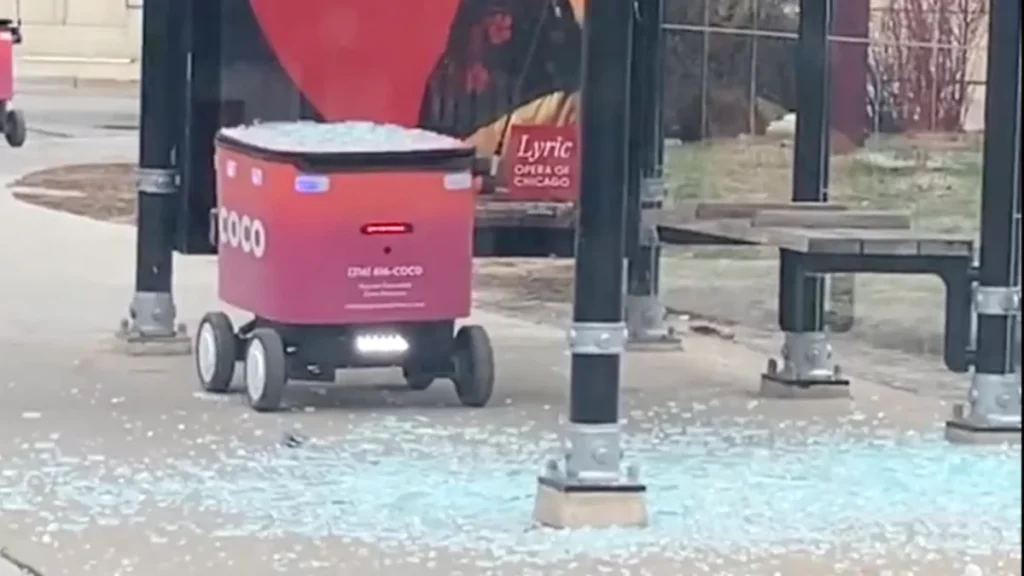
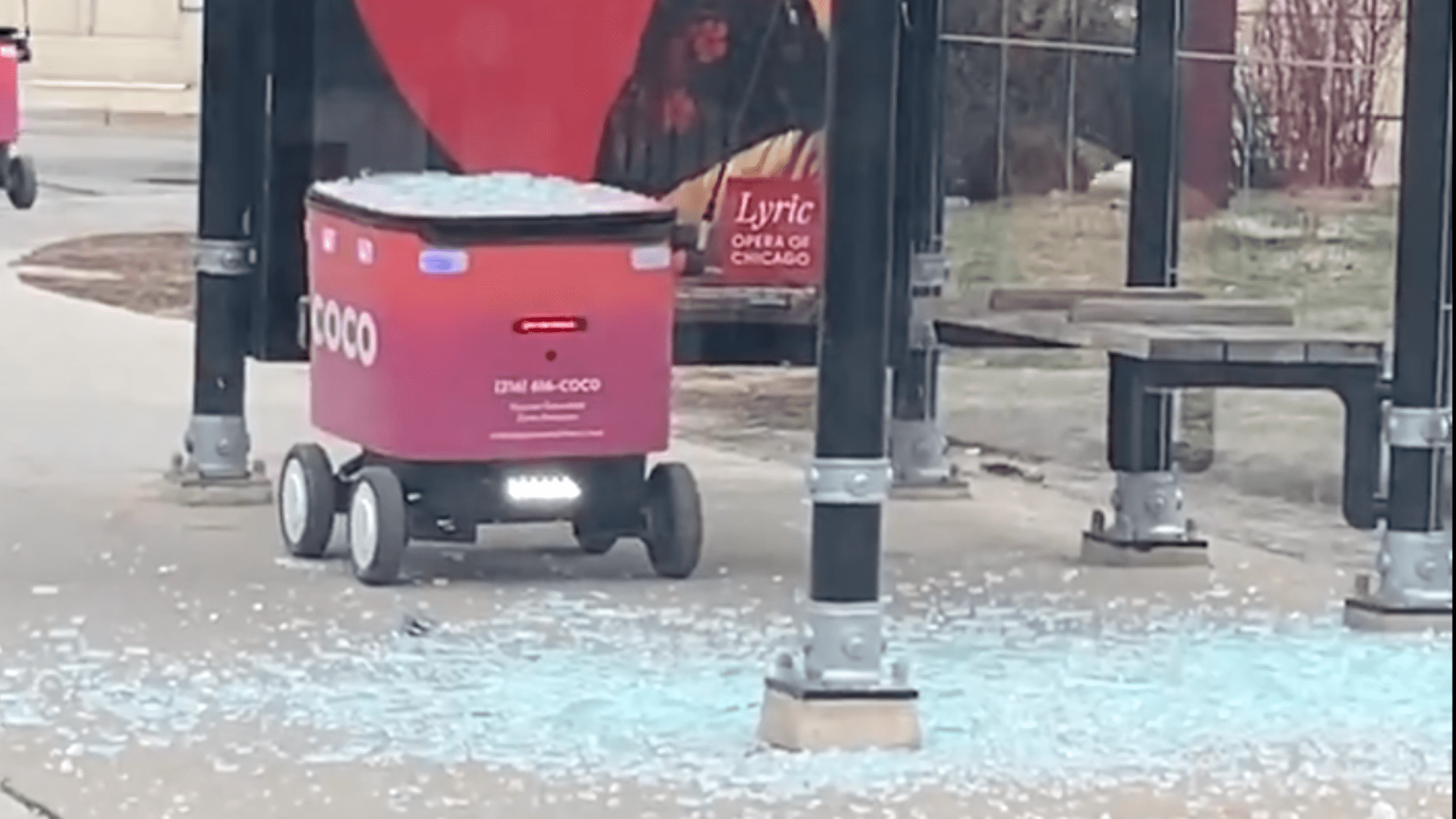
The second collision followed less than 24 hours later on Tuesday, March 24, in the Old Town neighborhood. This incident involved a robot operated by Coco Robotics. Similar to the Serve Robotics crash, the Coco unit reportedly swerved into a bus shelter while navigating toward a delivery destination. The impact resulted in another destroyed glass panel. By the time local news affiliates arrived at the scene, the robot had been retrieved by a rapid-response team, but the debris remained a hazard for commuters.
A local business owner, who operates a barbershop adjacent to the crash site, reported hearing a "concussive" sound before discovering the damaged shelter. Notably, the witness observed a second Coco robot stationed nearby shortly after the crash, which appeared to be equipped with a red flag—a detail that sparked speculation regarding whether the second unit was acting as a marker or was also experiencing a navigational error.
Technical Analysis: The Transition to Visual Positioning Systems
The timing of these accidents is particularly scrutinized due to a recent technological shift in how these robots navigate. Just weeks prior to the crashes, Coco Robotics announced the implementation of a new Visual Positioning System (VPS) provided by Niantic Spatial. Unlike traditional Global Positioning Systems (GPS), which rely on satellite signals that can be obstructed by tall buildings—a phenomenon known as "urban canyons"—the VPS utilizes a database of millions of images to help the robot "see" and recognize its surroundings.
The data powering this new system was largely crowdsourced from users of Niantic’s augmented reality games, most notably "Pokémon Go." By using the 3D maps generated by millions of players’ smartphone cameras, the robots were expected to achieve centimeter-level localization accuracy. However, the recent accidents have led critics and tech analysts to question whether the system is properly calibrated to recognize transparent obstacles like glass bus shelters.
In a statement following the incidents, a spokesperson for Coco Robotics clarified that the company is still in the process of integrating the VPS and maintained that the root cause of the Old Town crash was not related to geolocation errors. Nevertheless, the inability of two different robotic platforms to navigate around a standard piece of city furniture suggests a systemic challenge in how autonomous sensors interpret urban infrastructure.
Public Safety and the Regulatory Response
The collisions have galvanized a growing movement of Chicago residents and lawmakers who view the robots as a nuisance and a safety hazard. Chicago has historically been a testing ground for various "last-mile" delivery solutions, but the friction between pedestrians and machines has reached a boiling point.
Alderman Daniel La Spata, representing the 1st Ward, has been a vocal critic of the program. Prior to these accidents, La Spata had already moved to temporarily ban both Serve and Coco from operating within his ward’s boundaries, citing concerns over sidewalk accessibility and the safety of elderly and disabled residents. "Our sidewalks are a public utility for people, not a laboratory for unproven tech," La Spata remarked in a recent community meeting.
The city’s infrastructure department has also seen a surge in complaints. Chicago recently added a specific category to its 311 non-emergency reporting system dedicated to "Personal Delivery Devices" (PDDs). This allow residents to lodge formal complaints about robots blocking wheelchair ramps, colliding with pets, or, as seen this week, damaging public property. A citywide petition to ban the robots has already garnered more than 3,600 signatures, reflecting a significant portion of the electorate that remains unconvinced of the technology’s benefits.

Corporate Accountability and Remediation
In the wake of the crashes, both Serve Robotics and Coco Robotics have moved to manage the fallout. Serve Robotics confirmed that they dispatched a support crew to West Town to clear the shattered glass and are currently conducting a comprehensive review of the robot’s sensor logs to determine why the collision avoidance system failed to trigger.
Coco Robotics Vice President and Head of Government Relations, Carl Hansen, emphasized that the incident was an anomaly in the company’s history. "Across more than one million miles of deliveries, this is the first time one of our robots has collided with a structure like this," Hansen stated. He reiterated that the robots are designed to operate at a maximum speed of 5 miles per hour and that safety remains the company’s primary design pillar. Coco has pledged to cover the full cost of the repairs for the damaged CTA shelter and has launched an internal investigation to ensure such an error is not repeated.
Despite these assurances, the financial and logistical burden of these "edge case" failures often falls on the municipality until the companies can be held liable. The CTA, already facing budgetary constraints, must now coordinate the replacement of expensive glass panels, which are essential for protecting commuters from Chicago’s harsh weather.
Broader Implications for the Future of Sidewalk Automation
The "sidewalk wars" in Chicago are a microcosm of a national debate. As delivery companies seek to reduce labor costs and carbon emissions by replacing vans with small electric robots, the physical limitations of urban environments remain a formidable barrier.
- The Transparency Problem: One of the most significant technical hurdles for autonomous vehicles is the detection of glass. Lidar (Light Detection and Ranging) sensors often pass through glass or are refracted by it, while cameras may misinterpret reflections as open space. If delivery robots cannot reliably "see" the very shelters designed to protect humans, their viability in dense cities is fundamentally compromised.
- Accessibility Concerns: Advocacy groups for the disabled have long argued that delivery robots pose a threat to those with visual impairments or mobility issues. A robot that cannot avoid a stationary bus shelter is unlikely to navigate safely around a person using a white cane or a child darting across a sidewalk.
- The Labor Debate: Beyond safety, the presence of robots is a point of contention for delivery drivers and unions. The push toward automation is seen by many as an attempt to circumvent the fair wages and benefits required by human couriers, adding a socio-economic layer to the public’s frustration.
- Winter Performance: Chicago’s climate presents unique challenges. Previous reports have shown these robots struggling with lake-effect snow and slush, often becoming immobilized and blocking pedestrian paths. The March crashes suggest that even in clearer weather, the complexities of the city’s layout remain a challenge.
Conclusion
As Chicago officials weigh the future of autonomous delivery, the shattered glass in West Town and Old Town serves as a visible reminder of the gap between technological promise and real-world performance. While companies like Serve and Coco Robotics view these incidents as isolated learning opportunities, for the residents of Chicago, they represent a tangible risk to public infrastructure and pedestrian safety. The coming months will likely see increased legislative pressure on the City Council to define the legal boundaries of sidewalk automation, potentially setting a precedent for other major American cities grappling with the same transition. For now, the "googly-eyed" couriers remain under heavy scrutiny, their every move monitored by a public that is increasingly wary of the machines sharing their path.