

As the global education sector navigates the rapid integration of generative artificial intelligence, Microsoft has released a comprehensive report and a suite of new tools designed to pivot the technology from a mere productivity aid to a foundational element of learning science. According to the 2026 Microsoft AI in Education Report, adoption has reached a near-saturation point, with 92% of students and education leaders and 88% of educators reporting the use of AI for school-related tasks. However, the report highlights a critical transition period: the focus is shifting from "how much" AI is being used to "how well" it supports pedagogical goals such as critical thinking and independent problem-solving.
The findings, based on a survey of over 3,300 respondents across the United States, the United Kingdom, Australia, Brazil, Japan, and Saudi Arabia, reveal a significant appetite for structured support. Approximately 66% of educators and 52% of students expressed a desire for monthly or quarterly AI training, indicating that while the technology is accessible, the proficiency required to use it responsibly and effectively remains a work in progress. In response, Microsoft is launching several AI-powered capabilities integrated into Microsoft 365 Education, aimed at providing secure, student-centered experiences that emphasize "scaffolded" learning rather than automated answer generation.
The Evolution of AI in Education: From Productivity to Pedagogy
The initial wave of AI in schools, sparked by the mass availability of large language models in late 2022 and 2023, was largely characterized by concerns over academic integrity and the automation of basic tasks. By 2026, the narrative has matured. Education leaders are increasingly seeking tools that align with established learning sciences—methods that encourage students to struggle productively with concepts rather than bypassing the cognitive effort required for mastery.

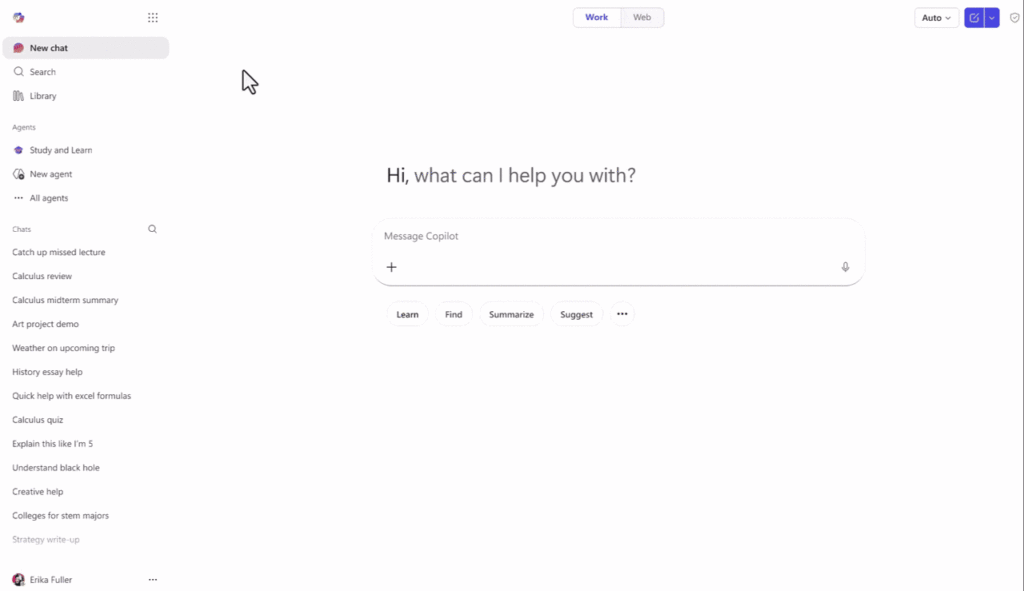
Microsoft’s latest announcements center on this philosophy. The "Study and Learn Agent," a new experience within Copilot Chat, is specifically engineered for students aged 13 and older. Unlike standard AI chatbots that provide direct answers to queries, the Study and Learn Agent is designed to act as an interactive coach. It utilizes research-based principles to guide students through complex problems using scaffolded questions, flashcards, and quizzes. This approach ensures that the AI supports knowledge retention and independent thinking, preventing the technology from "doing the work" for the student.
For educators, the focus has shifted toward reducing the "administrative tax" that often leads to burnout, allowing more time for direct student engagement. New features developed through the Education Insiders Program are being integrated into daily workflows. These include intelligent assistance for lesson planning, rubric creation, and the development of unit plans. By embedding these tools directly into Microsoft 365 Education, the company aims to provide a consistent and trusted environment where data privacy and security are prioritized.
Chronology of Integration and Future Rollout
The path to the current AI-centric educational landscape has been marked by several key milestones over the past few years:
- Late 2022 – Early 2023: The emergence of generative AI leads to widespread bans in several school districts globally due to concerns over plagiarism.
- Mid-2023: Microsoft and other major tech providers begin integrating basic AI assistants (Copilots) into productivity suites.
- 2024: The shift toward "Responsible AI" frameworks begins, with organizations like UNESCO and the OECD releasing preliminary guidelines for AI in the classroom.
- 2025: Microsoft launches the Education Insiders Program to gather direct feedback from thousands of educators on how AI can be used to support diverse learning needs.
- February – March 2026: PSB Insights conducts a global survey for Microsoft, revealing the urgent need for formal AI training and literacy.
- Mid-2026 (Present): Microsoft announces the Study and Learn Agent, Copilot Notebooks, and the Elevate for Educators program to provide a structured, learning-science-based approach to AI.
Looking ahead, Microsoft plans to make these features generally available in the coming months. IT administrators currently have the ability to enable Copilot Chat for K-12 environments, which activates the Study and Learn Agent by default. In the next phase of the rollout, educators will be able to assign specific AI-coached tasks directly within Microsoft Teams Assignments.

Bridging the Skills Gap: Data on Training and Literacy
The 2026 report underscores a growing "literacy gap" that threatens to leave some students and educators behind. While 87% of educators and 79% of students agree that AI proficiency is essential for future career success, the lack of formal training remains a hurdle. The demand for frequent, high-quality professional development is a recurring theme in the data.
To address this, Microsoft is expanding its "Elevate for Educators" initiative. This program provides community support, credentials, and capacity-building resources. Central to this effort is the "AI Literacy for Educators" credential pathway, developed in collaboration with ISTE (International Society for Technology in Education) and ASCD (Association for Supervision and Curriculum Development). This pathway is aligned with the AI Literacy Framework, a global standard developed by the European Commission and the OECD in partnership with CodeAI.
The framework provides a shared playbook for policymakers and curriculum designers, outlining what students should understand about AI—including its ethical implications, limitations, and technical foundations—by the time they graduate. By providing a clear roadmap, these organizations hope to standardize AI education across different regions and socioeconomic backgrounds.
Security, Privacy, and Institutional Governance
One of the primary concerns for school boards and IT departments is the security of student data. Microsoft has addressed this by ensuring that the new AI experiences are built with "enterprise-grade" protections. When students and educators use AI through their institutional Microsoft 365 accounts, the data remains within the institution’s tenant, and the information is not used to train the underlying large language models.

The introduction of "Copilot Notebooks" further enhances this focus on controlled environments. This AI-powered workspace allows students to upload their own materials—such as lecture slides, handouts, and personal notes—and receive assistance grounded strictly in those sources. This "grounding" reduces the risk of hallucinations (the AI generating false information) and ensures that the assistance provided is relevant to the specific curriculum being taught in the classroom.
Furthermore, the new "Teach and Learn" taskbar shortcuts on Windows devices are designed to provide quick, personalized access to these tools, while giving IT teams the governance tools needed for an institution-wide rollout. This centralized approach allows school leaders to deploy AI with greater confidence, knowing that the tools are being used within a monitored and secure ecosystem.
Implications for the Future of Global Education
The shift toward AI as a "learning coach" represents a significant departure from traditional educational software. Industry analysts suggest that this could lead to more personalized learning at scale, providing every student with a 1:1 tutor that can adapt to their specific pace and style of learning.
However, the implications go beyond the classroom. As the workforce increasingly demands AI literacy, the role of schools in preparing students for a "post-AI" economy becomes paramount. The collaboration between tech giants like Microsoft and international bodies like the OECD suggests that AI literacy is becoming a new fundamental skill, akin to reading or mathematics.

While the benefits of efficiency and personalized support are clear, the 2026 report serves as a reminder that technology is only as effective as the support systems surrounding it. The emphasis on monthly training and clear guidance on responsible use indicates that the human element—the educator—remains the most critical factor in the successful integration of AI.
As the current academic year concludes and institutions prepare for the next, the focus for Microsoft and the broader education community remains on building confidence. By grounding AI in learning science and providing robust professional development, the goal is to ensure that AI serves as a bridge to deeper understanding rather than a shortcut that bypasses the learning process. The coming months will be a crucial testing ground for these new tools as they move from preview communities to general availability in classrooms around the world.