




Nvidia has officially introduced Nemotron 3.5 Lightning, an advanced open artificial intelligence model engineered specifically to serve as a high-speed operational workhorse within complex, long-running AI agent frameworks rather than functioning as a traditional, all-purpose conversational assistant. Released on August 11, the model arrives as the artificial intelligence industry increasingly shifts its focus away from isolated prompt-and-response paradigms toward multi-step autonomous agents capable of executing dozens, or even hundreds, of backend operations to fulfill a single user directive.
The introduction of Nemotron 3.5 Lightning signals a profound architectural evolution in enterprise artificial intelligence deployment. As corporations move rapidly to integrate generative AI into mission-critical workflows, the industry is confronting the severe economic and latency bottlenecks associated with routing every computational step through monolithic, high-parameter frontier models. By providing a specialized, high-velocity model alongside open-source routing infrastructure, Nvidia aims to establish a new standard for efficient, multi-model enterprise architectures.
Architecture and Technical Specifications

At its core, Nemotron 3.5 Lightning is structured as a 30 billion-parameter mixture-of-experts (MoE) model. However, its efficiency is derived from its sparse activation design, which activates only 3 billion parameters per token generated. This selective parameter activation allows the system to achieve processing speeds up to four times faster than comparable models of similar total size, while simultaneously supporting massive context windows of up to 1 million tokens.
To maximize inference efficiency and minimize computational overhead, Nvidia integrated several advanced optimization techniques into the model’s design. These include multi-token prediction capabilities, speculative decoding frameworks, and an NVFP4 quantized checkpoint. By leveraging these hardware-software co-optimizations, Nemotron 3.5 Lightning can process extensive documents, codebases, or data streams while maintaining the rapid response times required for automated, high-frequency enterprise workflows.
In keeping with Nvidia’s recent open-science initiatives, the company is distributing Nemotron 3.5 Lightning under its OpenMDW-1.1 license. This release encompasses not just the open weights of the model, but also the underlying training data and architectural recipes, granting developers and enterprise IT departments unprecedented transparency and customization capabilities.
The Rise of the "System of Models" Paradigm
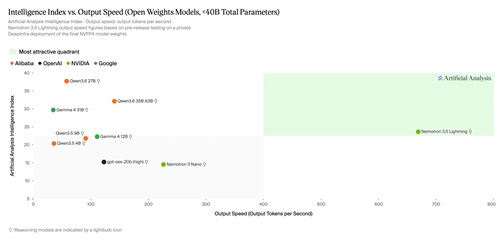
The most significant aspect of the Nemotron 3.5 Lightning deployment is not merely the speed or parameter count of the model itself, but the broader operational philosophy it represents. Nvidia is actively championing a transition from single-model dependency to a collaborative "system of models" approach within enterprise environments.
In traditional AI implementations, a single large language model is tasked with handling every phase of a user request, from high-level strategic reasoning to basic formatting, syntax validation, and repeated tool execution. This approach is highly inefficient. Reasoning-intensive tasks require deep cognitive processing and consume substantial compute resources, whereas routine validation checks or API calls do not require deep intelligence—they require speed, accuracy, and low latency.
Nvidia’s enterprise deployment strategy envisions an ensemble approach where different models within an organization are assigned roles tailored specifically to their strengths. Under this framework, a massive, highly capable reasoning model handles initial workflow planning, strategic decomposition, and complex decision-making. Once the plan is established, specialized, lightning-fast models like Nemotron 3.5 take over the heavy lifting. These specialized models execute the repetitive tool calls, data formatting, constraint checking, and validation tasks generated as the agent carries out the workflow.
This division of labor fundamentally alters the economic calculus of AI deployment. Enterprises no longer need to evaluate models exclusively on raw intelligence benchmarks. Instead, decision-makers must weigh a matrix of variables that includes latency, inference cost, deployment location, and specific task specialization. A model that falls short on esoteric reasoning benchmarks may nevertheless deliver immense ROI if it can process millions of routine enterprise transactions faster and more cheaply than a frontier model.

NeMo Switchyard: Dynamic Routing at Runtime
To operationalize this multi-model architecture without imposing prohibitive engineering burdens on development teams, Nvidia has released NeMo Switchyard alongside the Lightning model. NeMo Switchyard is an open-source routing library engineered to dynamically direct individual computational requests to the most appropriate model within an enterprise ecosystem based on real-time constraints such as required output quality, maximum allowable latency, and operational cost.
Crucially, NeMo Switchyard allows organizations to route workloads across a heterogeneous mix of open-source models, proprietary third-party models, and Nvidia’s native hardware-accelerated models. This routing occurs seamlessly behind the scenes, enabling enterprises to update their underlying model mix or adjust cost-performance thresholds without rewriting the core applications that submit the requests.
The introduction of dynamic runtime routing points toward a fundamental shift in software engineering for artificial intelligence. Rather than making a static, one-time platform choice regarding which AI model to integrate into an application, development teams will increasingly evaluate the performance of entire workflows. Model selection is evolving into a dynamic, runtime decision made on a token-by-token or task-by-task basis.

Chronology of Nvidia’s Enterprise AI Strategy
Nvidia’s release of Nemotron 3.5 Lightning and NeMo Switchyard is the latest milestone in a calculated, multi-year strategy to dominate not only the hardware layer of artificial intelligence through advanced graphics processing units and accelerators, but also the software and architectural layers that dictate how AI is deployed at scale.
Throughout late 2023 and 2024, as generative AI transitioned from consumer experimentation to enterprise integration, Nvidia steadily expanded its software portfolio. The company recognized early that enterprise adoption would stall if companies were forced to choose between exorbitant inference costs associated with frontier models and lower-quality outputs from older open-source alternatives. By developing specialized inference engines, quantization techniques, and optimized frameworks like TensorRT-LLM, Nvidia laid the groundwork for high-efficiency enterprise deployments.
The announcement of the Nemotron family of models represented Nvidia’s entry into model creation, designed explicitly to showcase what is possible when hardware and software are co-designed from the silicon up. With the August 11 release of Nemotron 3.5 Lightning, the company has pivoted from general-purpose model competition to targeted operational efficiency, addressing the specific bottlenecks plaguing multi-agent AI systems in production environments.

Industry Implications and Economic Analysis
The commercial implications of Nvidia’s new ecosystem extend across the entire technology sector, influencing cloud providers, enterprise software vendors, and independent software developers building autonomous agent platforms.
From an economic perspective, the cost of inference has emerged as the single greatest barrier to the widespread profitability of generative AI applications. While consumer-facing chatbots can absorb high compute costs subsidized by subscription fees or venture capital, enterprise applications requiring millions of automated backend calls face severe margin pressures if every operation relies on top-tier frontier models. By offloading 80% to 90% of routine agentic tasks to a fast, low-cost model like Nemotron 3.5 Lightning, enterprises can dramatically reduce their total cost of ownership (TCO) without sacrificing overall system performance.
Furthermore, the emphasis on open weights and transparency addresses growing enterprise concerns regarding vendor lock-in and data sovereignty. Many heavily regulated industries—such as healthcare, finance, and defense—cannot send sensitive operational data to third-party proprietary APIs. By offering an open model that can be deployed locally on enterprise infrastructure alongside open routing tools, Nvidia provides a secure pathway for organizations to build sophisticated agentic workflows entirely within their own perimeter security.

Looking ahead, the success of the system-of-models approach will likely accelerate the adoption of autonomous agents in mainstream enterprise software. As latency drops and execution costs plummet, software applications will transform from passive tools that wait for human prompts into proactive, background agents that continuously monitor, validate, and execute complex business processes.
Nvidia’s positioning at the intersection of high-performance silicon, specialized open models, and dynamic runtime routing ensures that the company will remain a foundational architect of this next phase of the artificial intelligence revolution. As developers begin integrating Nemotron 3.5 Lightning and NeMo Switchyard into production environments over the coming months, the industry will gain its first clear view of whether multi-model ensembles can successfully deliver on the promise of scalable, cost-effective autonomous enterprise AI.