


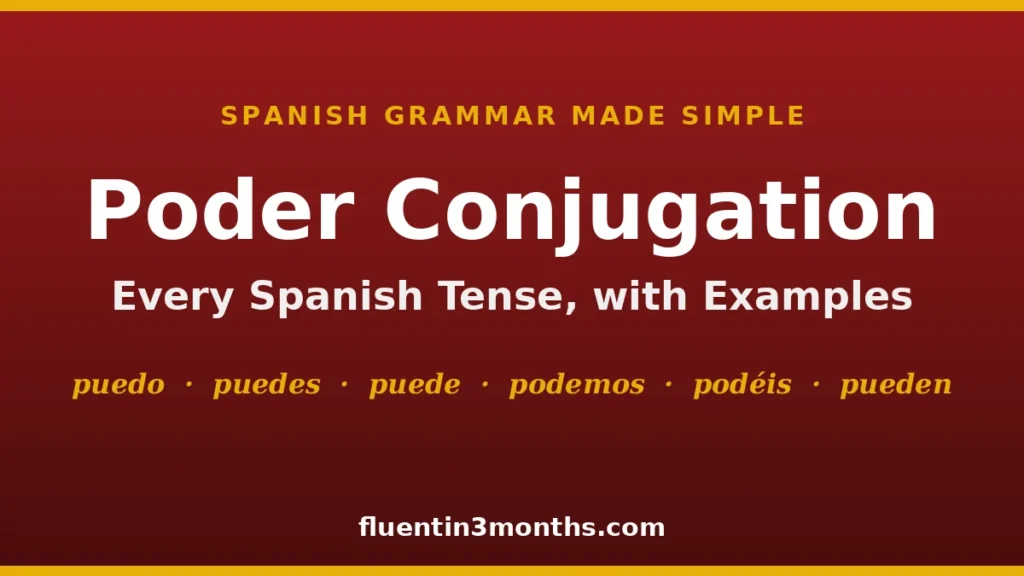
The Spanish verb poder serves as the fundamental bedrock of the language’s communicative capacity, functioning as the primary modal auxiliary for expressing ability, possibility, and permission. In the landscape of Hispanic linguistics, poder is classified as a highly irregular verb, presenting a twofold challenge for learners due to its stem-changing nature and its deviation from standard preterite conjugation patterns. As a high-frequency verb—often appearing in the top 20 most utilized words in Spanish-language media and literature—its mastery is an essential milestone for achieving professional fluency.
Linguistic Anatomy and Structural Irregularities
The complexity of poder stems from its historical evolution within the Romance language family, descending from the Latin posse. Its structural idiosyncrasies are categorized into two primary areas: the "boot" or stem-change pattern and the "strong" preterite system.
In the present indicative and subjunctive moods, poder undergoes a stem shift from pod- to pued- whenever the stress falls upon the stem. This occurs in the first, second, and third-person singular, as well as the third-person plural. Linguistically, this shift occurs to resolve the phonetic tension created when stress is applied to the vowel o in a closed syllable. Conversely, the nosotros and vosotros forms retain the pod- stem because the accentuation shifts to the terminal suffix, effectively stabilizing the vowel structure.
The second layer of irregularity involves the preterite tense, which belongs to the category of pretéritos fuertes (strong preterites). In this tense, the stem is transformed into pud-, and the verb adopts a specific set of endings that omit the traditional written accents found in regular verbs. For instance, the first-person singular is pude and the third-person singular is pudo; neither requires an accent mark, a common point of orthographic error for non-native speakers.
Historical Context and Usage Evolution
The usage of poder has remained relatively stable over the last five centuries, serving as the essential instrument for modal expression. Historical texts from the Golden Age of Spanish literature (Siglo de Oro) show that the distinction between poder (situational ability) and saber (learned capacity) was already firmly established, mirroring the Latin distinction between posse and scire.
Data from the Royal Spanish Academy (RAE) corpus indicates that poder maintains one of the highest usage rates in both formal diplomatic documents and informal daily speech. Its endurance in the language is attributed to its versatility. Unlike English, where "can" is relatively static, Spanish speakers leverage the various tenses of poder to convey nuances of time, probability, and conditionality that are crucial for precise communication in business, law, and social interaction.
The Poder vs. Saber Dichotomy
A significant hurdle for learners is the frequent conflation of poder and saber. While both are translated into English as "can," their semantic domains are distinct. Saber denotes a skill or a piece of information acquired through study or experience—Sé hablar español (I know how to speak Spanish). Poder, by contrast, relates to environmental or situational constraints—Puedo hablar español hoy (I am able to speak Spanish today, perhaps due to a lack of distractions or permission).
Failure to distinguish between these two can result in unintended meaning. To say puedo nadar when referring to a lifelong swimming skill implies that the speaker is merely "permitted" to swim at that moment, rather than possessing the athletic ability to do so. This distinction is critical in professional settings where expressing capability (saber) versus availability (poder) can alter the reception of a statement.
Comparative Conjugation Framework
To facilitate technical mastery, the following overview categorizes the verb’s most critical tenses:
| Tense | Key Characteristic | Usage Focus |
|---|---|---|
| Present Indicative | Stem change (o to ue) | Current ability or permission |
| Preterite | Strong stem (pud-) | Successfully completed actions |
| Imperfect | Regular ending, irregular stem | Ongoing, past-tense capacity |
| Conditional | podr- stem | Politeness and hypothesis |
| Subjunctive | Stem change present | Subjectivity, doubt, or desire |
Data-Driven Analysis of Usage Frequency
According to frequency studies conducted by the Corpus de Referencia del Español Actual (CREA), the present indicative form puede is the most commonly used iteration, followed by the conditional podría. The high frequency of the conditional reflects the cultural importance of politeness in Spanish-speaking regions, where podría is the standard, soft-edged approach for making requests in service, retail, and professional environments.
Experts in second-language acquisition emphasize that learners should prioritize these high-frequency forms before attempting to master the more obscure, literary tenses such as the pretérito anterior (hube podido). The pretérito anterior has largely fallen out of common usage, appearing almost exclusively in archaic legal or high-literary contexts, rendering it unnecessary for standard communicative proficiency.
Strategic Implications for Learners
The necessity of mastering poder extends beyond mere grammar; it is a gateway to navigating complex social dynamics. In Spanish-speaking cultures, the ability to negotiate and offer assistance relies heavily on the nuanced use of modal verbs.
- Politeness Markers: Utilizing ¿Podrías? (Conditional) instead of ¿Puedes? (Present) is often the difference between a blunt request and a culturally respectful inquiry.
- Result-Oriented Language: Utilizing the preterite pude demonstrates a definitive outcome, which is essential for reporting completed tasks in a project management or professional context.
- Hypothetical Negotiation: The imperfect subjunctive (pudiera) is frequently used in conditional "if" clauses, allowing speakers to propose complex scenarios and negotiate terms effectively.
Official Linguistic Stance and Educational Trends
Language institutions, including the Instituto Cervantes, emphasize the importance of "communicative competence" over "mechanical memorization." While the conjugation tables provided in this analysis are accurate to the strict standards of the RAE, educators now advise students to focus on the "functional load" of the verb.
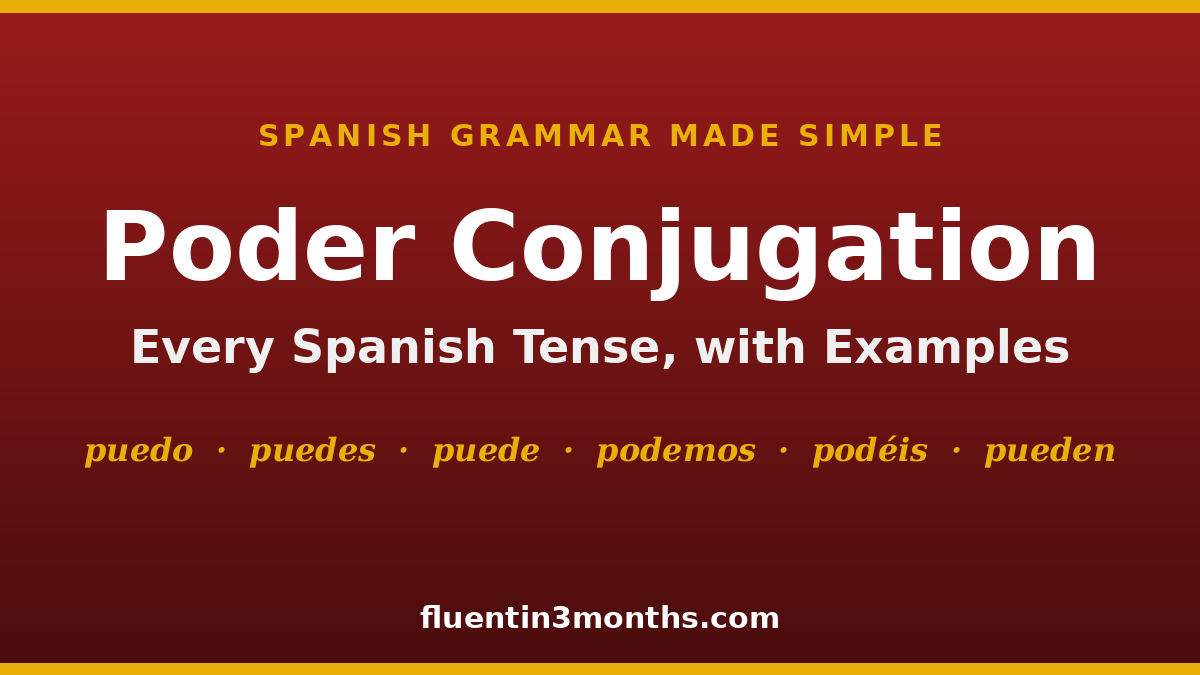
Instead of rote memorization of every possible conjugation, learners are encouraged to practice the "Big Five": puedo (I can), puedes (you can), puede (he/she/it can), podemos (we can), and pueden (they can). By securing these, the speaker can manage approximately 80% of daily interactions requiring the expression of ability.
Conclusion
The verb poder remains a pillar of Spanish syntax. Its irregularity is not a barrier but a feature that provides the language with its characteristic rhythm and expressive depth. By understanding the phonetic motivations behind its stem changes, the logic of its strong preterite, and the essential semantic boundary between it and saber, speakers can significantly enhance their clarity and precision.
As linguistic research continues to evolve, the consensus among polyglots and educators is that poder is the most efficient tool for unlocking higher levels of fluency. Whether in a casual conversation or a formal negotiation, the command of poder allows for the articulation of potentiality, making it an indispensable asset in the lexicon of any serious student of the Spanish language. With consistent application and an awareness of these structural rules, the verb ceases to be a hurdle and becomes the primary mechanism for effective, fluent communication.