


The Hellenic Republic has witnessed a significant surge in international tourism over the last several years, with the Greek National Tourism Organization (GNTO) reporting record-breaking visitor numbers exceeding 32 million annually. As the country solidifies its position as a global travel hub, a growing trend toward "meaningful travel" has emerged, where visitors seek deeper cultural integration rather than superficial sightseeing. Central to this movement is the acquisition of linguistic skills. While English is widely spoken in major urban centers like Athens and Thessaloniki, as well as on popular islands like Mykonos and Santorini, the mastery of foundational Greek phrases remains a critical tool for navigating rural landscapes, fostering genuine connections with locals, and honoring the historical legacy of one of the world’s oldest recorded languages.
The Strategic Importance of Linguistic Integration in Greece
Linguistic experts and travel analysts suggest that even a rudimentary understanding of Modern Greek—a language with a continuous history spanning over 3,400 years—can fundamentally alter the traveler’s experience. Greece’s economy is heavily reliant on tourism, accounting for approximately 20% of its Gross Domestic Product (GDP). In this competitive landscape, "Philoxenia"—the ancient Greek concept of hospitality toward strangers—is often most vibrantly expressed when visitors demonstrate an effort to communicate in the local tongue.
The linguistic landscape of Greece transitioned significantly in 1976 when "Dimotiki" (the popular language) became the official tongue, replacing the more archaic "Katharevousa." Today, Modern Greek serves as a bridge between the ancient past and a contemporary, tech-savvy society. For the modern traveler, learning the language is not merely a survival tactic but a form of cultural diplomacy.
Foundational Etiquette: Formal vs. Informal Greetings
The Greek language places a high premium on social hierarchy and familiarity, which is reflected in its greeting structures. Understanding the distinction between formal (plural) and informal (singular) addresses is the first step toward respectful communication.
Essential Daily Greetings:
- Hello (Formal or Plural): Γεια σας (Yassas) – Used when addressing elders, superiors, or groups of people.
- Hello (Informal): Γεια σου (Ya sou) – Reserved for friends, children, and peers.
- Yes: Ναι (Ne) – Note that "Ne" sounds like the English "Nay," but it means "Yes."
- No: Όχι (Ochi) – Pronounced with a guttural ‘ch’ sound.
- Please / You’re Welcome: Παρακαλώ (Parakalo) – A versatile word used both to ask for something and to respond to "Thank you."
- Thank you: Ευχαριστώ (Efcharisto) – Derived from the same root as the English word "Eucharist."
- Sorry: Συγγνώμη (Signomi) – Essential for navigating crowded public transport or seeking attention.
Time-Sensitive Salutations:
The Greek day is divided by specific greetings that reflect the Mediterranean lifestyle.
- Good morning: Καλημέρα (Kalimera) – Typically used until 12:00 PM.
- Good evening: Καλησπέρα (Kalispera) – Used from late afternoon through the night.
- Have a good afternoon: Καλό απόγευμα (Kalo apogevma).
- Good night: Καληνύχτα (Kalinihta) – Used only when retiring for the evening.
- Goodbye: Αντίο (Adio).
- See you later / Speak soon: Τα λέμε (Ta leme) – A very common informal parting.
Navigational and Survival Greek for Travelers
For those venturing beyond the guided tours, survival phrases are indispensable. In the "Blue Zones" of Ikaria or the mountain villages of Epirus, English proficiency may drop, making these phrases the primary means of logistics.
Dining and Transactions:
In a country where the culinary experience is a cornerstone of the culture, the ability to navigate a "taverna" is vital.
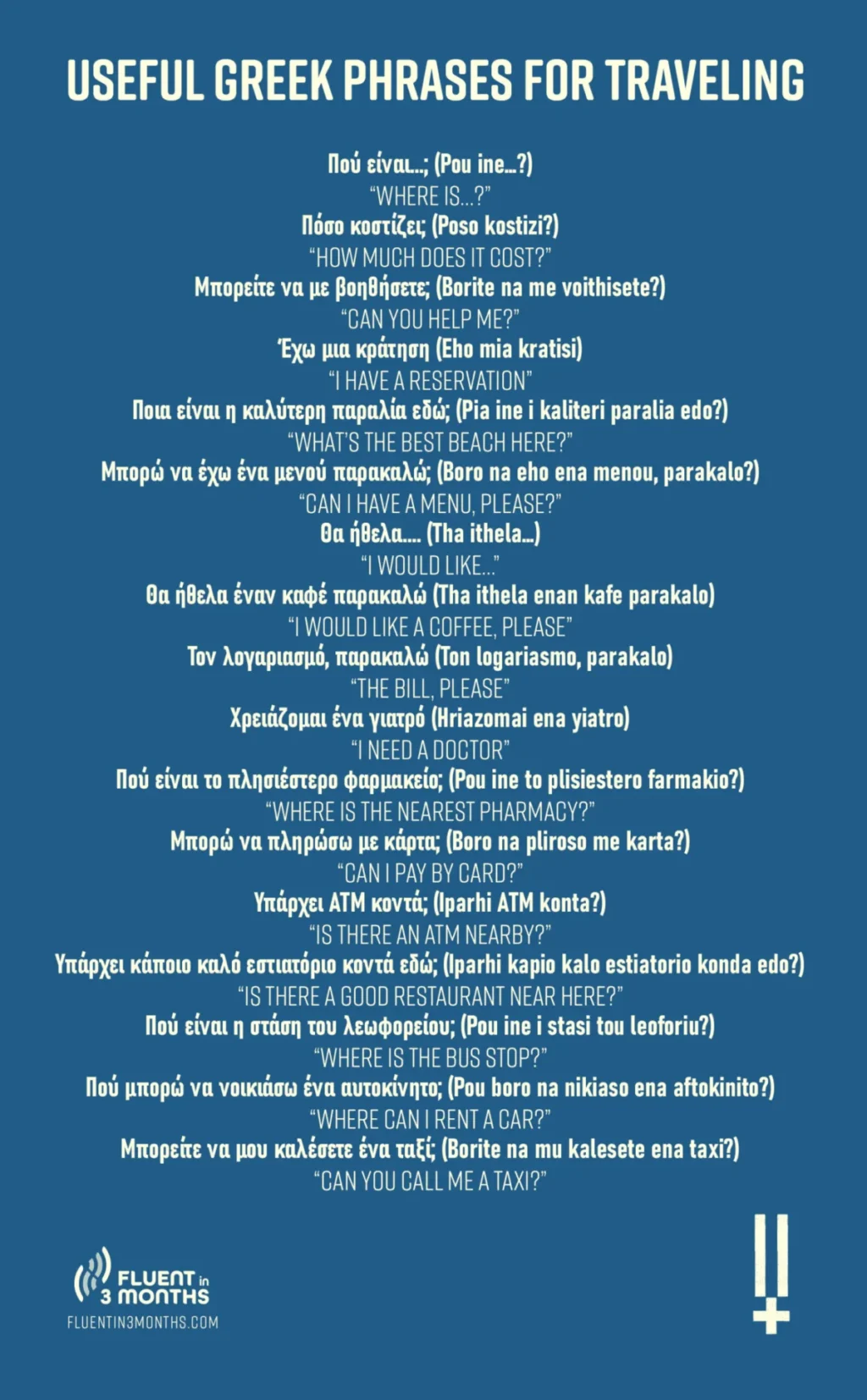
- How much is it?: Πόσο κάνει; (Poso kani?)
- The bill, please: Τον λογαριασμό, παρακαλώ (Ton logariasmo, parakalo)
- Can I have the menu, please?: Μπορώ να έχω ένα μενού παρακαλώ; (Boro na eho ena menou, parakalo?)
- I would like a coffee, please: Θα ήθελα έναν καφέ παρακαλώ (Tha ithela enan kafe parakalo)
- Enjoy your meal: Καλή όρεξη (Kali orexi) – The Greek equivalent of "Bon appétit."
- Cheers!: Γεια μας! (Yamas!) – Literally meaning "To our health."
Logistics and Emergencies:
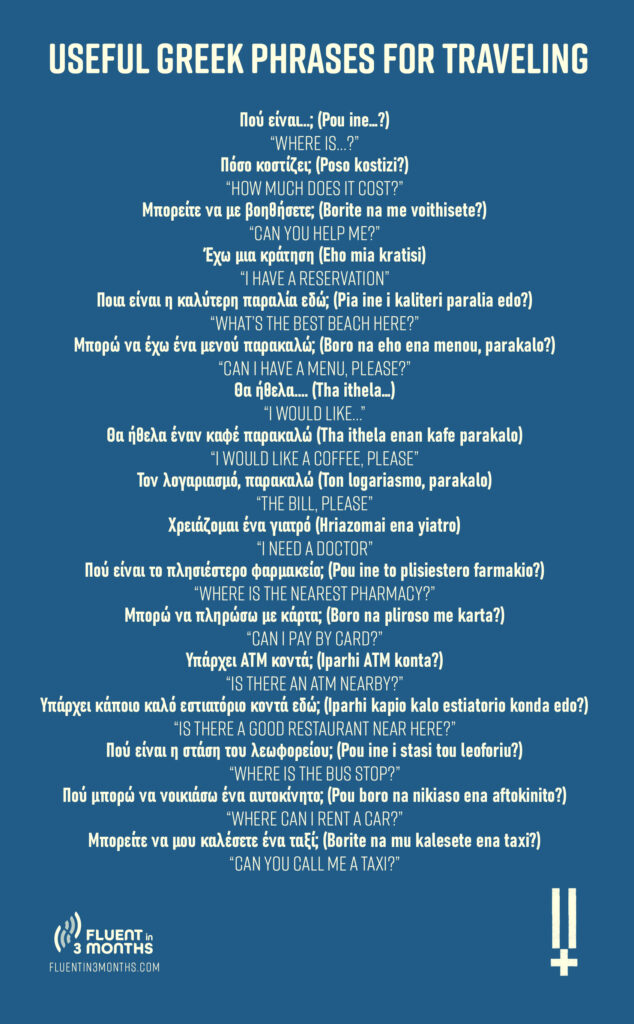
- Where is the bathroom?: Πού είναι η τουαλέτα; (Pou ine i tualeta?)
- Where is the bus stop?: Πού είναι η στάση του λεωφορείου; (Pou ine i stasi tou leoforiu?)
- Can you call me a taxi?: Μπορείτε να μου καλέσετε ένα ταξί; (Borite na mu kalesete ena taxi?)
- Can I pay by card?: Μπορώ να πληρώσω με κάρτα; (Boro na pliroso me karta?)
- Is there an ATM nearby?: Υπάρχει ΑΤΜ κοντά; (Iparhi ATM konta?)
- I need a doctor: Χρειάζομαι ένα γιατρό (Hriazomai ena yiatro)
Social Integration: Establishing Identity
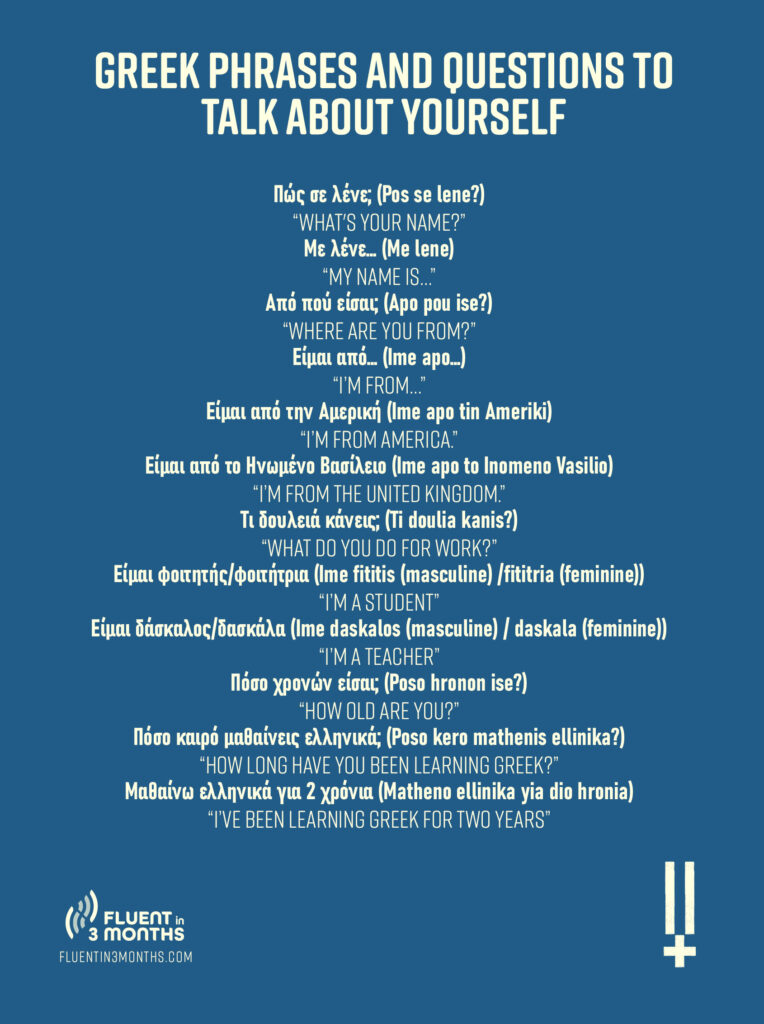
Building rapport with locals often begins with a simple introduction. Greek culture is inherently social, and "Ti kanis?" (How are you?) is often the start of a longer conversation.
Personal Information Templates:
- What’s your name?: Πώς σε λένε; (Pos se lene?)
- My name is…: Με λένε… (Me lene…)
- Where are you from?: Από πού είσαι; (Apo pou ise?)
- I’m from America: Είμαι από την Αμερική (Ime apo tin Ameriki)
- I’m from the United Kingdom: Είμαι από το Ηνωμένο Βασίλειο (Ime apo to Inomeno Vasilio)
- How long have you been learning Greek?: Πόσο καιρό μαθαίνεις ελληνικά; (Poso kero mathenis ellinika?)
- I’ve been learning Greek for two years: Μαθαίνω ελληνικά για 2 χρόνια (Matheno ellinika yia dio hronia)
Professional and academic status also holds weight in Greek social circles. Addressing someone as a student (fititis/fititria) or a teacher (daskalos/daskala) can provide context to one’s background during an exchange.
The Vernacular: Slang and Informal Communication
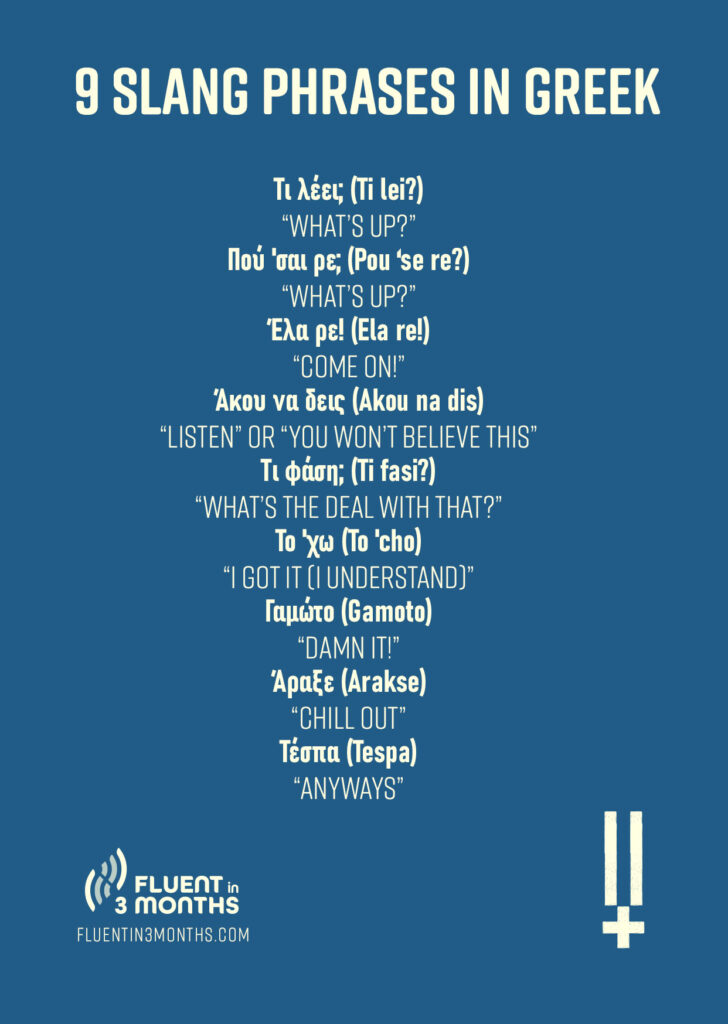
To truly sound like a local, one must understand the nuances of Greek slang. However, experts warn that these should be used with caution, as they are strictly informal and can occasionally be offensive if used in the wrong context.
The most famous—and controversial—word is Malaka (μαλάκα). While technically a swear word, it is used ubiquitously among friends as a term of endearment or a casual filler, similar to "dude" or "mate" in English.
Common Slang Expressions:
- What’s up?: Τι λέει; (Ti lei?) or Πού ‘σαι ρε; (Pou ‘se re?)
- Come on!: Έλα ρε! (Ela re!) – Used to express surprise, disbelief, or encouragement.
- Chill out: Άραξε (Arakse).
- Anyways: Τέσπα (Tespa) – A shorthand for "telos panton."
- I got it: Το ‘χω (To ‘cho).
- What’s the deal with that?: Τι φάση; (Ti fasi?)
Philosophical Foundations: Proverbs as Cultural Windows
Greek proverbs, many of which date back to antiquity, offer a glimpse into the national psyche. These phrases are more complex than daily greetings and reflect a culture that values wisdom, patience, and irony.
- "Kallio pente ke sto heri, para deka ke karteri": (Better five in hand than ten and waiting). This reflects a pragmatic Mediterranean approach to life and resources.
- "An den vrexis tin oraia sou oura, psari den tros": (If you don’t get your beautiful tail wet, you won’t eat fish). This is the Greek equivalent of "No pain, no gain," emphasizing the necessity of effort.
- "I glossa kokala den ehi ke kokala tsakizi": (The tongue has no bones, but it breaks bones). This warns of the immense power of words and the damage caused by gossip or insults.
- "Eipe o gaidaros ton petino kefala": (The donkey called the rooster ‘big-headed’). A commentary on hypocrisy, similar to "the pot calling the kettle black."
- "To gargo nero tin petra tin tripaei": (The dripping water bores through the stone). A testament to the power of persistence over brute force.
Data-Driven Analysis of Language Learning Trends
Recent data from language learning platforms like Duolingo and Babbel indicates that interest in the Greek language has grown by approximately 15% year-over-year since 2021. This is attributed to the rise of "digital nomads" choosing Athens and Crete as long-term bases. The Greek government has responded to this by introducing "Digital Nomad Visas," further incentivizing linguistic and cultural education.
Educational psychologists suggest that for English speakers, Greek is a "Category II" language, meaning it takes approximately 30 weeks (750 class hours) to reach professional proficiency. However, for the average traveler, a "survival level" can be achieved in as little as two weeks of dedicated study. The primary challenge for English speakers is the Greek alphabet and the three different genders for nouns, but the phonetic nature of the language—where words are almost always pronounced exactly as they are written—provides a significant advantage once the alphabet is mastered.
Broader Impact and Future Outlook
As Greece continues to evolve into a premier year-round destination, the emphasis on local language will likely intensify. The Ministry of Culture has recently invested in digital initiatives to preserve local dialects and promote Modern Greek literacy among the diaspora and tourists alike.
For the traveler, the impact of learning these phrases extends beyond mere convenience. It is an act of respect that is almost always rewarded with a warmer smile, a better table at a restaurant, or a deeper conversation with a shopkeeper. In an era of over-tourism and standardized global experiences, the Greek language remains a powerful tool for reclaiming the authenticity of travel. By moving beyond "Hello" and "Thank you," visitors contribute to the preservation of a living history while enriching their own global perspective.