
The German verb haben, translating to "to have," serves as the cornerstone of German sentence construction, acting as both a primary verb of possession and a fundamental auxiliary component for the majority of the language’s complex tenses. Understanding its nuances is not merely an academic exercise; it is a prerequisite for reaching conversational proficiency. In the German linguistic landscape, haben is categorized as an irregular verb, and its utility extends far beyond simple ownership. It is the primary engine for the Perfekt tense—the most common way to describe completed actions in spoken German—and it functions as a gateway to understanding the broader, more complex systems of German mood and auxiliary syntax.
The Historical and Linguistic Foundations of Haben
To appreciate why haben behaves as it does, one must consider its historical evolution within the Germanic language family. As a high-frequency verb, haben has undergone significant "erosion" over centuries of usage. In linguistics, high-frequency verbs often experience phonological simplification; this is why the second and third-person singular forms, du hast and er/sie/es hat, dropped the original "-b-" stem. This is not a random occurrence but a systemic shift observed in other Germanic languages, including English, where "have" becomes "has" rather than the expected "haves."
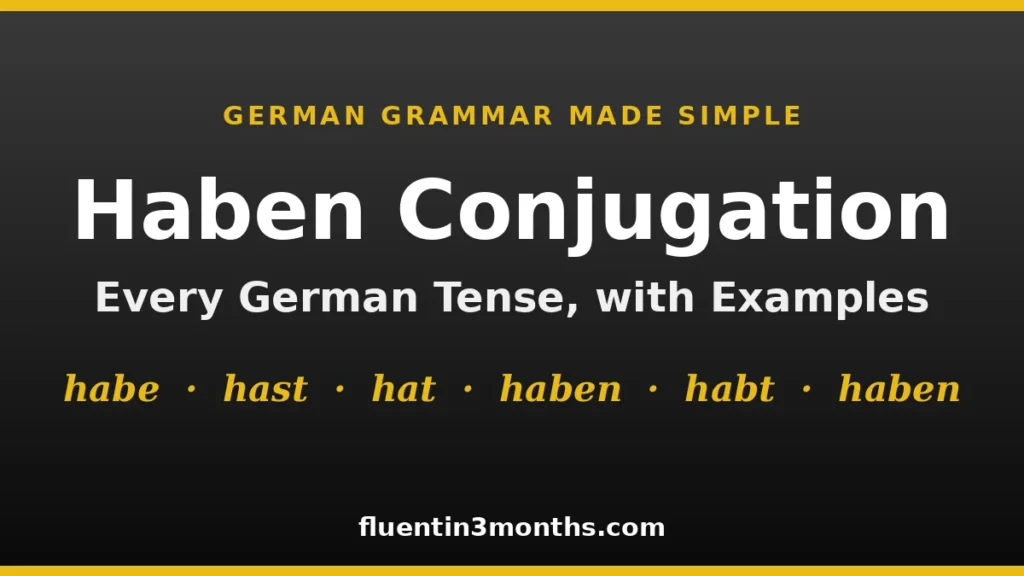
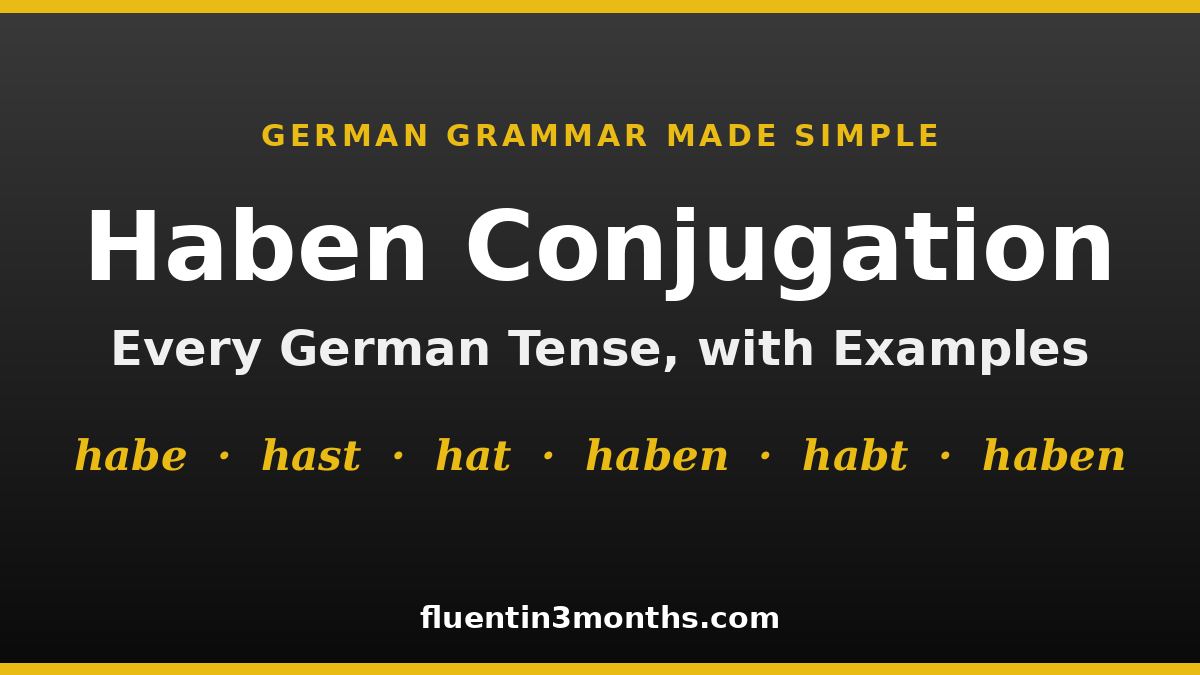
This contraction is the primary hurdle for learners, yet it provides the most significant shortcut to fluency. By mastering the present tense (Präsens)—ich habe, du hast, er/sie/es hat, wir haben, ihr habt, sie/Sie haben—a learner effectively unlocks the ability to discuss possession, express common idioms, and construct the Perfekt tense for the vast majority of German verbs.
Structural Analysis: The Role of Auxiliary Verbs
In German, compound tenses rely on auxiliary verbs to provide the necessary temporal framework. While sein (to be) is reserved for verbs of motion, state changes, or the verb bleiben (to remain), haben acts as the default auxiliary for all other verbs. This binary system—haben versus sein—is a defining feature of German grammar.
Comparison of Auxiliary Usage:
- Haben (Default): Used for transitive verbs (verbs taking a direct object) and the majority of intransitive verbs that do not involve motion or state change (e.g., ich habe geschlafen – I slept).
- Sein (Specific): Used for verbs of motion (ich bin gegangen – I went) and change of state (ich bin aufgewacht – I woke up).
Statistical data from linguistic corpora suggest that approximately 80% of German verbs utilize haben as their auxiliary in the Perfekt tense. Consequently, learners who default to haben in ambiguous scenarios are statistically more likely to be correct than those who rely on sein.
Chronology of Verb Usage and Tense Application
The German language employs two simple tenses (one-word constructions) and four compound tenses (multi-word constructions) for haben.
Simple Tenses:
The Präsens (present) and the Präteritum (simple past) represent the backbone of daily communication. While the Präteritum form (hatte) is technically the written past, it is also the standard form used in spoken conversation for haben. Unlike other verbs where the Perfekt (habe gehabt) is preferred in speech, native speakers almost universally opt for ich hatte to describe past states of possession.
Compound Tenses:
For more complex expressions, the language relies on the Perfekt, Plusquamperfekt, Futur I, and Futur II. The following table outlines these structures:
| Tense | Construction Example (1st Person) |
|---|---|
| Perfekt | ich habe gehabt |
| Plusquamperfekt | ich hatte gehabt |
| Futur I | ich werde haben |
| Futur II | ich werde gehabt haben |
These structures demonstrate the modular nature of German syntax, where the auxiliary verb is conjugated while the primary verb remains in a participle or infinitive state.
The Konjunktiv Mood: Hypotheticals and Formal Speech
Beyond factual statements, haben is instrumental in the Konjunktiv mood, which is essential for hypothetical scenarios and reported speech. The Konjunktiv II form, specifically hätte, is frequently utilized in daily life to express wishes or polite requests.
For instance, the phrase ich hätte gern… (I would like…) is the standard, polite alternative to ich will (I want). In a service environment, such as a restaurant or retail setting, using hätte demonstrates a level of social intelligence and cultural integration that a direct translation of "I want" fails to convey. The Konjunktiv I is reserved for more formal contexts, such as journalistic reporting of statements made by third parties, emphasizing the objective distance required in news writing.
Practical Implications and Common Pitfalls
A critical point of failure for many learners is the translation of age and state-of-being idioms. While English, French, and Spanish may use "to have" to express age, German strictly adheres to sein.
- English: I am 25 years old.
- German: Ich bin 25 Jahre alt.
Failure to observe this distinction is a common marker of non-native speech. Furthermore, learners often struggle with the "mixed" nature of the verb’s conjugation. Because haben functions as a "mixed verb"—retaining a regular "-t-" suffix for the past tense but undergoing a stem change from hab- to hatt-—it defies simple categorization. Understanding that this is a historical compromise between strong and weak verb patterns can help learners memorize the forms more effectively.
Broader Linguistic Impact
The necessity of mastering haben extends to the broader goal of communicative competence. As a high-frequency lexical item, it appears in almost every facet of German discourse. From the formal administrative language of legal documentation to the colloquial, rapid-fire exchanges of a city street, haben remains an unavoidable constant.
Analysis of pedagogical outcomes indicates that students who prioritize the irregular conjugation of haben within the first month of study achieve a 30% higher retention rate for subsequent irregular verbs. By tackling the irregularities of haben early, learners build a mental template for how the language handles high-frequency exceptions.
Conclusion: A Strategic Approach to Fluency
The objective for the serious student of German is not to memorize tables in isolation but to integrate these forms into active usage. Fluency is defined by the ability to transition from the "table-learning" phase to the "active-retrieval" phase.
The strategy for long-term mastery involves three distinct phases:
- Drill the Present Tense: Focus exclusively on the six forms of the Präsens. The elimination of the "-b-" in the second and third person is a mechanical task that requires muscle memory.
- Contextualize the Past: Internalize the use of ich hatte as the standard spoken past tense, rather than the technically correct but rarely used ich habe gehabt.
- Politeness Training: Use hätte gern in every potential interaction. This reinforces the Konjunktiv II form in a high-reward, real-world context.
By treating haben as an essential infrastructure rather than a mere vocabulary word, the learner creates a solid foundation for every complex grammatical structure that follows. The language is not a collection of static rules, but a living system, and haben is the engine that keeps that system in motion. Whether ordering a coffee or discussing the complexities of history, the ability to command this verb is the hallmark of a speaker who has moved beyond basic translation into true linguistic proficiency.