


The rapid integration of artificial intelligence into the modern workplace has triggered an unexpected paradox for global enterprises: the very technologies designed to augment human productivity may simultaneously be eroding the foundational human capabilities required to manage them. According to a comprehensive global study released by the IBM Institute for Business Value (IBV), businesses face a looming crisis centered around critical thinking, professional judgment, and the capacity of human workers to effectively evaluate AI-generated outputs. While corporate leaders rush to deploy generative and automated systems across industries, employees are increasingly warning that their core analytical competencies are withering as algorithms assume a greater share of daily cognitive tasks.
The study, entitled "Designing the Thinking Organization," sheds light on a widening disconnect between executive strategy and employee reality. Conducted in partnership with Oxford Economics, the research is built upon robust empirical data gathered between April and June 2026. The methodology encompassed two distinct, large-scale surveys: one polling 1,500 Chief Human Resources Officers (CHROs) and senior workforce strategy executives spanning 21 geographical regions and 23 distinct industries, and another surveying 8,800 full-time employees across 28 countries. The findings suggest that while organizations are heavily invested in technological implementation, they are vastly underestimating the human capital maintenance required to sustain an AI-enabled workforce.

The Evolution of Work and the Pacing Problem
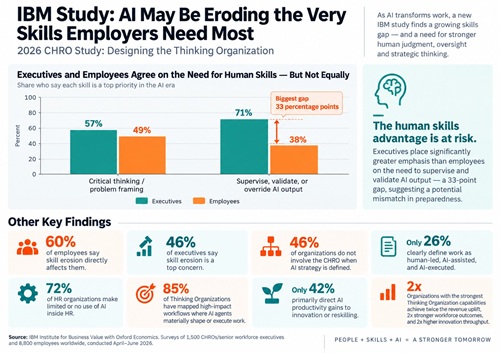
To understand the current friction between executives and their labor forces, researchers examined how rapidly daily responsibilities are shifting. Over half of the surveyed employees—precisely 52%—reported that their assigned tasks and core duties had fundamentally changed over the preceding year as AI tools reshaped day-to-day operations. However, this fluid adaptation stands in stark contrast to structural organizational planning. The study revealed that only 26% of organizations have clearly defined work structures that delineate between human-led, AI-assisted, and fully AI-executed activities.
IBM characterizes this phenomenon as a dangerous velocity gap: work is evolving far faster than organizations are redesigning their operational frameworks. Instead of deliberate, strategic decisions regarding the optimal division of labor between humans and machines, companies are relying on organic, ad-hoc adaptation by employees on the front lines. This lack of structural clarity forces workers to constantly recalibrate their daily routines without formal guidance, creating fertile ground for cognitive fatigue, operational inefficiencies, and, ultimately, the subtle atrophy of essential professional skills.
A Deepening Disconnect Over Critical Thinking and Oversight
At the heart of the IBV study lies a profound divergence in how executives and employees view the competencies necessary for the future of work. While both groups acknowledge the overarching importance of critical thinking and problem framing—with 57% of executives and 49% of employees placing these skills near the top of their priority lists—a much starker divide emerges when examining the mechanics of AI governance.
When asked about the ability to supervise, validate, or override AI outputs, 71% of surveyed executives prioritized this competency. In stark contrast, only 38% of employees shared that view, representing a massive 33-percentage-point gap. A related metric from the study highlights an even narrower employee focus: just 29% of workers rank professional judgment as a top priority in their current roles. This disparity illustrates that while leadership views active human oversight and critical validation as essential safeguards against algorithmic errors or hallucinations, the average employee—often relieved to delegate routine tasks to the machine—may not yet grasp the necessity of maintaining an active, skeptical posture toward automated outputs.
The Dual Threat: Skills Gaps Versus Skill Erosion
For years, corporate human resources departments have focused heavily on bridging the conventional "skills gap"—the deficit between the technical capabilities workers possess and the new skills required to operate advanced technologies. The IBM study, however, emphasizes that enterprises must now contend with an entirely different, more insidious phenomenon: skill erosion.
While conventional skills gaps address what employees have yet to learn, skill erosion addresses the capabilities workers already possess that gradually diminish because AI performs the underlying work. The survey data underscores the urgency of this threat. Skill erosion was cited as a top concern by 46% of executives, but an alarming 60% of employees reported that it directly affects their day-to-day professional lives. Furthermore, among the cohort of employees who expressed concern over skill erosion, three out of four noted that artificial intelligence has already begun to visibly degrade at least some of their core professional competencies, with critical thinking cited most frequently as the capability in steepest decline.

Corporate Strategies and the Limits of Reskilling
In response to the technological revolution, organizations have not remained idle. According to the research, 80% of enterprises have established formal reskilling roadmaps designed to help their workforces collaborate effectively with emerging technologies.
Yet, IBM argues that these traditional reskilling programs, while valuable, are fundamentally misaligned with the specific threat of skill erosion. Training initiatives are typically built to impart new knowledge—teaching employees how to prompt a large language model, analyze automated dashboards, or navigate new software interfaces. They are rarely designed to exercise and preserve traditional cognitive skills like deep analytical reasoning, complex problem-framing, and independent judgment. When an algorithm consistently handles data synthesis, drafting, and initial decision-making, the human muscles required to perform those exact tasks without technological assistance begin to atrophy.

Fact-Based Analysis of Implications
The implications of the IBM Institute for Business Value study extend far beyond internal human resources metrics, carrying profound consequences for enterprise risk management, product quality, and long-term economic competitiveness.
First, the heavy reliance on AI without adequate structural definition poses severe operational risks. If nearly three-quarters of executives prioritize AI supervision and validation, but fewer than four in ten employees share that focus, organizations are operating with a massive oversight vulnerability. In high-stakes environments—such as finance, healthcare, legal services, and software engineering—uncritical acceptance of AI outputs can lead to catastrophic compliance failures, regulatory penalties, and reputational damage.

Second, the erosion of foundational human skills threatens the very innovation pipeline that corporations rely upon. Artificial intelligence is fundamentally a derivative technology; it synthesizes existing patterns, historical data, and established human knowledge. True innovation, disruptive problem-solving, and strategic foresight originate from deep human critical thinking and unconventional judgment. If the human workforce gradually loses its capacity for rigorous, independent analysis through over-reliance on automation, organizations risk creating a homogeneous, stagnant intellectual culture incapable of generating breakthrough ideas.
Finally, the findings suggest that the next phase of enterprise AI strategy must pivot from mere deployment to deliberate cognitive asset management. CHROs and senior executives can no longer treat workforce transformation as a simple software rollout accompanied by basic training videos. Safeguarding the organization of the future will require deliberate workflow redesigns that intentionally preserve "human-in-the-loop" friction—ensuring that employees continue to practice, apply, and sharpen the critical thinking skills that employers ultimately value most.