




Nutanix has officially expanded the capabilities of the Nutanix Cloud Platform to support production-grade agentic artificial intelligence, highlighting a significant shift in enterprise infrastructure strategy. Announced on August 26, the sweeping architectural updates include the immediate general availability of Nutanix Enterprise AI 2.8 alongside the upcoming release of Nutanix Kubernetes Platform 2.19. Furthermore, the company rolled out Service Provider Central, a multitenant control plane engineered to streamline infrastructure, cloud-native, application, and AI services across distributed environments.
The core objective of these platform enhancements is to provide enterprise organizations with the flexibility to deploy and run sophisticated AI workloads directly alongside their legacy virtualized and containerized applications. By utilizing a unified management and governance framework, IT administrators can maintain operational consistency without being forced to segregate artificial intelligence initiatives onto disparate, standalone architectures.
The Evolution of Dual-Native Infrastructure Strategy
To fully comprehend the significance of the latest Nutanix releases, one must examine the broader architectural trajectory of modern enterprise IT. For years, organizations deploying artificial intelligence and machine learning models faced a stark operational dilemma. Traditional virtualization platforms were ill-equipped to handle the high-throughput, low-latency demands of large language models and containerized microservices, forcing infrastructure teams to build isolated, specialized silos for AI projects.
This siloed approach created profound management overhead, introduced complex security vulnerabilities, and isolated valuable enterprise data from the applications that needed it most. Nutanix sought to challenge this paradigm by championing a "dual-native" architectural model. Under this methodology, virtual machines and containers are treated as first-class, co-equal infrastructure primitives.

Speaking on the strategic vision behind the platform updates, Thomas Cornely, executive vice president of product management at Nutanix, emphasized the necessity of architectural continuity. Enterprise AI should not require customers to rebuild the core systems that already run their business, Cornely noted during the August product unveiling. This philosophy underpins the entire ecosystem update, allowing businesses to leverage their existing investments in hypervisors and storage while seamlessly layering advanced agentic AI capabilities on top.
Chronology of Recent AI Infrastructure Deployments
The August 26 rollout of Nutanix Enterprise AI 2.8 and the preview of Nutanix Kubernetes Platform 2.19 represent the culmination of a rapid, highly focused sequence of product releases designed to capture the burgeoning enterprise agentic AI market.
The timeline of recent innovations reveals a methodical strategy:
- August 10: Nutanix released an open-source Model Context Protocol server explicitly built for the Nutanix Cloud Platform. This foundational software utilized the Prism v4 API to bridge AI developer tools and autonomous agents directly with enterprise infrastructure operations.
- August 26: Nutanix announced the immediate general availability of Nutanix Enterprise AI 2.8, introducing advanced Model Context Protocol governance through the Nutanix Agent Gateway alongside expanding private inference capabilities.
- August 26: The company concurrently previewed Nutanix Kubernetes Platform 2.19, detailing upcoming support for bare-metal Kubernetes deployments, advanced network-level isolation, and a specialized AI Applications Catalog.
- August 26: Nutanix confirmed the general availability of Service Provider Central, establishing a centralized multitenant control plane for managed service providers and enterprise cloud architects alike.
Deep Dive into Nutanix Enterprise AI 2.8 and MCP Governance
As artificial intelligence transitions from static chatbots to autonomous agentic systems capable of executing multi-step workflows, the issue of security, permissioning, and governance has emerged as a top priority for Chief Information Security Officers. Autonomous agents require secure, programmatic access to corporate data stores, APIs, and underlying IT infrastructure.
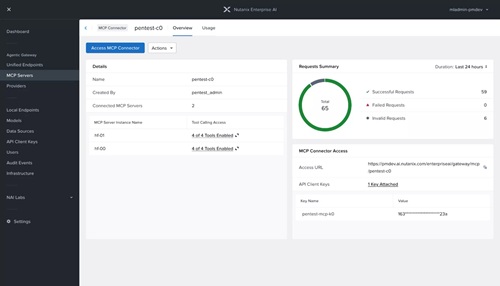
To address this challenge, Nutanix Enterprise AI 2.8 introduces robust, generally available Model Context Protocol server management within the Nutanix Agent Gateway. The Agent Gateway acts as an intelligent, centralized routing and connection layer, sitting securely between active AI agents and various MCP servers deployed either locally within the NAI environment or remotely across external networks.
Within this framework, administrators retain granular control over execution parameters. They can assign specific tool permissions to individual users or distinct API keys, ensuring that agents operate within strict compliance boundaries. Furthermore, locally deployed MCP servers within the NAI 2.8 architecture fully support rolling updates, minimizing downtime during critical software maintenance cycles.
This native governance structure builds directly upon the open-source MCP server for NCP that Nutanix launched earlier in the month. By integrating the Nutanix Prism v4 API, popular AI coding assistants and developer environments—such as GitHub Copilot, Claude Code, and Cursor—can securely interface with the platform. The underlying Prism v4 API Gateway manages critical administrative functions, including role-based access control, request throttling, transaction metering, and comprehensive auditing trails.
In effect, Nutanix has established a dual-component governance model: the NCP MCP server exposes essential infrastructure operations to external AI tools, while the Agent Gateway strictly governs how autonomous agents access those servers, underlying tools, and sensitive corporate data.
Expanding Private Inference and Hardware Acceleration
Beyond governance, Nutanix Enterprise AI 2.8 significantly enhances the underlying mechanics of model execution through extended private inference capabilities. Organizations handling sensitive intellectual property or operating under strict regulatory frameworks often require air-gapped or strictly on-premises AI pipelines.

To support these use cases, NAI 2.8 introduces native fine-tuning capabilities for localized models containing fewer than 8 billion parameters. Additionally, the platform now fully supports the deployment of NVIDIA NIM microservices within completely air-gapped network environments, allowing enterprises to harness accelerated hardware without compromising data sovereignty.
However, industry analysts have pointed out that scaling to massive foundational models remains a resource-intensive engineering challenge. To address this, Nutanix has introduced technical previews for several high-capacity infrastructure features:
- Multi-node and multi-GPU inference, engineered specifically to support complex models exceeding 100 billion parameters.
- KV cache offloading, which transfers key-value cache memory from high-priced GPU memory over to more abundant CPU host memory, optimizing hardware utilization.
Nutanix has issued explicit guidance to enterprise customers, warning that features designated as technical previews should be tested thoroughly and are not yet cleared for mission-critical production environments.
Nutanix Kubernetes Platform 2.19 Targets Containerized AI
Complementing the software updates in Enterprise AI 2.8, the upcoming release of Nutanix Kubernetes Platform 2.19 aims to unify container orchestration across diverse physical and virtual infrastructures. As modern AI pipelines rely heavily on containerized microservices, Kubernetes has become the de facto operating system for cloud-native AI.
NKP 2.19 introduces several key architectural pillars, prominently featuring NKP Metal. This capability extends the familiar, automated Nutanix operational model directly onto bare-metal physical servers. By leveraging integrated Nutanix Foundation and Lifecycle Manager technologies, IT teams can automate node provisioning, operating system installations, and ongoing firmware lifecycle management on physical hardware without the overhead of an intermediate hypervisor layer.

Simultaneously, NKP running on the AHV hypervisor offers robust integration with Nutanix Flow. This combination provides network-level micro-segmentation and isolation for autonomous AI agents, ensuring that compromised agents or aberrant workloads cannot traverse laterally across the enterprise network.
To accelerate time-to-value for development teams, NKP 2.19 features a curated AI Applications Catalog. This repository supplies pre-validated, production-ready machine learning software, including widely adopted tools such as Kubeflow for machine learning workflows, Milvus for vector database management, and Slurm for high-performance computing cluster management. In a testament to its adherence to open industry standards, Nutanix has confirmed that NKP has officially achieved CNCF Kubernetes AI Conformant Platform certification.
Industry Implications and Strategic Analysis
The broad rollout of these platform updates underscores a pivotal realization within the enterprise software market: infrastructure providers must evolve to support the entire lifecycle of agentic AI. As enterprises move past proof-of-concept deployments and demand production-ready reliability, the friction between traditional IT silos and agile AI development teams has become untenable.
By taking a dual-native approach that treats virtual machines and containers with equal weight, Nutanix is positioning its Cloud Platform as a universal bridge. Organizations no longer need to execute costly, high-risk migrations of core business logic into dedicated artificial intelligence clouds. Instead, they can harness local private inference, enforce stringent governance via Model Context Protocol gateways, and scale containerized AI applications on demand using unified tools.
Nevertheless, challenges remain. The successful deployment of models exceeding 100 billion parameters requires complex orchestration of multi-node and multi-GPU hardware, an area where features like KV cache offloading are still in technical preview. Enterprise technology leaders will need to carefully weigh the readiness of these preview features against the stringent demands of their production environments.

Ultimately, the combination of Nutanix Enterprise AI 2.8, the upcoming Nutanix Kubernetes Platform 2.19, and Service Provider Central provides a comprehensive blueprint for modern infrastructure management. By embedding security, governance, and model flexibility directly into the operational fabric of the data center, Nutanix is equipping enterprises with the tools necessary to deploy production agentic AI securely, efficiently, and entirely on their own terms.