


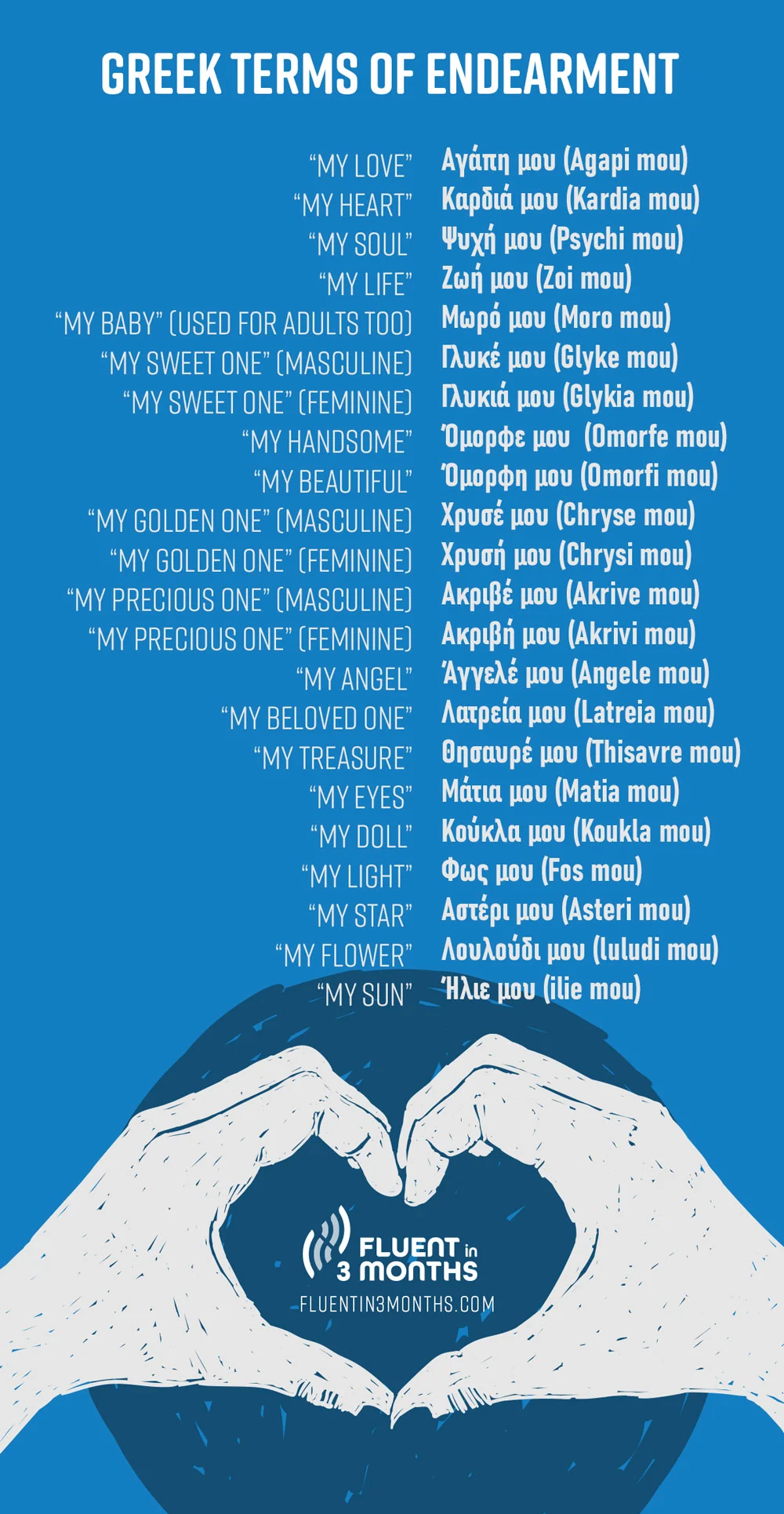
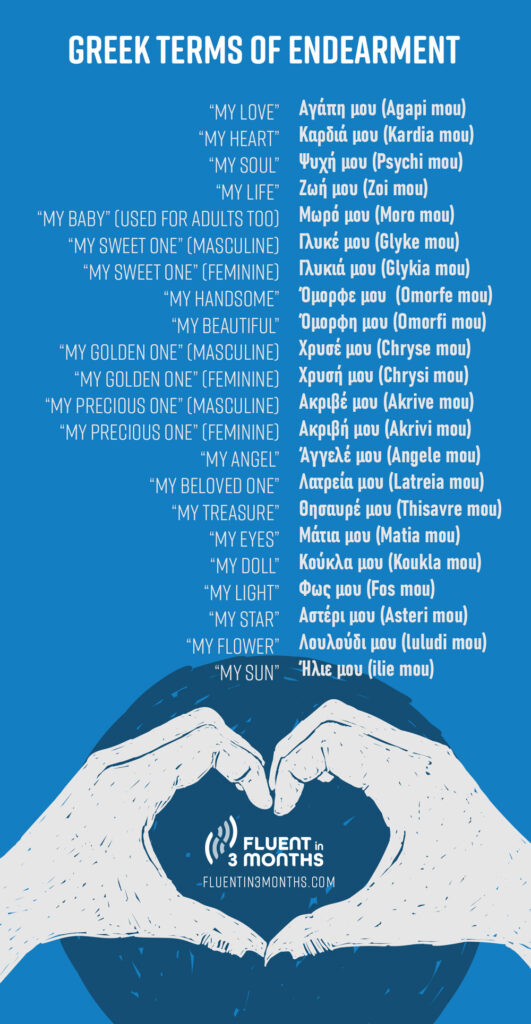
The Greek language, one of the oldest recorded living languages in the world, possesses a unique depth regarding the expression of emotion, intimacy, and social bonding. Central to this linguistic tradition is the frequent use of terms of endearment, which serve as a primary vehicle for reinforcing social structures and personal relationships within Hellenic culture. From the ubiquitous "agapi mou" (my love) to the complex system of diminutive suffixes, the Greek lexicon provides a nuanced framework for expressing affection across various social contexts, including romantic partnerships, familial ties, and friendships. Understanding these terms requires more than a simple translation; it demands an analysis of the grammatical rules, cultural history, and sociolinguistic patterns that define modern Greek communication.
Linguistic Foundations and the Pervasiveness of Affection
In contemporary Greek society, terms of endearment are not reserved solely for private or highly intimate moments. Instead, they are integrated into daily discourse, reflecting the "high-context" nature of Mediterranean cultures where emotional warmth and social proximity are prioritized. The foundational term in this category is "S’agapo" (Σ’ αγαπώ), meaning "I love you." While this phrase is powerful on its own, it is frequently paired with specific nouns to create a more personalized and evocative sentiment.
A critical grammatical component of Greek endearment is the use of the possessive pronoun "mou" (μου), which translates to "my." In Greek syntax, this pronoun invariably follows the noun it modifies. For instance, "agapi" (love) becomes "agapi mou" (my love). This structure emphasizes the personal connection between the speaker and the recipient, effectively "claiming" the person within a circle of affection. The failure to include "mou" in many of these expressions can render them formal or clinical, stripping them of their intended warmth.
Historical Evolution of Greek Emotional Lexicons
The modern use of endearment terms is deeply rooted in the evolution of the Greek language, from the Homeric era through the Byzantine period to the modern Demotic form. Ancient Greek was famous for having multiple words for love, a distinction that continues to influence modern usage. These include:
- Eros: Passionate, romantic love.
- Philia: The love between friends or equals.
- Storge: The natural affection between parents and children.
- Agape: Unconditional, sacrificial love.
- Ludus: Playful or flirtatious love.
- Pragma: Long-standing, enduring love.
- Philautia: Self-love.
- Mania: Obsessive or possessive love.
While modern Greek has consolidated some of these concepts, the underlying philosophy remains. For example, "agapi mou" derives from "agape," suggesting a level of devotion that transcends mere physical attraction. Similarly, terms like "psychi mou" (my soul) and "kardia mou" (my heart) reflect a centuries-old tradition of identifying the seat of emotion within the vital organs, a trope common in Greek poetry and folk songs (Rebetiko and Laïko).
Categorization of Modern Endearments: From Romance to Kinship
The application of endearment terms in Greece is categorized by the nature of the relationship. Journalists and sociologists observing Greek social interactions note that these terms are often used to soften commands, express gratitude, or establish immediate rapport.
Romantic Partnerships
In romantic contexts, the vocabulary is expansive. While "agapi mou" is the standard, partners often utilize more visceral or celestial terms. "Zoi mou" (my life) and "matia mou" (my eyes) are common, the latter signifying that the partner is as precious as the speaker’s own sight. Gender-specific terms also play a role; a man might be called "omorfe mou" (my handsome) or "agori mou" (my boy), while a woman might be addressed as "omorfi mou" (my beautiful) or "koukla mou" (my doll).
Familial Bonds
Family is the cornerstone of Greek social life, and the language reflects this through highly specialized "cute" versions of titles. The transition from "mitera" (mother) to "manoula" (mommy) or "pateras" (father) to "mpampaka" (daddy) signifies a shift from formal respect to intimate affection. These terms are often used throughout adulthood, reinforcing the lifelong bond between parents and children that is characteristic of the region.
Social and Platonic Friendships
Among friends, terms of endearment serve to diminish social distance. It is common for friends to call each other "glike mou" (my sweet one) or "asteri mou" (my star). In casual settings, the word "file" (friend) is frequently appended with "mou" to create "file mou" (my friend), a term that can be used even with acquaintances to foster a sense of "philoxenia"—the traditional Greek concept of hospitality and kindness toward strangers.
The Diminutive Suffix: A Tool for Social Intimacy
Perhaps the most distinctive feature of Greek endearment is the use of diminutive suffixes. By adding specific endings to a proper name or a common noun, a speaker can instantly convey affection, smallness, or "cuteness." This linguistic tool is known as the diminutive form.
Common suffixes include:
- -aki (-άκι): Used for both genders and objects (e.g., "Yiorgaki" for George).
- -itsa (-ίτσα): Typically used for female names (e.g., "Elenitsa" for Helen).
- -oulis/-oula (-ούλης/-ούλα): Used for male and female names respectively to denote a sense of "little" or "dear."
For example, the name "Maria" may become "Marioula," or "Paidi" (child) may become "Paidaki" (little child). This practice is so prevalent that many Greeks go by their diminutive names in professional and social settings for their entire lives. From a journalistic perspective, this reflects a society that values accessibility and emotional transparency over rigid formality.
Supporting Data: Language Learning and Cultural Export
The global interest in Greek terms of endearment has seen a measurable increase, driven by tourism and the international popularity of Greek media. According to data from language learning platforms, Greek remains a popular "heritage language" for the global diaspora, which is estimated to be between 6 and 7 million people.
Tourism statistics from the Hellenic Statistical Authority (ELSTAT) indicate that Greece receives over 30 million international visitors annually. This influx of visitors has created a demand for "survival Greek," where terms of endearment are often the first phrases learned by tourists to interact more warmly with locals. The "Greek Summer" marketing campaigns frequently utilize these terms to evoke a sense of belonging and emotional resonance, suggesting that the language itself is a key component of the country’s soft power.
Chronology of Linguistic Integration
The integration of these terms into the modern vernacular can be traced through several key periods:
- The Post-War Era (1950s-1960s): The rise of Greek cinema (the "Golden Age") popularized romantic and familial endearments through iconic actors like Aliki Vougiouklaki and Dimitris Papamichael.
- The Transition to Demotic (1976): The official adoption of Demotic Greek (the language of the people) over the formal Katharevousa allowed for the standardized use of informal endearments in public life and education.
- The Digital Age (2000s-Present): Social media and instant messaging have seen the evolution of these terms into "Greeklish" (Greek written with Latin characters), where "agapi mou" becomes "agapi m" or "agapi mou," maintaining its cultural relevance in a digitized format.
Socio-Cultural Implications of High-Context Communication
Linguists categorize Greek as a "high-context" language, meaning that much of the communication is conveyed through tone, relationship, and non-verbal cues rather than just the literal meaning of words. The frequent use of endearment terms serves as a "social lubricant," reducing the potential for conflict and reinforcing a collective identity.
However, some sociologists argue that the excessive use of these terms can sometimes blur professional boundaries. In a professional setting, being called "moro mou" (my baby) by a stranger might be seen as patronizing in a low-context culture like the United States or Germany, but in Greece, it is often interpreted as a sign of harmless friendliness or "kefi" (spirit/joy). This cultural nuance is a vital area of study for international business and diplomatic relations.
The Role of the Diaspora in Preserving Linguistic Traditions
The Greek diaspora, particularly in Australia, the United States, and Canada, plays a significant role in the preservation of these endearment terms. For second and third-generation immigrants, words like "yia-yia" (grandma) and "papou" (grandpa), often paired with "mou," are frequently the last vestiges of the Greek language to be lost.
Community leaders in the diaspora often emphasize that these terms carry the "emotional DNA" of the Greek culture. By maintaining the use of endearments, the diaspora maintains a psychological link to the homeland, ensuring that the Hellenic values of family and "philotimo" (honor/virtue) are passed down through the generations.
Conclusion: The Enduring Power of Hellenic Philology
The study of Greek terms of endearment reveals a society that is unapologetically expressive and deeply connected to its historical roots. Whether through the use of ancient concepts of love or the modern application of diminutive suffixes, the Greek language remains a powerful tool for human connection. As the world becomes increasingly globalized, the persistence of these unique linguistic markers serves as a testament to the enduring strength of Greek cultural identity. For the language learner or the casual traveler, mastering "agapi mou" is not just a lesson in vocabulary—it is an entry point into the heart of the Hellenic experience.