


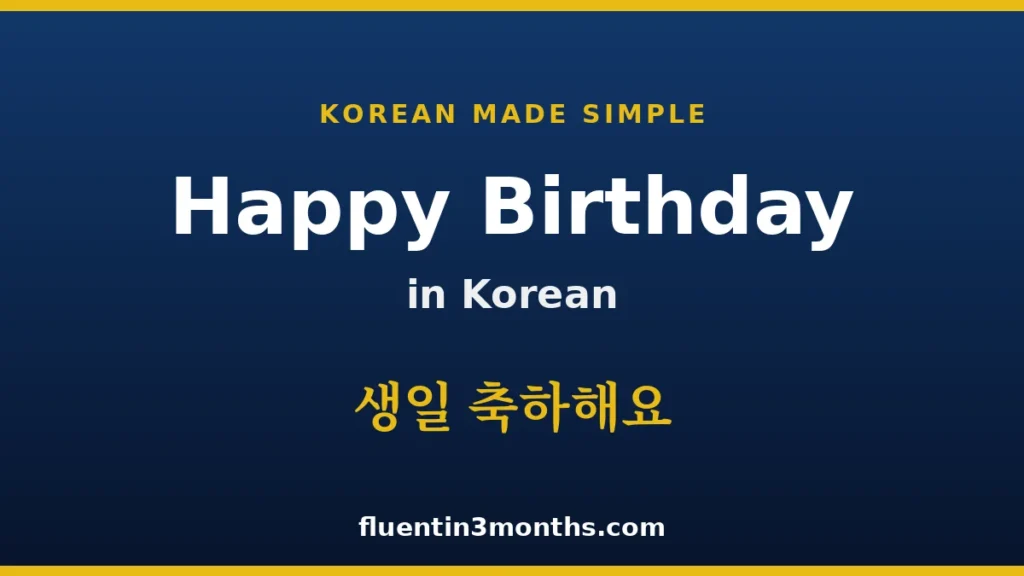
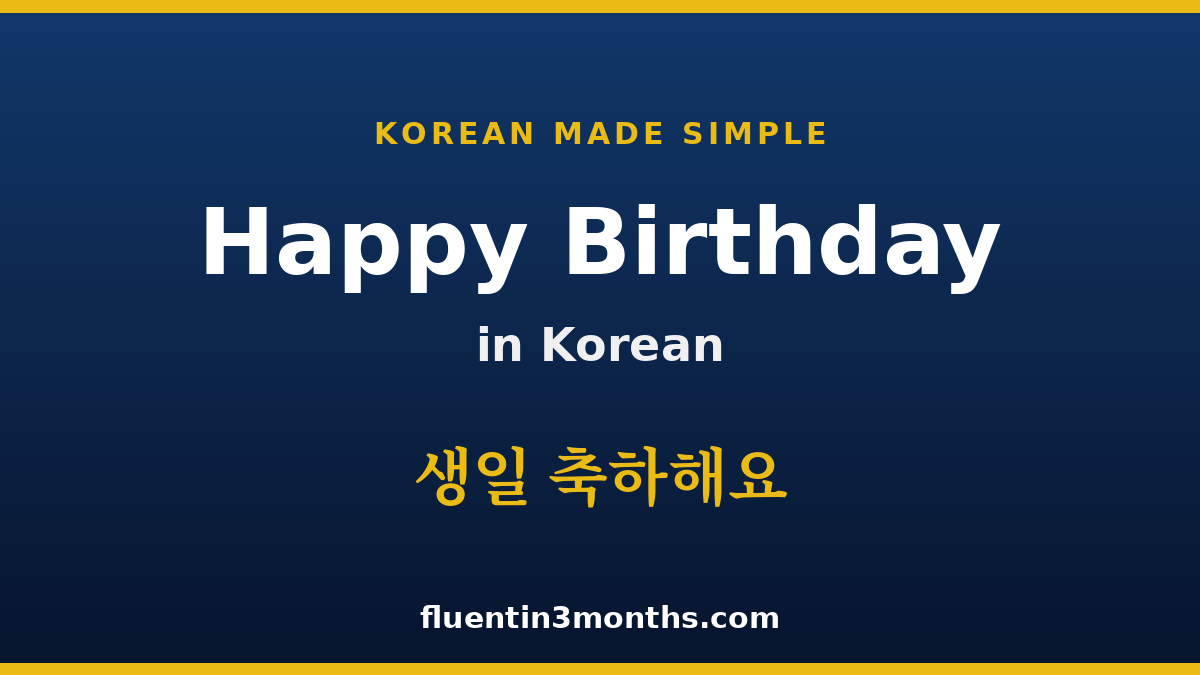
The most common and versatile way to express "Happy Birthday" in Korean is the phrase 생일 축하해요 (saengil chukhahaeyo). Mastering this greeting requires an understanding of the nuances inherent in the Korean language, where speech levels, honorifics, and social hierarchy dictate the appropriate choice of words. Unlike English, where a single phrase suffices for most social interactions, Korean greetings are deeply stratified based on the relationship between the speaker and the recipient, as well as the formality of the setting.
Linguistic Structure and Honorific Levels
At its core, the phrase "saengil chukhahaeyo" functions as a congratulatory expression. The term "saengil" translates to "birthday," while "chukha" derives from the noun for "congratulation." The final element, "-haeyo," serves as a polite sentence ending, making the phrase suitable for acquaintances, colleagues, and individuals with whom one is not on intimate terms.
The complexity of Korean social etiquette, however, extends beyond a singular greeting. To navigate Korean culture effectively, one must understand the distinction between "banmal" (casual, informal speech) and "jondaemal" (polite, formal speech). Casual speech is generally reserved for close friends or those younger than the speaker, though age alone does not dictate the use of informal language; mutual consent is the standard prerequisite.
For more formal or respectful contexts, the vocabulary itself shifts. When addressing elders, parents, or superiors, the standard word for birthday, "saengil," is replaced with the honorific "saengsin." Furthermore, the verb "haeyo" is replaced with the humble verb "deurida." Consequently, the formal, honorific expression becomes "saengsin chukhadeurimnida." This transition from casual to formal reflects the Confucian-influenced societal emphasis on hierarchy and filial piety.
Chronology and Evolution of Korean Birthday Traditions
Birthday celebrations in Korea are marked by specific cultural markers that have persisted through centuries. Central to these is the consumption of "miyeokguk," or seaweed soup. This tradition is rooted in the postpartum recovery period; because the soup is rich in iodine and calcium, it is traditionally served to new mothers. By consuming this soup on their birthday, individuals acknowledge their mother’s sacrifice and the physical toll of their birth.
The most significant early-life milestone in Korean culture is the "doljanchi," or first birthday celebration. Historically, when infant mortality rates were significantly higher, surviving the first year of life was a major achievement, warranting a formal gathering of family and friends. A defining ritual of the doljanchi is "doljabi," a predictive ceremony where the child is presented with various objects—such as thread, money, or a writing implement. The object the child selects is traditionally interpreted as a symbolic omen regarding their future vocation or prosperity.
The 2023 Regulatory Shift in Age Calculation
The methodology for determining age in South Korea underwent a significant transition in June 2023. Previously, the country utilized "seneun nai," or the "Korean age" system. Under this traditional framework, an individual was considered one year old at birth, and everyone collectively aged one year on January 1st of each calendar year. This system often resulted in a discrepancy where an individual could be one or two years older in the Korean system than by international standards.
To streamline administrative processes and minimize social confusion, the South Korean government mandated the adoption of "man nai," or the international age system, for all civil and administrative matters. While the legal framework now aligns with global standards, the traditional system remains deeply embedded in social discourse. In casual settings, Koreans may still reference their traditional age, as it is intrinsically linked to social hierarchies and the use of honorifics. For those navigating the complexities of social interactions, it is advisable to clarify the age calculation system if precise age is relevant to the formality of the greeting.
Data and Linguistic Analysis: The Impact of Honorifics
The use of language in Korea is not merely functional; it is a signal of social alignment. A 2022 analysis of sociolinguistic trends suggests that the rigid application of honorifics is slowly evolving in corporate environments, where a "horizontal" culture is being promoted to encourage creativity and efficiency. However, in the context of personal milestones like birthdays, traditional honorifics remain the gold standard of social etiquette.
The pronunciation of "saengil chukhahaeyo" presents a challenge for non-native speakers due to the phonetic nature of Hangul, the Korean alphabet. Hangul was developed in 1443 under King Sejong the Great, designed specifically to be intuitive, with consonant shapes modeled after the physiological movements of the tongue and throat. Relying on Romanization—the phonetic transcription of Korean into the Latin alphabet—often leads to inaccuracies. For instance, the "ch" in "chukha" is aspirated, and the "ae" sound requires a specific mouth position that does not have a direct equivalent in English.
Birthday Songs and Social Etiquette
In group settings, the "Happy Birthday" song is sung using the same melody as the internationally recognized English version. However, the lyrics are adapted into Korean. The standard lyrics utilize the formal "chukhamnida" ending, regardless of the age or social standing of the person being celebrated. This creates a uniform, respectful atmosphere during the song, even if the speakers might otherwise use casual language with the individual later in the conversation.
When writing cards or sending digital messages, the choice of phrasing is equally important. Simple, direct wishes are often preferred over overly flowery language. Common additions include phrases wishing for a "happy and healthy day" or expressing gratitude for the individual’s existence. Choosing the correct phrasing is less about complexity and more about identifying the appropriate level of distance or intimacy.
Implications for International Travelers and Learners
For those engaging with Korean culture, the primary takeaway is the importance of context. When in doubt, the polite form ("saengil chukhahaeyo") is the safest default. It is respectful enough to be used with superiors while being accessible enough for acquaintances. Saving the more deferential "saengsin chukhadeurimnida" for family elders or highly respected figures ensures that one remains within the bounds of appropriate social conduct.
The transition to the international age system and the ongoing evolution of language in the digital age have not diminished the significance of these rituals. Whether through the consumption of seaweed soup or the precise selection of a birthday greeting, these traditions continue to serve as a vital mechanism for maintaining social cohesion and expressing respect. By prioritizing the relationship dynamics over mere translation, learners of the language can ensure that their greetings are not only linguistically correct but also culturally resonant.
As South Korea continues to integrate more deeply into the global community, the standardizing of administrative procedures like age calculation highlights a broader trend of modernization. Yet, the enduring nature of birthday traditions—rooted in familial gratitude and historical rituals—suggests that the core of the culture remains firmly grounded in its history. Whether one is a tourist or a serious student of the language, the ability to navigate these social markers is an essential component of cross-cultural communication.