


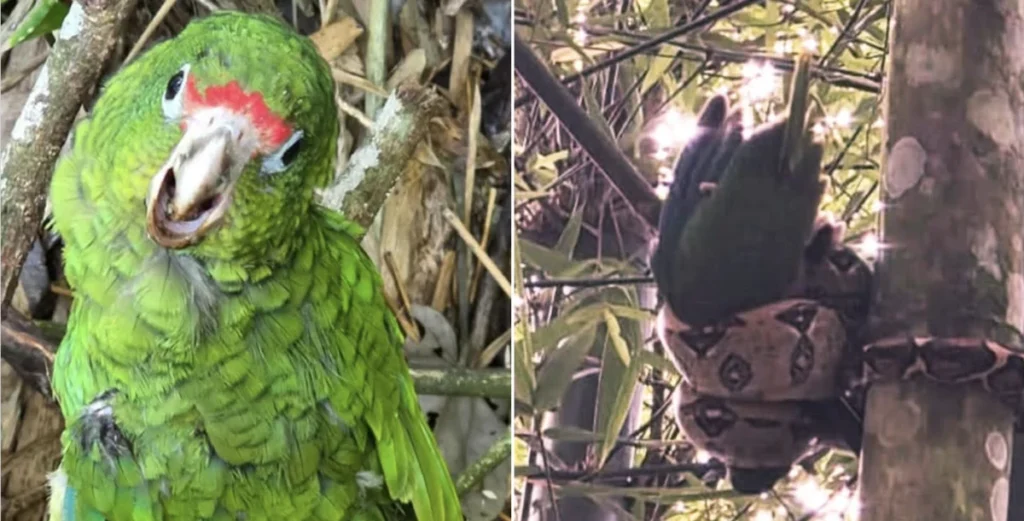
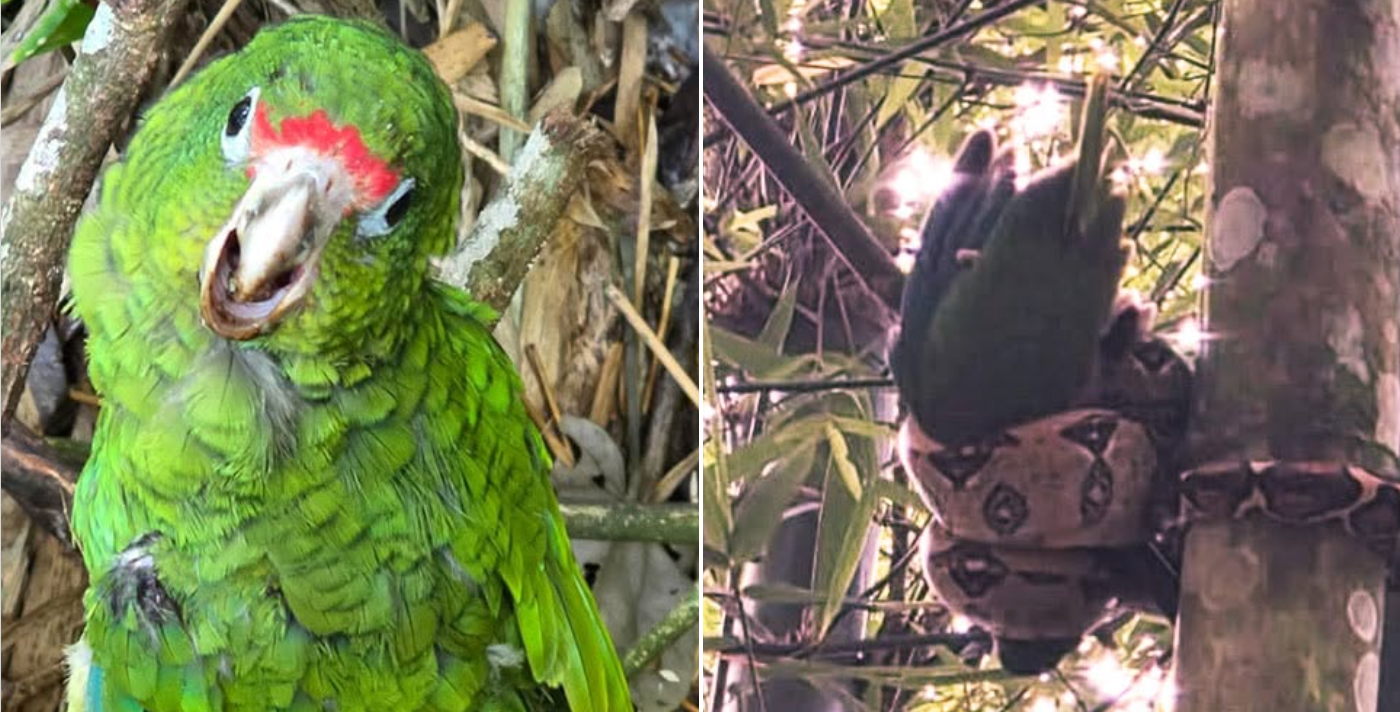
Deep within the lush, biodiverse canopy of the Maricao State Forest on the western end of Puerto Rico, a routine field observation turned into a high-stakes rescue operation. Raúl Correa, a wildlife biologist with the U.S. Fish and Wildlife Service (USFWS), was conducting standard monitoring work when he was alerted by a chaotic, distressed commotion echoing through the trees. Following the frantic squawks of a disturbed flock of birds, Correa discovered a dramatic and alarming scene: a young, critically endangered Puerto Rican parrot (Amazona vittata) trapped in the suffocating coils of a formidable red-tailed boa (Boa constrictor).
The predator had cornered its prey on a slender bamboo stalk, wrapping its muscular body around the juvenile bird. Recognizing the urgency of the moment and the immense conservation value of the individual parrot—a species teetering on the absolute brink of extinction—Correa took immediate action. With a swift cut to the bamboo stalk supporting the struggle, he disrupted the predator’s leverage, forcing the snake to lose its grip and release the captive bird. Following the tense rescue, USFWS personnel carefully monitored the juvenile parrot to assess its physical condition and check for internal or external injuries. Miraculously, the young bird demonstrated remarkable resilience; just a day after the harrowing encounter, it was observed successfully rejoining its flock and soaring through the island canopy once again.
While this particular story concluded with a rare victory for conservationists, it serves as a stark, micro-level illustration of a macro-level ecological crisis unfolding across the Caribbean. The red-tailed boa is not a native inhabitant of Puerto Rico. Originating in South America, these non-native constrictors were introduced to the island during the 1990s, primarily driven by the illicit and unregulated exotic pet trade. Escaped or intentionally released pets found an accommodating tropical climate, an abundance of naive prey, and a critical ecological vacuum: an absence of apex predators capable of keeping their population growth in check. Without natural checks and balances, the invasive boas have multiplied exponentially, expanding their geographic range and wreaking havoc on vulnerable native fauna.
The Ecological Contrast: Native versus Invasive Serpents
To fully understand the severity of the threat posed by the red-tailed boa, wildlife biologists emphasize the stark biological differences between the invasive species and Puerto Rico’s native serpentine life. The island is historically home to the Puerto Rican boa (Chilabothrus inornatus), a native constrictor that typically reaches lengths of up to seven feet. While the native boa is an integral and balanced component of the local ecosystem, the invasive South American counterpart is a vastly different ecological force.
Red-tailed boas are capable of growing well beyond 10 feet in length, boasting a larger mass, broader diet, and higher reproductive capacity. Furthermore, scientific research underscores that the threat extends far beyond direct predation. A landmark 2023 study published in the Caribbean Journal of Science revealed that invasive red-tailed boas have introduced novel pathogens, specifically reptarenaviruses, to the island. These pathogens pose a severe, latent health risk to native snake populations that lack historical immunity, threatening to destabilize multiple rungs of the island’s trophic web simultaneously.
Island Vulnerability and the Amplifying Threat to Avian Conservation
Island ecosystems are globally recognized by conservation biologists as uniquely fragile laboratories of evolution. Because island species often evolve in isolation without heavy mammalian or reptilian predator pressure, they frequently lack behavioral defenses against aggressive ambush predators like large constrictors. The Puerto Rican parrot, which has faced decades of intensive, multi-agency recovery efforts after its wild population dwindled to near-zero numbers in the 20th century, is particularly susceptible.
The loss of even a single juvenile parrot represents a measurable setback for recovery programs that rely on captive breeding, hacking, and vigilant nest monitoring to eke out population gains. The Maricao State Forest, where Correa made his discovery, serves as one of the critical strongholds for these green-and-red-feathered avians. When apex invasive predators infiltrate these designated sanctuaries, the margins for conservation error shrink dramatically.
Voices from the Scientific and Conservation Communities
The incident has reignited urgent discussions among federal and territorial wildlife authorities regarding the trajectory of invasive species management in the Caribbean. Experts emphasize that the current trajectory is unsustainable without a paradigm shift in resource allocation and eradication strategies.
"Experience has shown that island ecosystems are particularly vulnerable to snake invasions, and unfortunately Puerto Rico has no natural predators that can keep the numbers of these prolific snakes in check," stated USGS Director Marcia McNutt in previous evaluations of the island’s invasive species crisis. "Humans were responsible for introducing this scourge to the island, and are the only hope for mitigating the problem before it is too late for the native species."
Conservationists echo these sentiments, pointing out that public awareness campaigns and rapid-response removal networks are woefully underfunded compared to the reproductive output of the boas. Unlike continental regions where invasive species can sometimes migrate or disperse across vast borders, island populations are geographically contained, which theoretically offers a tactical advantage for containment—if sufficient capital and labor are deployed.
Comparative Regional Responses: Lessons from the Mainland
As Puerto Rico grapples with its constrictor crisis, land managers and conservation strategists frequently look to other U.S. jurisdictions combating similar biological invasions. Most notably, the state of Florida has grappled with an explosive population of invasive Burmese pythons (Python bivittatus) across the Everglades ecosystem.
To combat its python crisis, Florida institutionalized large-scale, high-profile mitigation events, such as the annual Florida Python Challenge. This heavily publicized competition invites both amateur outdoor enthusiasts and professional snake hunters from across the nation to capture and humanely euthanize invasive pythons, incentivizing the removal effort with substantial cash prizes and awards. While geographical and habitat differences between the Florida Everglades and the rugged, mountainous terrain of Puerto Rico prevent a direct, plug-and-play replication of the Python Challenge, conservationists argue that culturally engaging public-private partnerships and targeted bounty or removal programs could serve as a valuable framework for the territory.
The Broader Implications for Caribbean Biodiversity
The confrontation between a U.S. Fish and Wildlife Service biologist and a red-tailed boa over a single parrot is emblematic of a wider global conservation narrative: the relentless pressure of anthropogenic species displacement colliding with endemic biodiversity. As global trade continues to move plants, animals, and pathogens across natural oceanic and continental barriers, localized ecosystems bear the brunt of the biological fallout.
For Puerto Rico, the stakes could not be higher. The survival of the Puerto Rican parrot is not merely a matter of preserving a charismatic bird; it is a barometer for the health of the island’s remaining native forests. If apex invasive predators like the red-tailed boa are allowed to dominate the understory and canopy unchecked, the cascading ecological degradation will likely spell doom for numerous other endemic birds, reptiles, and mammals that share the habitat.
Mitigating this trajectory will require a sustained, generational commitment from federal agencies, territorial governments, local communities, and the scientific establishment. As biologists continue to patrol sanctuaries like the Maricao State Forest, interventions like Raúl Correa’s quick thinking provide vital breathing room, buying precious time for a fragile ecosystem while scientists search for scalable, long-term solutions to roll back the invasive tide.