



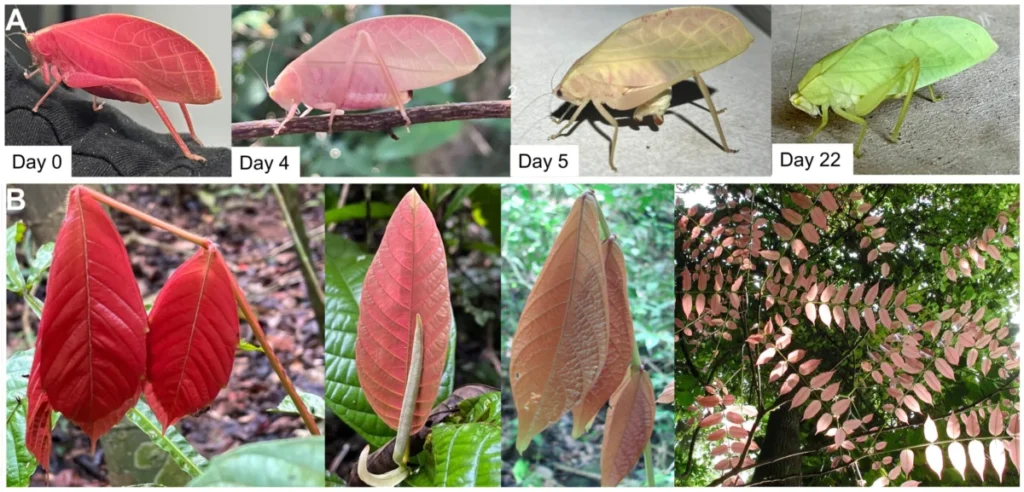
The tropical rainforests of Central America have long been regarded as some of the most biodiverse and enigmatic ecosystems on Earth, yet they continue to yield secrets that challenge fundamental biological assumptions. In a landmark discovery on Barro Colorado Island in Panama, an international team of scientists has documented a phenomenon never before recorded in the life cycle of the katydid: a complete and rapid color transformation within a single adult life stage. The subject, a leaf-masquerading katydid scientifically known as Arota festae, was observed transitioning from a vibrant, "hot pink" hue to a standard leafy green over the course of just eleven days. This finding, recently published in the journal Ecology, suggests that what was once dismissed as a rare genetic mutation may actually be a sophisticated evolutionary strategy designed to mirror the developmental stages of tropical vegetation.
The Midnight Discovery on Barro Colorado Island
The observation began during the nocturnal hours of a research expedition in March. Barro Colorado Island, managed by the Smithsonian Tropical Research Institute (STRI), serves as a premier site for tropical biology, providing a controlled yet wild environment for long-term ecological studies. It was near midnight when researchers, working under the glow of a research station light, spotted an individual that defied the typical emerald-green palette of the local insect population.
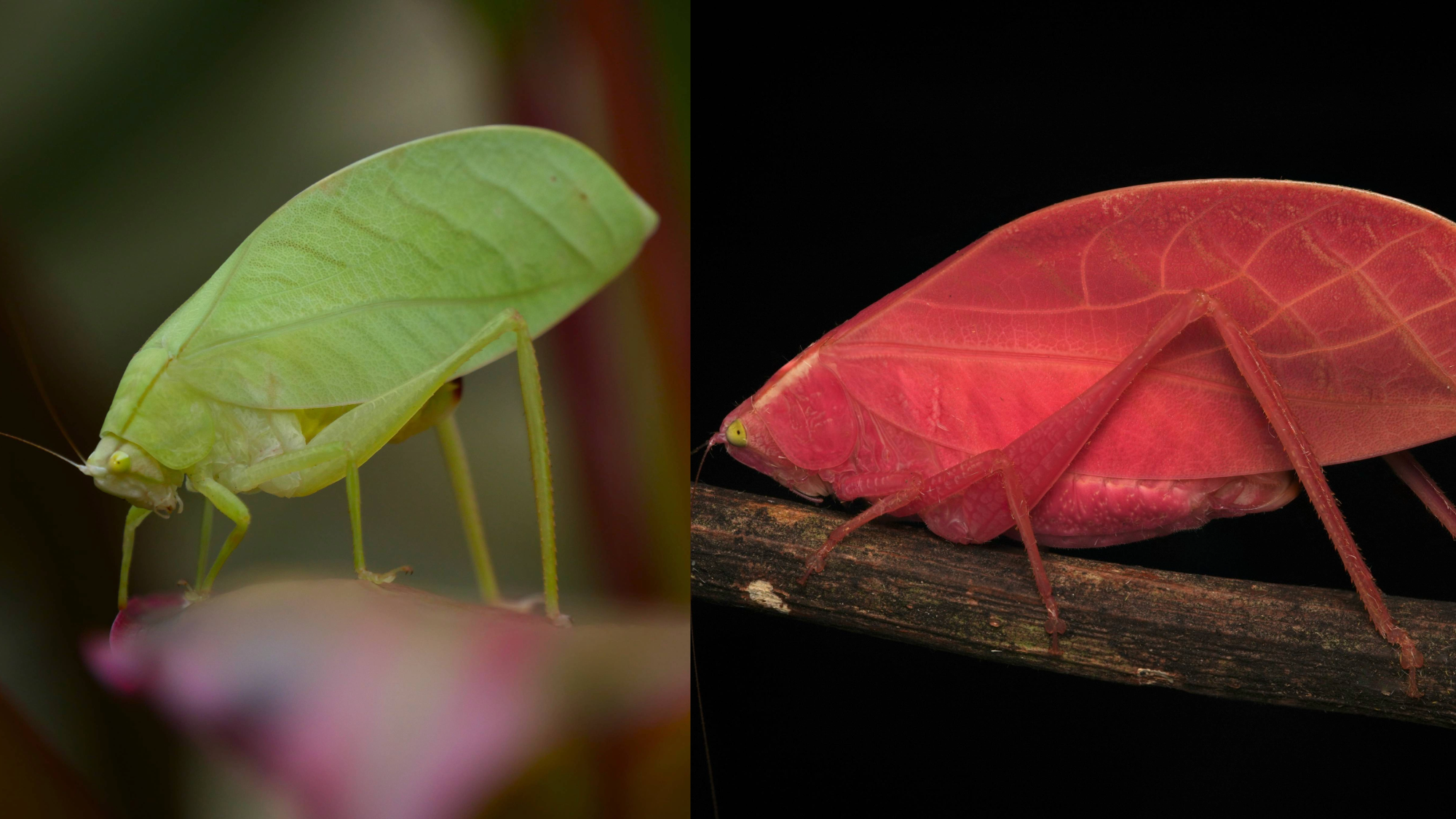
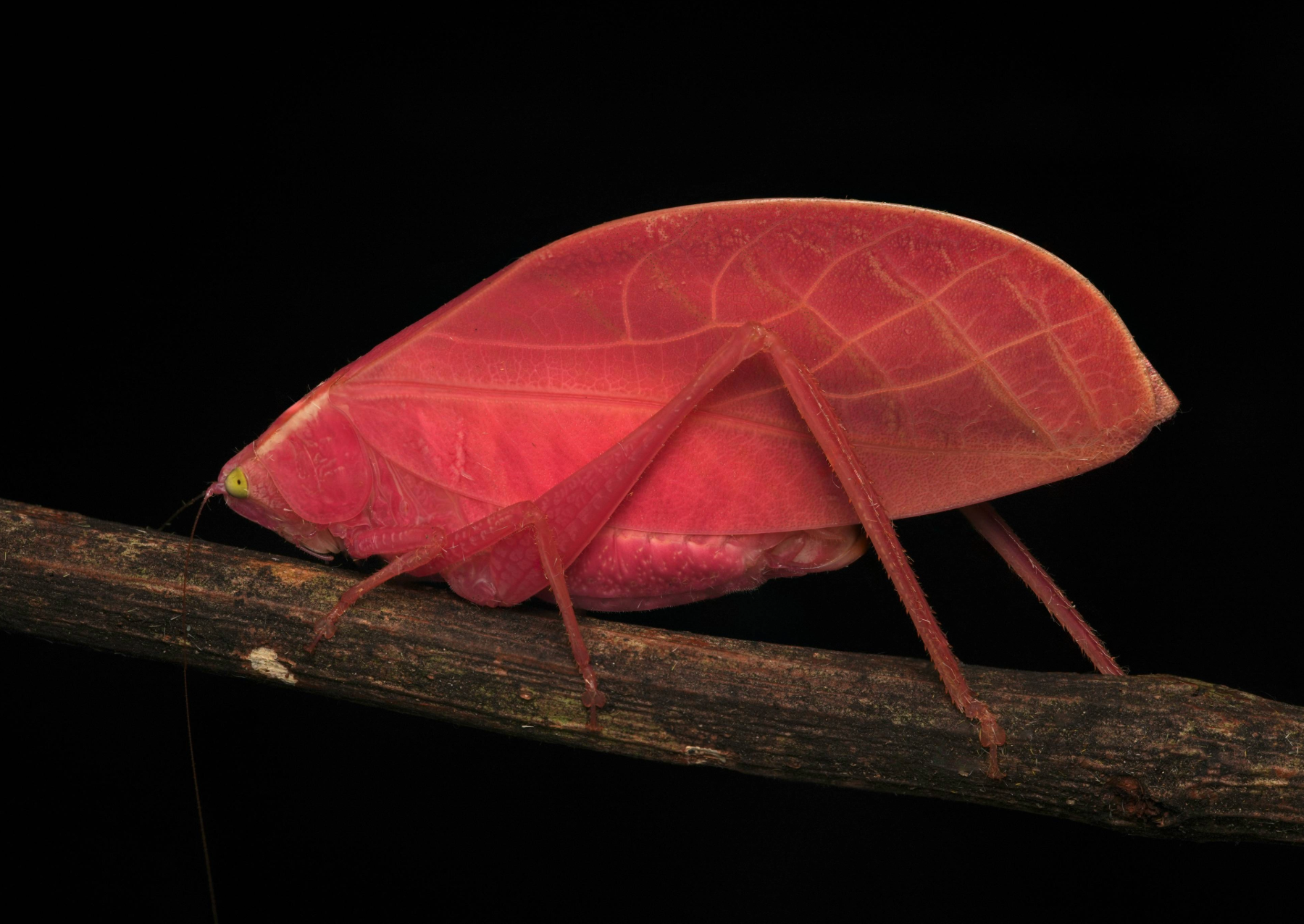
The specimen was an adult female Arota festae. While most members of this species are masters of crypsis—possessing wings that mimic the veins, spots, and texture of a healthy green leaf—this individual was a striking, neon pink. Historically, pink katydids have been treated as biological oddities. First documented in the late 19th century, these colorful variants were attributed to erythrism, a genetic condition similar to albinism that results in an overproduction of red pigments or a localized underproduction of green ones. Because such bright coloration usually makes an insect highly visible to predators, scientists long assumed these individuals were "evolutionary dead ends" with significantly reduced lifespans in the wild.
However, the team, led by Benito Wainwright of the University of St Andrews, opted to keep the insect under close observation rather than treating it as a mere curiosity. This decision led to the first recorded evidence of ontogenetic color change in an adult katydid, a discovery that fundamentally alters the understanding of insect camouflage.
A Chronology of Transformation
The research team monitored the female katydid for a total of 30 days, maintaining her in an environment that replicated the natural ambient temperature and humidity of the Panamanian rainforest. The speed of the physiological change was unexpected and followed a clear, documented timeline:
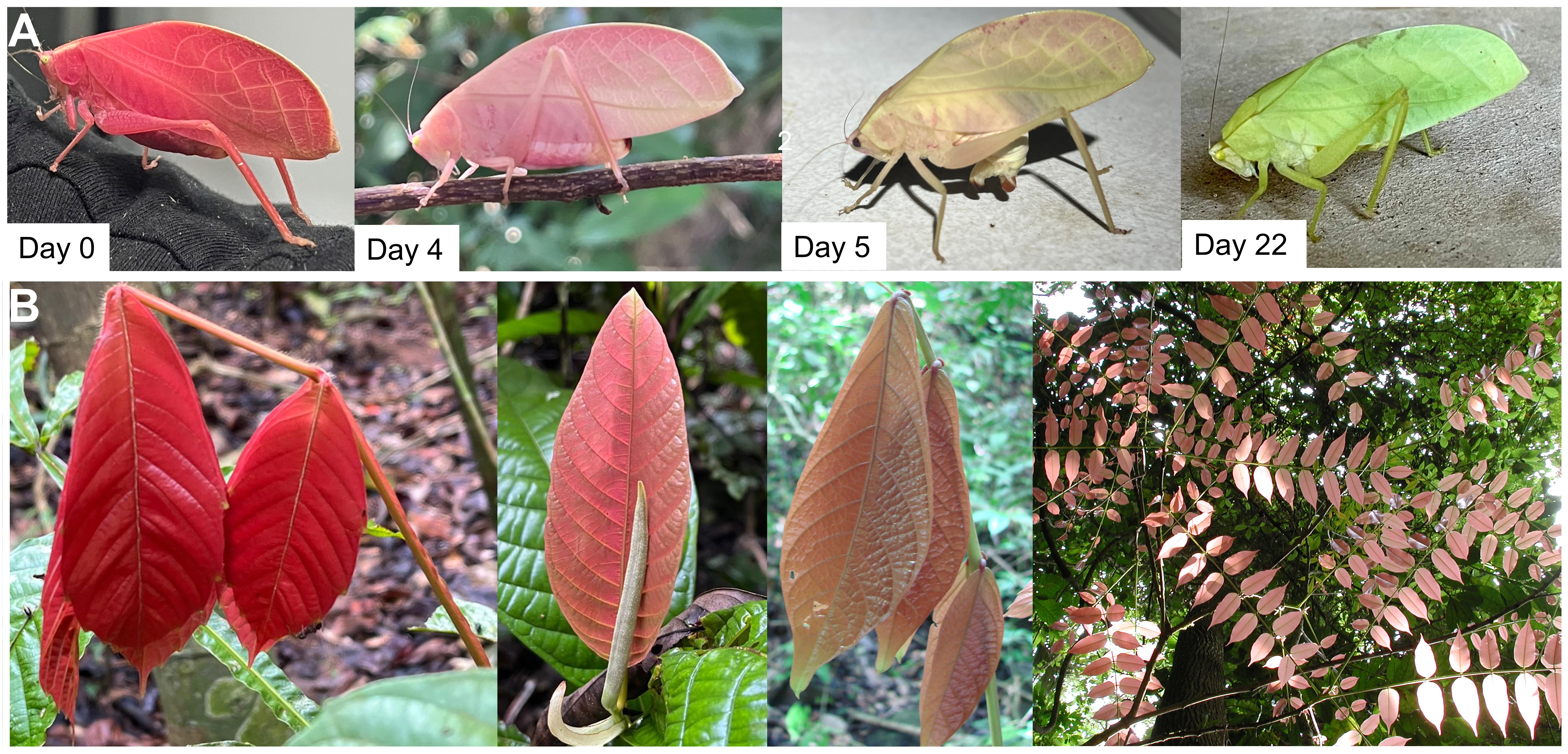
- Day 1 to Day 3: The insect maintained its intense, "hot pink" coloration. During this period, it remained highly conspicuous against green backgrounds, reinforcing the traditional view that such a color would be a liability.
- Day 4: The first signs of transition appeared. The vibrant magenta tones began to soften, fading into a muted, pastel pink.
- Day 5 to Day 10: The pink pigments continued to diminish, replaced gradually by yellow and light green tones. The transition appeared uniform across the thorax, abdomen, and the specialized wing structures that mimic leaf morphology.
- Day 11: The transformation was complete. The katydid was now indistinguishable from the standard green members of its species. The researchers noted that the green was not merely a surface tint but a deep, pigmented mimicry of a mature leaf.
This 11-day window is significant because it occurs within the adult stage of the insect’s life. While many insects change color as they molt from nymph to adult, a color shift of this magnitude in a fully formed adult—without the shedding of an exoskeleton—is an extraordinary biological feat.
The Theory of Delayed Greening Mimicry
The core of the study’s impact lies in the "why" behind this transformation. The researchers propose that the pink-to-green shift is not a mistake of nature, but a "finely tuned survival strategy" that tracks the life cycle of rainforest flora. This hypothesis centers on a botanical phenomenon known as "delayed greening."
In many tropical plant species, newly sprouted leaves do not begin their lives as green. Instead, they are infused with anthocyanins—pigments that produce red, pink, or purple hues. These pigments serve several protective functions for the young, vulnerable leaves: they act as a "sunscreen" against intense tropical UV radiation and may signal to herbivores that the leaf is either toxic or lacks nutritional value. As the leaf matures, toughens, and begins photosynthesis in earnest, the anthocyanins fade, and chlorophyll takes over, turning the leaf green.
"Rather than a bizarre genetic quirk, this may actually be a finely tuned survival strategy that tracks the life cycle of the rainforest leaves this insect is trying to resemble," stated Benito Wainwright. By starting its adult life as pink, the Arota festae may be specifically camouflaging itself among the new growth of the canopy. As the surrounding foliage transitions to green, the insect undergoes a parallel physiological change to maintain its invisibility.
Supporting Data and Biological Mechanisms
The study involved collaborators from the University of St Andrews, the University of Reading, the University of Amsterdam, and STRI. To understand the mechanism, the team had to look at the chemistry of insect coloration. Unlike chameleons, which use chromatophores to change color in seconds, insects typically rely on the accumulation or degradation of pigments like carotenoids and ommochromes within their cuticle and underlying tissues.
The rapid degradation of the pink pigment in Arota festae suggests an active metabolic process. The researchers are now investigating whether this change is triggered by environmental cues—such as the color of the background vegetation or light intensity—or if it is a fixed internal "timer" that coincides with the average rate of leaf maturation in the Panamanian jungle.
Data collected during the observation period also considered the role of predation. In the rainforest, katydids are a primary food source for a variety of "visual hunters," including birds like motmots and flycatchers, as well as monkeys and lizards. They are also targeted by "acoustic hunters" like gleaning bats, which use echolocation to find insects on leaves. While pink coloration might seem like a "high-vis jacket" for a bird, it is a perfect match for a cluster of young, reddish-pink tropical leaves.
Institutional Responses and Peer Analysis
The discovery has prompted a re-evaluation of historical records regarding erythrism in orthopterans (the order including grasshoppers and katydids). Dr. Matt Greenwell, a co-author from the University of Reading, noted the irony of the insect’s appearance. "You would think that a bright pink insect in a mostly green forest would stand out to predators… The idea that an insect might gradually shift color to keep pace with the leaves it mimics shows how dynamic the rainforest can be."
Other experts in the field of entomology have reacted with cautious excitement. The consensus is that this finding highlights the limitations of short-term field observations. Because most researchers only see a pink katydid for a moment before moving on, the assumption was always that the insect stayed pink until it died. The long-term monitoring conducted on Barro Colorado Island was essential to uncovering the truth.
This research also raises questions about other "rare" color variants in the insect world. If Arota festae can change color, it is highly probable that other species within the Tettigoniidae family possess similar, yet undocumented, capabilities.
Broader Impact and Future Implications
The implications of this study extend beyond the niche of entomology. It serves as a critical reminder of the complexity of evolutionary adaptation. In the context of climate change, understanding the timing (phenology) of these biological shifts is vital. If tropical trees change their leafing patterns due to shifting rainfall or temperature, and the insects’ color-change "timer" no longer aligns with the vegetation, these species could face sudden, intense predation pressure.
Furthermore, the discovery underscores the importance of protecting high-biodiversity areas like Barro Colorado Island. Such locations provide the necessary stability for scientists to conduct the patient, multi-week observations required to see nature’s slower processes in action.
Moving forward, the international team plans to conduct further experiments to determine the exact triggers of the color shift. They aim to test whether a pink katydid kept on a strictly green background will still change color, or if the process is slowed or accelerated by visual feedback. Additionally, they hope to use spectrophotometry to analyze the exact pigment composition of the pink stage versus the green stage.
In conclusion, the pink katydid of Panama is no longer a mere genetic fluke. It is a symbol of the sophisticated, ever-changing dance between predator and prey, and a testament to the hidden wonders that still exist within the world’s tropical canopies. By "standing out to blend in," Arota festae has provided science with a remarkable new example of how life adapts to the shifting colors of its environment.