

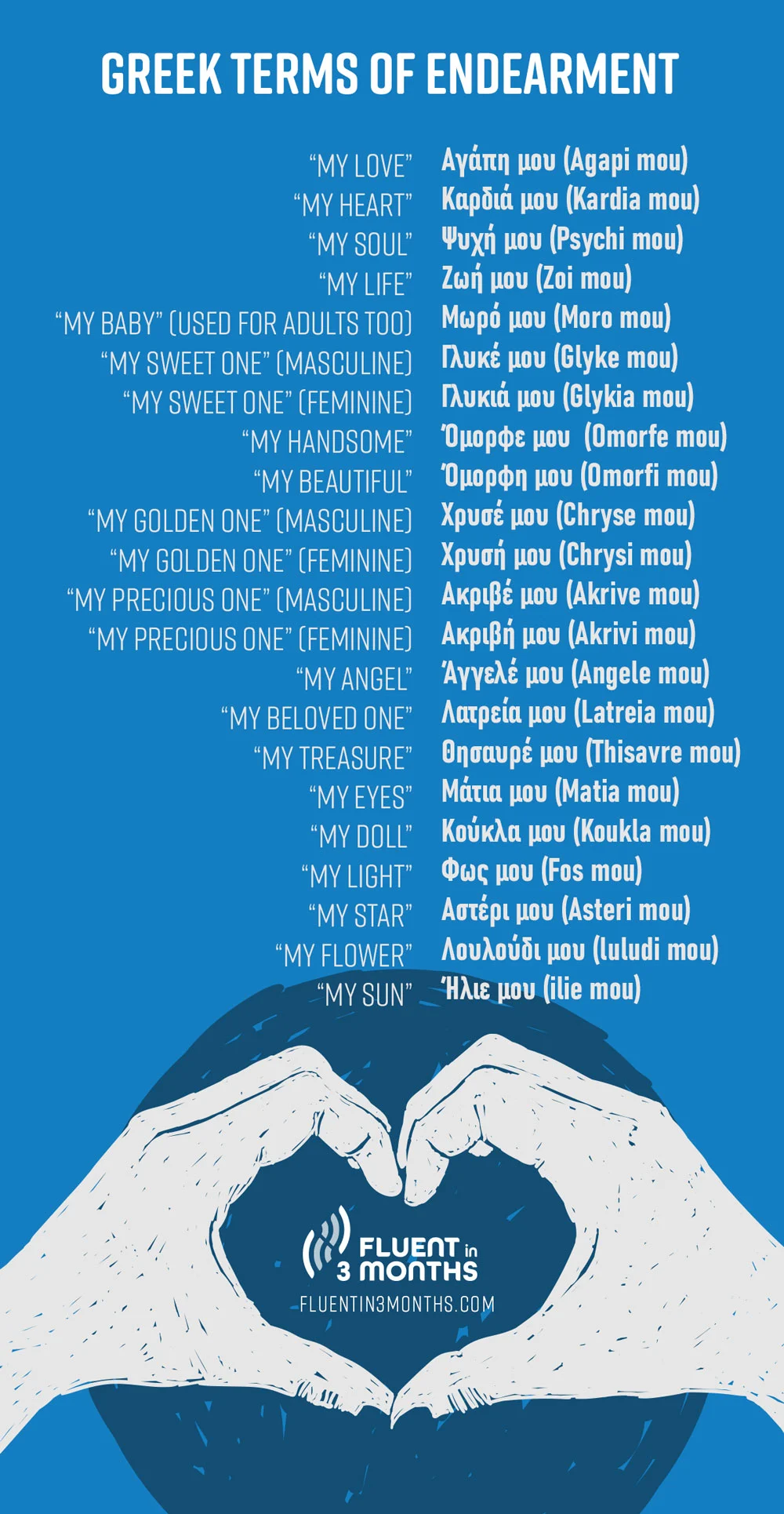
The Greek language, one of the oldest recorded living languages with a documented history spanning over 3,400 years, maintains a unique system of endearment that serves as a cornerstone of social cohesion and familial identity. Beyond the basic expression of affection, "S’agapo" (I love you), the Hellenic linguistic tradition utilizes a complex hierarchy of terms—ranging from "agapi mou" (my love) to "kardia mou" (my heart)—to define relationships and reduce social distance. As globalization increases intercultural romantic and professional unions, understanding the nuances of Greek endearment has transitioned from a niche linguistic exercise to a critical component of sociolinguistic fluency.
Historical Evolution and the Eight Pillars of Love
To understand modern Greek endearment, one must examine the philosophical foundations established in antiquity. Ancient Greek thinkers identified eight distinct types of love, a classification system that continues to inform the usage of modern terms. These include Eros (romantic, passionate love), Philia (deep friendship), Storge (familial affection), Agape (universal, unconditional love), Ludus (playful or uncommitted love), Pragma (long-standing, practical love), Philautia (self-love), and Mania (obsessive love).
Modern colloquialisms are often direct descendants of these concepts. For instance, the term "agapi mou" derives from "Agape," signifying a love that is profound and selfless. The transition from Ancient Greek to Koine, and eventually to Modern Demotic Greek, has preserved these distinctions, allowing speakers to navigate social interactions with high degrees of emotional precision. In 1976, when Dimotiki (the people’s language) was officially recognized as the standard for the Greek state, many of these traditional endearments were codified into everyday usage, moving away from the more rigid and formal Katharevousa.
The Grammatical Framework of Affection
The structural application of endearment in Greek is governed by specific grammatical rules, most notably the use of the enclitic possessive pronoun "mou" (my). In Greek syntax, the possessive must follow the noun, creating a rhythmic cadence in phrases such as "zoi mou" (my life) or "matia mou" (my eyes).
Furthermore, the language utilizes the vocative case for direct address. When a speaker uses an endearment term or a name to address someone, the ending of the word often changes. For example, the masculine adjective "omorfos" (handsome) becomes "omorfe" when used as a term of endearment ("omorfe mou"). This grammatical shift signals a transition from objective description to personal connection, a nuance that is frequently lost in English translations.
Categorization of Endearment by Social Relationship
Linguistic experts categorize Greek terms of endearment based on the intended recipient and the intensity of the relationship. These categories are not mutually exclusive but carry specific social weight.
Romantic Partnerships
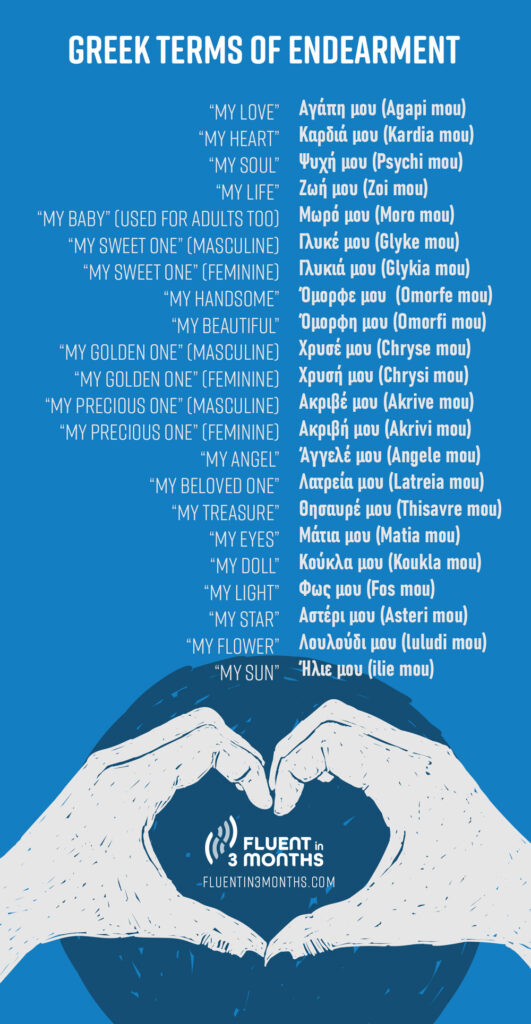
In romantic contexts, the most prevalent term remains "agapi mou." However, partners frequently employ more evocative imagery. "Kardia mou" (my heart) and "psychi mou" (my soul) are used to denote a level of intimacy where the partner is viewed as essential to the speaker’s own existence. For younger couples or in more casual stages of a relationship, "moro mou" (my baby) is common, though it is notably used for adults as well, unlike the more literal English counterpart which is often reserved for infants.
Familial Bonds and the Diminutive System
Family is the central unit of Greek society, and the language reflects this through "storge." A defining characteristic of familial Greek is the use of diminutives. By adding suffixes such as "-aki," "-itsa," "-oulis," or "-oula," speakers transform standard nouns into affectionate nicknames.
- "Mitera" (Mother) becomes "Manoula" (Mommy).
- "Pateras" (Father) becomes "Bambakas" or "Bambouli."
- Proper names like "Yiorgos" become "Yiorgaki," and "Maria" becomes "Marioula."
These suffixes do not merely imply smallness in size; they signify a "softening" of the relationship, conveying warmth and protection. Data from sociolinguistic studies indicate that the use of diminutives in Greek households remains high even among third-generation members of the Greek diaspora, serving as a primary link to cultural heritage.
Platonic and Social Endearment
Greek culture is characterized by an "outer-directed" social nature, where even strangers or casual acquaintances may be addressed with terms of endearment to foster a friendly atmosphere. Terms like "koukla mou" (my doll) or "glike mou" (my sweet one) are frequently used among friends. In marketplace settings or neighborhood interactions, it is common to hear "chryse mou" (my golden one) or "matia mou" (my eyes), which serve to lubricate social interactions and establish a baseline of mutual respect and "philotimo"—a complex Greek virtue representing honor and "love of honor."
Linguistic Data and Phonetic Considerations
The pronunciation of these terms is vital for their correct emotional delivery. The Greek language contains several phonemes that do not have direct equivalents in English, such as the "gamma" (γ), which is a voiced velar fricative, and the "chi" (χ), a voiceless velar fricative.
- Agapi (αγάπη): The ‘g’ is soft, similar to a voiced ‘h’ or the ‘y’ in ‘yellow’ when followed by certain vowels.
- Psychi (ψυχή): Requires the simultaneous pronunciation of ‘p’ and ‘s,’ followed by the breathy ‘ch’ sound similar to the ‘ch’ in the Scottish ‘loch.’
According to data from language acquisition platforms, these phonetic hurdles represent the primary challenge for non-native speakers attempting to integrate endearment into their vocabulary. However, the successful use of these terms is often cited by learners as the "turning point" where they feel a genuine connection to the Greek-speaking community.
Societal Impact and Global Diaspora
The influence of Greek endearment extends far beyond the borders of the Hellenic Republic and Cyprus. With a global diaspora estimated at over 7 million people, particularly in the United States, Australia, Canada, and Germany, these linguistic markers serve as a "cultural shorthand."
In major Hellenic hubs such as Melbourne, Australia—often cited as the city with the largest Greek population outside of Greece—the preservation of endearment terms is viewed by community leaders as a vital tool against cultural assimilation. Reactions from educators in the diaspora suggest that while younger generations may lose fluency in complex Greek syntax, they almost universally retain terms like "yia-yia" (grandma), "pappous" (grandpa), and "agapi mou." This "affective vocabulary" maintains the emotional infrastructure of the family unit across geographic distances.
Implications for Intercultural Communication
The use of Greek endearment terms in intercultural relationships provides a unique case study in "linguistic borrowing." When a non-Greek partner adopts these terms, it is often perceived by the Greek partner and their family as a significant gesture of respect and integration.
Linguistic analysts suggest that the "possession" inherent in these terms—the constant use of "mou"—actually reinforces a sense of belonging and security. In an era of digital communication, where emotional nuance can be lost in text, the inclusion of "kardia mou" or "asteri mou" (my star) provides a layer of warmth that standard English often lacks.
Conclusion: The Enduring Power of the Hellenic Voice
The persistence of these terms of endearment in the 21st century highlights the resilience of the Greek language. While modern technology and global English have altered the vocabulary of business and science, the vocabulary of the heart remains remarkably consistent with its ancient roots.
For the language learner or the romantic partner, mastering these terms is not merely about memorizing a list of words; it is about participating in a centuries-old tradition of emotional expression. Whether it is the protective "angele mou" (my angel) or the reverent "latreia mou" (my worship), these expressions continue to define the Greek experience, proving that language is not just a tool for communication, but a vessel for the soul. As the Greek diaspora continues to evolve, these "words of the heart" will undoubtedly remain the primary threads in the fabric of Hellenic identity worldwide.