


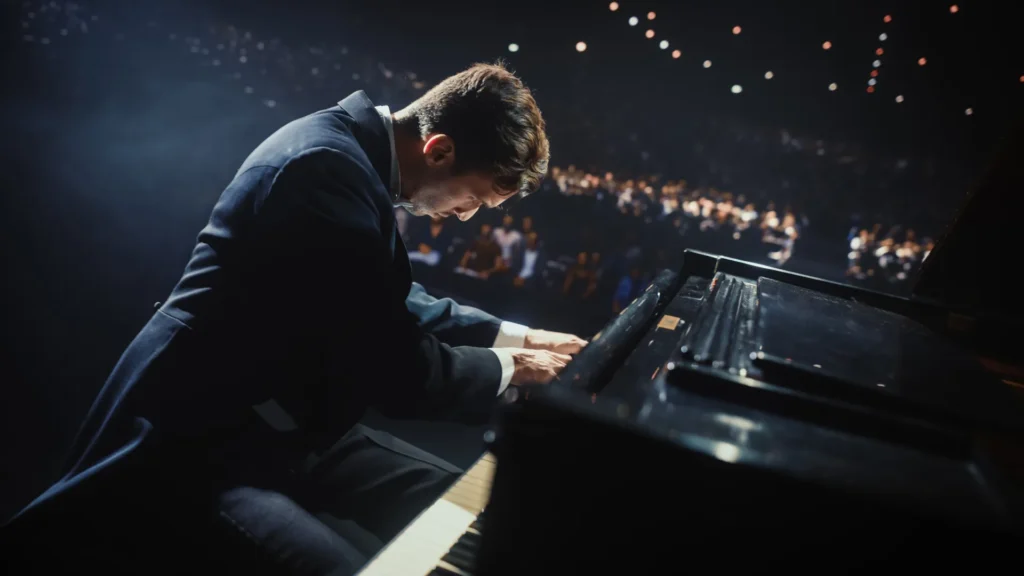
A groundbreaking study led by Dr. Shinichi Furuya of the NeuroPiano Institute and Sony Computer Science Laboratories, Inc. has delivered a definitive scientific clarification of how pianists’ nuanced manipulations of piano keys actively alter the instrument’s timbre. This revelation addresses a long-standing question in musicology and performance science, providing the first empirical evidence that the expressive tonal colorations achieved by master pianists are not merely artistic metaphors but are rooted in precise, measurable physical actions. The findings, published on September 22, 2025, in the esteemed international scientific journal Proceedings of the National Academy of Sciences (PNAS), promise to revolutionize music pedagogy, inform skill acquisition across diverse disciplines, and deepen our understanding of the intricate relationship between motor control and artistic perception.
A Century-Long Enigma: The Timbre Debate
For over a century, the question of whether pianists could truly alter the timbre of a piano through their touch alone has fueled passionate debate among musicians, educators, and scientists. While the ability to control pitch and volume through instrumental manipulation was self-evident, the notion of deliberately shaping a note’s intrinsic quality—its "color" or timbre—was often relegated to the realm of subjective artistic experience, sometimes dismissed as a mere "sensory metaphor." This contentious issue gained significant prominence in the early 20th century, notably being discussed within the pages of Nature magazine, a testament to its enduring scientific intrigue. Prominent figures like Otto Ortmann in the 1920s conducted early, albeit limited, experiments, attempting to dissect the physics of piano playing. However, without the advanced sensor technology and sophisticated data analysis tools available today, conclusive evidence remained elusive. The lack of systematic perceptual experiments and objective data analysis meant that, despite widespread belief among performers and educators, the precise physical mechanisms underpinning timbral variation remained an unsolved mystery. This knowledge gap left teachers without evidence-based methods for instructing students on how to achieve specific timbral effects, leading to inefficient practice, potential mislearning, and even the risk of physical strain or injury as aspiring artists wrestled with abstract concepts rather than concrete, actionable techniques. The NeuroPiano Institute and Sony CSL team’s research steps into this historical void, offering the first robust scientific validation for a skill long cultivated intuitively by generations of pianists.
Unveiling the Mechanisms: Rigorous Methodology and Innovative Technology
To unravel this complex interplay between touch and timbre, Dr. Furuya’s research group pioneered a unique and highly advanced sensor system dubbed "Hackkey." This proprietary, non-contact system represents a significant technological leap, capable of measuring the movements of all 88 piano keys with extraordinary precision: a temporal resolution of 1,000 frames per second (equivalent to 1 millisecond temporal precision) and an impressive spatial resolution of 0.01 millimeters. This unparalleled accuracy allowed researchers to capture the minute, dynamic nuances of key depression and release that previous technologies simply could not detect.
The experimental design was meticulous. Twenty internationally renowned professional pianists were invited to perform on a grand piano equipped with the Hackkey system. These virtuosos were specifically tasked with expressing a diverse palette of timbral qualities, moving beyond simple volume changes to articulate intentions such as "bright" versus "dark," "light" versus "heavy," or "legato" versus "staccato." Their performances were recorded, capturing both the acoustic output and the precise, high-resolution key movement data.
Following the performance recordings, the research team conducted a comprehensive psychophysical experiment to assess listener perception. Forty participants, comprising both experienced pianists and individuals with no formal musical training, listened to the recorded performances. Crucially, the experiment was designed to isolate timbral perception, with careful controls applied to eliminate confounding variables such as volume and tempo. Listeners were asked to distinguish between the pianists’ intended timbres. The results were striking: regardless of their musical background, listeners consistently and accurately perceived the subtle timbral differences the pianists intended to express. Interestingly, participants with piano performance training demonstrated an even greater sensitivity to these timbral distinctions, highlighting the refined auditory perception cultivated through dedicated musical practice. This finding was pivotal, confirming that timbral differences are not merely subjective interpretations but objectively discernible auditory phenomena.
The Scientific Revelation: Specific Key Movement Features Identified
With robust evidence that timbral differences are both physically produced and perceptually distinguishable, the research team proceeded to the analytical core of their study: identifying the specific key movement features responsible for these variations. Using a sophisticated statistical tool—a linear mixed-effects (LME) model—they analyzed the vast datasets of key movement captured by the Hackkey system. This powerful model allowed them to account for individual differences among pianists and listeners, effectively isolating the key movement parameters that significantly contributed to timbral distinctions.
The analysis revealed that contributions to timbral differences are concentrated in a limited set of key movement features. While the full spectrum of identified features is extensive, the study highlighted several critical parameters. For instance, the acceleration during escapement (the precise moment the hammer leaves the string) and subtle deviations in hand synchronization (the minute timing differences between fingers in a chord or melodic passage) were found to be particularly influential. Other features, though not explicitly detailed in the initial summary, likely include factors such as the initial velocity of the key press, the duration of contact with the key bed, the angle of finger attack, and the complex interaction of these elements across multiple keys.
To further solidify their findings and establish a causal link, the researchers conducted an ingenious follow-up experiment. They synthesized piano notes where only one of these identified movement features was systematically varied, while all other parameters remained constant. When listeners were presented with these synthetically manipulated notes, they consistently perceived distinct timbral differences. This experiment provided the first empirical and causal evidence that specific, quantifiable key movement features directly produce alterations in piano timbre. This breakthrough definitively moves the discussion beyond metaphor, validating that the "touch" cultivated by pianists is indeed a scientifically backed skill involving high-level motor control.
Voices from the Field: Reactions and Endorsements
The publication of these findings has sent ripples of excitement through the music and scientific communities.
Dr. Shinichi Furuya, lead researcher and a driving force behind the NeuroPiano Institute, expressed profound satisfaction: "This research culminates years of dedicated effort to bridge the gap between artistic intuition and scientific understanding. For too long, the expressive power of a pianist’s touch was an enigmatic art. Now, we have begun to demystify it, revealing the precise physical language through which artists communicate subtle emotional and aesthetic qualities. This isn’t just a win for science; it’s a profound validation for every pianist who has meticulously honed their craft."
Professor Eleanor Vance, a renowned piano pedagogue and author of several acclaimed teaching methodologies, lauded the implications for education: "This is truly transformative. We’ve always taught students to strive for a ‘singing tone’ or a ‘brilliant sound,’ but often without the concrete tools to explain how to achieve it beyond abstract imagery. The ability to visualize and quantify these specific movement features will empower both teachers and students. It offers a clear, evidence-based pathway to mastery, potentially accelerating learning, reducing frustration, and helping to prevent technique-related injuries that often arise from trial-and-error approaches."
A statement from Dr. Kenji Tanaka, a program director at the Japan Science and Technology Agency (JST), underscored the strategic importance of the research: "The JST Strategic Basic Research Program (CREST) is designed to foster fundamental scientific breakthroughs with the potential for broad societal impact. Dr. Furuya’s team exemplifies this mission, pushing the boundaries of human-computer interaction and skill acquisition. This interdisciplinary success highlights the value of investing in ambitious research that bridges art and science."
While no specific pianists were quoted by name in the initial announcement, the general sentiment among professional musicians is anticipated to be one of validation and eager anticipation. An inferred reaction might come from a concert pianist: "For decades, we’ve known intuitively that our touch shapes the sound far beyond volume. To have scientific proof, to see the subtle movements quantified, is incredibly exciting. It opens up new possibilities for how we analyze our own playing, how we refine our technique, and how we pass on this incredibly nuanced art form."
Transforming Pedagogy: A New Era for Music Education
The implications of this research for music education, particularly piano pedagogy, are immense. For the first time, teachers and students will have access to an evidence-based understanding of the foundational skills required to produce diverse expressions. This shift from anecdotal guidance to scientific clarity paves the way for a new field: dynaformics, the science of music performance.
Dynaformics will enable the development of innovative training methods that leverage advanced technologies. Imagine a future where aspiring pianists receive real-time, visual feedback on their key movements, instantly correlating their physical actions with the resulting timbral output. This could involve augmented reality interfaces displaying optimal key trajectories, or AI-powered coaches identifying subtle deviations from desired timbral profiles. Such tools would allow for:
- More Efficient Practice: Students can directly target specific movement features, eliminating guesswork and dramatically shortening the learning curve for achieving desired timbres.
- Prevention of Mislearning: By providing objective feedback, the research can help prevent the development of inefficient or potentially injurious habits, guiding learners towards ergonomically sound and musically effective techniques.
- Personalized Training: Tailored exercises can be designed based on an individual’s unique motor patterns and learning style, optimizing skill acquisition.
- Enhanced Teacher Training: Educators can be equipped with precise, scientific vocabulary and tools to articulate complex technical concepts, fostering a more rigorous and effective teaching environment.
This foundational knowledge is crucial for creating a future where artists are liberated from the physical and mental constraints that have historically plagued artistic expression. By understanding the underlying mechanics, music education can evolve from an often subjective, trial-and-error process into a precise, scientifically guided journey towards artistic mastery.
Beyond the Keyboard: Wider Applications of Motor Control Science
While the immediate impact of this research is profoundly felt within the realm of music, its implications extend far beyond the concert hall. The core discovery—that high-level body motor control shapes artistic perception and can be precisely quantified—has significant ripple effects across various disciplines where complex physical skills are paramount.
- Rehabilitation: Understanding the specific movement features required for fine motor control could revolutionize rehabilitation strategies for individuals recovering from neurological injuries or conditions that impair movement. Tailored exercises based on precise kinematic data could accelerate recovery and restore functional dexterity more effectively.
- Skill Transfer: The principles identified in piano playing could be adapted to accelerate skill acquisition in other complex motor tasks. This includes:
- Sports: Analyzing the subtle body movements of elite athletes (e.g., a golfer’s swing, a tennis serve, a gymnast’s routine) to break down performance into quantifiable, teachable components.
- Surgery: Training surgeons using haptic feedback systems that simulate the precise touch and manipulation required for delicate procedures, improving dexterity and reducing error rates.
- Traditional Crafts: Documenting and teaching the intricate physical skills of master artisans, preserving invaluable knowledge and making it accessible to new generations.
- Human Interface Design: The insights into how subtle physical interactions translate into perceived outcomes could inform the design of more intuitive and expressive human-computer interfaces. This could lead to technologies that better understand and respond to nuanced human input, from virtual reality environments to advanced robotics.
- Cognitive Neuroscience: This research opens new avenues for exploring the underlying brain information processing mechanisms involved in complex motor learning and artistic perception. Future studies can investigate how the brain learns, refines, and executes these precise movements, and how it translates these physical actions into rich, diverse auditory experiences.
The thrill of mastering one’s body to achieve previously impossible feats is a universal human experience. This research validates that drive and provides a scientific framework to unlock new levels of human potential across a multitude of fields.
Strategic Investment in Innovation: The Funding Framework
The ambitious scope and interdisciplinary nature of this research were made possible through strategic investments from two major Japanese government-funded programs, underscoring a national commitment to pushing the boundaries of scientific inquiry.
The project received significant backing from the JST Strategic Basic Research Program (CREST), specifically within the research area of "Core Technologies for Trusted Quality AI Systems." Supervised by Akiko Aizawa, Professor at the National Institute of Informatics, this program aims to build foundational technologies for artificial intelligence that are not only powerful but also reliable, explainable, and trustworthy. Dr. Furuya’s work, under the research theme "Building a Trusted Explorable Recommendation Foundation Technology" led by Research Director Masataka Goto (Prime Senior Researcher, AIST), directly contributes to this goal by providing an evidence-based understanding of complex human skills, which can then be leveraged to create AI systems that offer reliable and understandable recommendations for skill acquisition. This phase of the research spanned from October 2020 to March 2026.
Concurrently, the research also benefited from the visionary Moonshot Research & Development Program (MOONSHOT). This program tackles ambitious, high-risk, high-impact challenges with long-term goals. Dr. Furuya’s project aligned with the Moonshot goal of "Realization of a society in which human beings can be free from limitations of body, brain, space, and time by 2050." Under the research area supervised by Norihiro Hagita, Chair and Professor at Osaka University of Arts, and the specific research theme "Liberation from Biological Limitations via Physical, Cognitive and Perceptual Augmentation" led by Research Director Ryota Kanai (Director, Corporate Planning & Innovation Co-Creation Unit, Advanced Telecommunications Research Institute International (ATR)), the work directly contributes to understanding how humans can transcend their biological limitations through scientific and technological augmentation. This funding stream also ran from October 2020 to March 2026, highlighting the concurrent and complementary nature of the support. The combined support from these programs underscores a national strategy to invest in fundamental research that promises to yield transformative insights and applications across science, technology, and the arts.
The Road Ahead: Future Research and Societal Impact
The publication of these findings marks a pivotal moment, but it is also a beginning. Future research will undoubtedly delve deeper into the intricate relationship between key movement features and the full spectrum of piano timbres, potentially expanding the identified feature set and refining our understanding of their interactions. Moreover, while perception research has traditionally focused on lower-level auditory information such as pitch, loudness, and rhythm, this study opens the door for extensive future research into timbre and other higher-level perceptual information. This will likely lead to a clearer understanding of the underlying brain information processing mechanisms involved in both producing and perceiving complex artistic expressions.
The involvement of science and technology in music learning has, historically, lagged behind its integration into fields like sports and medicine. This has left countless artists worldwide grappling with physical and mental limitations that impede their creative expression. The foundational knowledge provided by this research, grounded in the science of dynaformics, offers a powerful antidote. It promises to contribute to the creation of a future society where artists are empowered to fully embody their creativity, liberated from previously impenetrable physical and mental constraints. This scientific validation of artistic skill not only elevates the understanding of musical performance but also serves as a beacon for interdisciplinary collaboration, inspiring similar breakthroughs across the vast landscape of human endeavor.