


The Turkish language, a primary branch of the Turkic language family, serves as a vital bridge between Eastern Europe and Western Asia, spoken by approximately 80 million people worldwide. For expatriates, business travelers, and students of linguistics, mastering the Turkish numerical system is not merely an academic exercise but a functional necessity for navigating daily life in the Republic of Turkey. From the bustling Grand Bazaar in Istanbul to the corporate boardrooms of Ankara, numbers dictate the flow of commerce, social interaction, and logistical planning. Unlike many Indo-European languages that feature irregular numbering patterns, Turkish offers a highly logical, agglutinative structure that, once understood, allows for the rapid construction of complex figures and mathematical concepts.
The Linguistic Architecture of Turkish Numerals
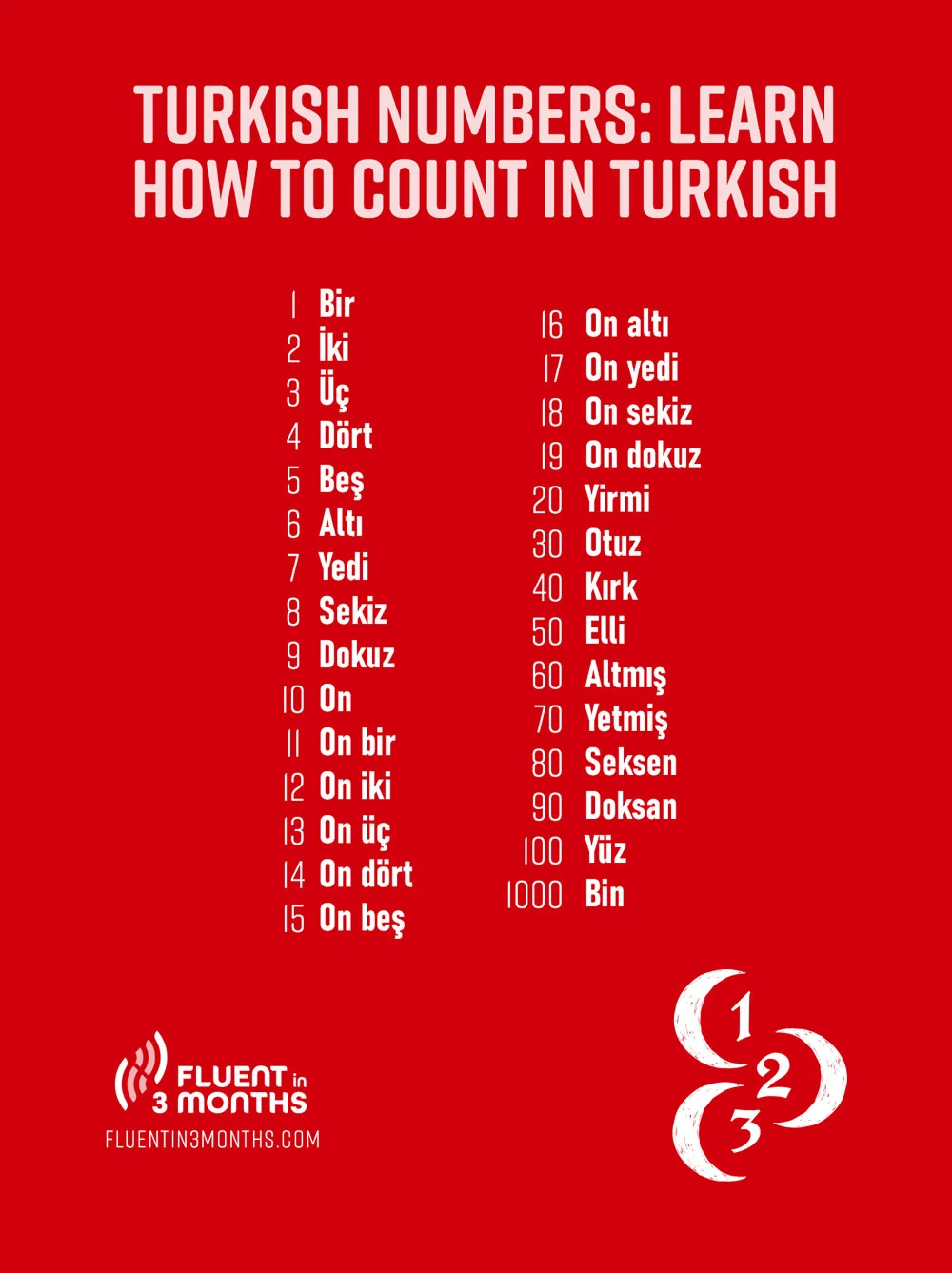
The foundation of the Turkish counting system is built upon the primary digits one through ten. These ten words are the essential building blocks for the entire numerical lexicon. Linguists often point to the phonetic efficiency of these terms as a reason for their durability across centuries of linguistic evolution.
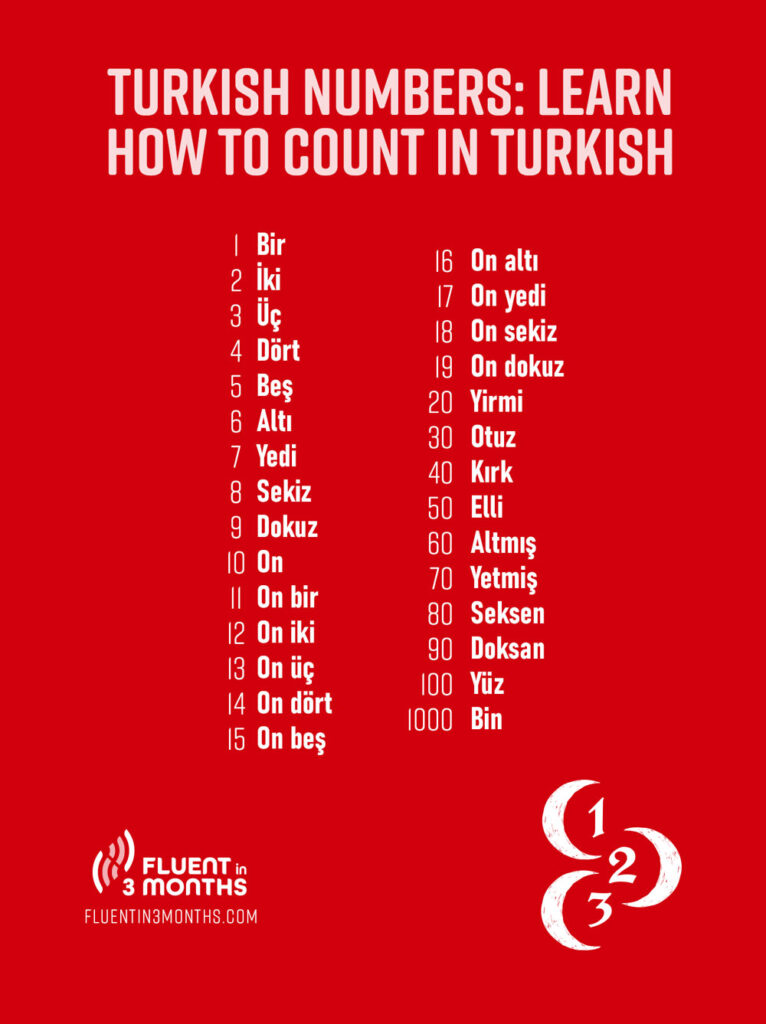
The primary digits are as follows:
1 – Bir
2 – İki
3 – Üç
4 – Dört
5 – Beş
6 – Altı
7 – Yedi
8 – Sekiz
9 – Dokuz
10 – On
In contrast to languages such as English or French, which utilize unique terms for the "teens" (e.g., eleven, twelve, treize, quatorze), Turkish employs a strictly additive logic. To express numbers between 11 and 19, the speaker simply places the word for ten (on) before the single digit. Consequently, 11 becomes on bir (ten-one), 12 becomes on iki (ten-two), and 19 becomes on dokuz (ten-nine). This systematic approach significantly reduces the cognitive load for new learners and reflects the broader mathematical precision inherent in Turkic grammar.
Scaling Up: Tens, Hundreds, and Thousands
Advancing beyond the initial twenty numbers requires the memorization of the distinct terms for each multiple of ten. Once these "anchor" words are mastered, any number up to 99 can be formed by appending the single digit to the decade word.
The multiples of ten include:
20 – Yirmi
30 – Otuz
40 – Kırk
50 – Elli
60 – Altmış
70 – Yetmiş
80 – Seksen
90 – Doksan
For example, to express the number 45, one combines kırk (40) and beş (5), resulting in kırk beş. This transparency remains consistent as the scale increases into the hundreds and thousands. The word for 100 is yüz. Unlike English, which often requires the indefinite article "a" or the number "one" (a hundred or one hundred), Turkish speakers frequently use yüz in isolation to denote 100, though bir yüz is grammatically permissible in specific contexts. To denote multiples of a hundred, the multiplier is placed before yüz: 200 is iki yüz, and 500 is beş yüz.
The same logic applies to the thousands. The term for 1,000 is bin. Thus, 2,000 is iki bin, and 10,000 is on bin. For the learner, this predictability means that after memorizing approximately 20 core words, they possess the linguistic tools to count to 999,999.
The Rule of Vowel Harmony in Ordinal Numbers
One of the more complex aspects of the Turkish language is the application of vowel harmony, a phonetic feature that ensures suffixes match the vowels of the root word. This is particularly evident when transforming cardinal numbers (one, two, three) into ordinal numbers (first, second, third).
In Turkish, ordinal numbers are formed by adding the suffix -ıncı, -inci, -uncu, or -üncü. The choice of suffix is dictated by the last vowel of the number:
- Bir (ends in ‘i’) becomes Birinci (First)
- İki (ends in ‘i’) becomes İkinci (Second)
- Üç (ends in ‘ü’) becomes Üçüncü (Third)
- Dört (ends in ‘ö’) becomes Dördüncü (Fourth – note the consonant shift from ‘t’ to ‘d’)
- Altı (ends in ‘ı’) becomes Altıncı (Sixth)
This grammatical nuance is essential for identifying floor levels in buildings, ranks in competitions, or centuries in historical discussions. The Turkish Language Association (Türk Dil Kurumu or TDK), the official regulatory body for the language, emphasizes the correct application of these suffixes to maintain the phonetic flow that is characteristic of the Turkish tongue.
Practical Applications: Currency, Time, and Measurements
The utility of numbers in Turkey is most visible in the economic sector. The national currency, the Turkish Lira (TRY or ₺), is divided into 100 kuruş. Following the currency redenomination in 2005, which removed six zeros from the old lira, the system has become more streamlined. When engaging in commerce, prices are stated with the lira amount followed by the kuruş. For instance, ₺15.50 is articulated as on beş lira elli kuruş. In high-inflation environments or fast-paced markets, the term kuruş is often dropped in speech, with the two numbers simply stated in sequence.
Telling time in Turkey involves two distinct systems: the 24-hour formal clock used by government agencies, airlines, and news broadcasts, and the 12-hour informal clock used in daily conversation.
- Formal: Saat on sekiz otuz (18:30)
- Informal: Saat altı buçuk (Half past six)
The term buçuk is used specifically for the half-hour mark, while çeyrek denotes a quarter hour. Understanding these distinctions is critical for social punctuality, which, while flexible in some Mediterranean cultures, remains formal in Turkish professional settings.
Furthermore, the method of sharing telephone numbers in Turkey follows a specific rhythmic grouping. A standard mobile number, such as 05XX XXX XX XX, is typically dictated as: zero-five-hundred-X (three digits), then two groups of two digits. For example, 0532 123 45 67 would be spoken as: sıfır beş yüz otuz iki, yüz yirmi üç, kırk beş, altmış yedi.
Chronology and Notation Standards
Turkey transitioned to the Latin alphabet and the Gregorian calendar in the 1920s as part of the sweeping reforms led by Mustafa Kemal Atatürk. This alignment with international standards included the adoption of Arabic numerals (1, 2, 3). However, a significant distinction remains in mathematical and financial notation.
In Turkish orthography:
- The comma (,) is used as a decimal separator.
- The period (.) is used as a thousands separator.
Therefore, "one thousand two hundred and fifty point five" is written as 1.250,5 in Turkey, the opposite of the standard convention in the United States or the United Kingdom. Misinterpreting this can lead to significant errors in accounting, engineering, and pharmaceutical dosing.
Sociocultural Analysis and Educational Implications
Educational experts suggest that the logical nature of Turkish numbers provides a "mathematical head start" for children. Because the language lacks the irregular naming conventions found in English (where "eleven" and "twelve" do not explicitly reference "ten"), students can grasp the concept of base-10 place value more intuitively.
From a broader perspective, the ability of a foreigner to use Turkish numbers correctly is often viewed as a sign of respect and cultural integration. In the "Pazar" (local market) culture, negotiating prices is a common social ritual. While many vendors in tourist hubs speak English, conducting a transaction in Turkish—using terms like fiyat ne kadar? (how much is the price?) and responding with Turkish numbers—can often result in more favorable "local" pricing and a deeper level of rapport.
Conclusion: The Path to Fluency
Mastering Turkish numbers represents the first major milestone in achieving functional fluency in the language. The system’s adherence to logic and symmetry reflects the broader structural integrity of Turkish grammar. For the global citizen, whether analyzing Turkish market trends, coordinating travel logistics, or simply making a new friend in a tea house in Erzurum, these numbers are the essential code for unlocking the richness of Turkish life.
As the Turkish economy continues to integrate with global markets and the nation remains a top destination for international tourism, the demand for Turkish language literacy is projected to rise. By starting with the foundational digits and progressing through the systematic layers of tens, hundreds, and ordinals, learners can navigate the complexities of this historic and vibrant culture with confidence and precision. Support for this learning process can be found through various digital platforms, the TDK’s official publications, and immersion programs that emphasize the practical, real-world application of numerical concepts.