



The widespread implementation of Artificial Intelligence (AI) tools within large organizations has reached a critical juncture. While enterprise-grade AI solutions have been procured, configured, and integrated, and governance frameworks are in place, a significant disconnect is emerging between technological access and tangible, enterprise-wide impact. Chief Learning Officers (CLOs) and HR leaders are increasingly recognizing this pattern: initial AI adoption steps are complete, yet the promised transformation in productivity and innovation remains elusive for the vast majority of the workforce. This gap highlights that the primary challenge is no longer technological access but rather workforce readiness.
The initial phase of AI adoption is characterized by a familiar sequence of events. Organizations invest in AI tools, license them, and establish the necessary legal and compliance guardrails. Internal announcements are made, often accompanied by optional resources, training sessions, or dedicated office hours to support employees. This foundational stage is now a common experience across industries. However, a divergence in adoption speed and proficiency is becoming starkly apparent. A vanguard of early adopters is rapidly experimenting, exploring, and integrating AI into their daily workflows, driving incremental gains. Conversely, a substantial portion of the workforce remains hesitant, uncertain about AI’s relevance to their roles, its appropriate application, or how to leverage it responsibly in practical scenarios. This uneven usage translates into a wide spectrum of confidence levels, leaving a significant portion of the workforce in a state of cautious observation rather than active engagement.
This disparity underscores the central tension in the current AI landscape. The discourse surrounding AI frequently emphasizes its potential for exponential improvements – a "10x" or even "100x" leap in productivity, creativity, or speed. Yet, the reality within organizations paints a more nuanced picture. Despite the presence of sophisticated tools, the promised revolutionary impact has yet to materialize at scale. The challenge has shifted decisively from ensuring access to AI to cultivating the human capacity to effectively utilize it. This is not merely a technological hurdle; it is fundamentally a human-centric challenge that demands a reimagining of how employees learn, practice, and perform in an AI-augmented environment.
The Widening Readiness Gap: Data Speaks Louder
The anecdotal experiences of learning leaders are now being corroborated by extensive industry research, painting a clear picture of a widening gap between AI adoption rates and the realization of measurable business outcomes. A landmark report, McKinsey’s 2025 "The State of AI," reveals that a remarkable 88 percent of organizations now deploy AI in at least one business function. However, a significantly smaller fraction has successfully translated this widespread adoption into substantial improvements in enterprise performance. This disconnect is further emphasized by recent commentary from the Forbes Technology Council, which notes that most organizations report less than 5 percent of their earnings are currently attributable to AI. This statistic starkly illustrates the persistent difficulty in transitioning from initial experimentation to generating quantifiable business value.
Workforce-specific data echoes these findings, providing a granular view of employee engagement with AI. A comprehensive 2026 Gallup workforce survey, encompassing over 22,000 employees, indicated that only about 12 percent of workers report using AI daily in their professional capacities, despite the pervasive deployment of AI tools across organizations. This data suggests a significant lag between the availability of AI technology and its integration into daily workflows by the majority of employees. The primary barrier, therefore, is not the accessibility of the technology itself, but rather the development of the confidence, capability, and sound judgment necessary for its effective and responsible application in real-world work contexts. In essence, organizations possess the AI tools, but they are struggling to establish a reliable and scalable mechanism to empower their employees to perform optimally and consistently with these tools.
Defining Workforce Readiness in the AI Era
Workforce readiness, in the context of AI, transcends mere familiarity with tools. It manifests as demonstrable competence and unwavering confidence in applying AI effectively within actual job functions. This is not about ticking boxes on course completion certificates or relying solely on self-reported confidence levels from surveys. True readiness is characterized by observed and sustained proficiency, built through a continuous cycle of preparation, action, feedback, reflection, and iterative improvement over time.
Historically, learning organizations have relied on indirect indicators to gauge readiness. Metrics such as completion rates for training programs, certifications obtained, employee tenure, or test scores served as proxies for capability. However, the advent of AI, when approached strategically, transforms this paradigm. Readiness becomes an observable, longitudinal, and scalable outcome, rather than an inferred state. This shift holds profound implications for both individuals and the organizations they serve. For employees, enhanced readiness translates into more rewarding work experiences, characterized by reduced uncertainty, increased confidence, and greater fluency in navigating complex challenges. For organizations, this translates directly into improved performance, more astute decision-making in dynamic environments, and a mitigated risk profile as new capabilities are introduced and adopted. This dual value proposition – individual growth and organizational advantage – is the defining characteristic of workforce readiness in an AI-integrated world.
The Overlooked Shift: From Transactional Use to Collaborative Iteration
A primary impediment to achieving widespread readiness is the prevailing mental model for early AI engagement, which often follows a simplistic, one-step approach: pose a question, receive an answer, and move on. This mirrors traditional search engine behavior – it is transactional, seemingly efficient, and immediately appealing. However, this approach is fundamentally limiting when considering the full potential of AI as a collaborative partner.
True collaboration implies a multi-step, iterative process where clarity and effectiveness are achieved through a cycle of planning, drafting, testing, refining, and revisiting decisions. In this model, judgment becomes paramount, and learning extends beyond the initial preparation phase to encompass the entire action and review process. This distinction is crucial because reflection and the ability to pivot or adjust one’s approach are contingent upon engaging in multi-step work. When AI is framed solely as an information retrieval tool – "find me the answer" – individuals are less likely to pause and critically evaluate the outcomes or adapt their strategies. However, when AI is treated as an active collaborator, a natural and powerful feedback loop emerges, facilitating continuous improvement.
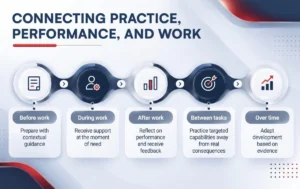
This iterative process can be conceptualized as a "Plan-Do-Reflect" loop. In this cycle, the initial plan involves defining the task and how AI can assist. The "Do" phase encompasses executing the task with AI, generating outputs. Crucially, the "Reflect" phase involves analyzing the AI’s output, evaluating its effectiveness, and considering how the process could be improved. This reflection then informs the next "Plan" phase, creating a dynamic and adaptive workflow. This Plan-Do-Reflect loop, and the inherent capacity for pivoting it enables, represents the human mechanism that transforms mere access to AI into demonstrable performance gains. Without this cyclical engagement, AI risks remaining a sophisticated tool used in superficial ways. With it, AI becomes a potent catalyst for ongoing learning and tangible improvement in real work.
The Practice-Perform-Learn Framework: A Foundation for Scalable Readiness
At the core of this forward-thinking approach lies the Practice-Perform-Learn framework, a robust learning architecture that has demonstrated success in enterprise settings for years, predating the widespread adoption of generative AI. This framework is not superseded by AI; rather, AI serves to amplify its effectiveness. It enables repeatable practice, delivers personalized feedback, and guides reflection without the constant need for direct instructor or manager intervention.
The Practice-Perform-Learn framework has garnered significant industry recognition, including Gold and Silver Brandon Hall Awards. These accolades underscore its proven ability to drive demonstrated performance improvement, moving beyond mere theoretical design to deliver tangible results in areas such as Human Capital Management (HCM) innovation, simulation-based learning, and advancements in business strategy and technology.
Case Study: Operationalizing Readiness in a Regulated Enterprise
To illustrate the practical application of this readiness-focused approach, consider a case study from a global, highly regulated enterprise with thousands of employees who already had access to enterprise AI tools. The challenge was clear: despite the availability of these tools, employee confidence and competence in their application were highly variable. While early adopters were making swift progress, a significant segment of the workforce remained hesitant, thereby hindering enterprise-wide impact and impeding the journey toward meaningful AI adoption.
The organization’s response was strategic. Instead of launching another tool-centric initiative, they introduced a dedicated, AI-powered environment designed to facilitate learning, practice, and performance. This environment empowered employees to explore and apply the AI tools they already possessed within the context of their actual workflows. This initiative effectively operationalized the Learn-Practice-Perform framework. Employees engaged in structured learning modules, practiced realistic scenarios tailored to their roles, and prepared for or reviewed key work moments. Throughout this process, they received personalized feedback and guided reflection – an approach characterized as "reflective intelligence." This methodology aimed to move beyond simply using AI to understanding its strategic application and optimizing its impact.
The measures of success were meticulously tracked, focusing on shifts in confidence distribution over time, the depth of engagement in practice activities, and the emergence of insightful reflections derived from real-world work scenarios. This case study serves as a tangible demonstration of how the promise of AI can be translated into concrete, measurable proof of workforce readiness.
Tangible Outcomes: Confidence, Judgment, and Sustained Improvement
The implementation of a multi-step, collaborative approach to AI utilization, coupled with a focus on reflective practice, yielded rapid and sustained positive outcomes. Within a mere 60 days, the organization observed a four-fold increase in the number of employees self-identifying within the high-confidence group. Critically, this surge in confidence was not a transient phenomenon; it remained elevated well beyond the initial pilot period, indicating a lasting impact on employee morale and capability.
Concurrently, there was a notable two-fold decrease in the number of participants reporting low confidence. This improvement was not confined to the high performers; it signified a positive shift across the broader middle segment of the workforce – the very population that determines whether readiness scales effectively or stalls. Furthermore, employees demonstrated enhanced judgment in their AI usage. They exhibited greater clarity regarding when AI provided genuine value, how to apply it responsibly, and, crucially, when to refrain from relying on it. In highly regulated and high-stakes environments, this discernment and restraint are powerful indicators of true readiness.
Reflective Intelligence: A Dual Value Proposition for People and Organization
Reflection was not an ancillary component of this strategy; it was the driving force behind continuous improvement. For employees, guided reflection provided deeper insights, enhancing accuracy, fluency, and the progression toward mastery. Individuals moved beyond simply knowing that a particular AI-driven approach was effective to understanding why it worked. This deeper comprehension enabled them to adapt more adeptly to evolving challenges and opportunities.
For the organization, the input generated through reflective practice provided actionable intelligence. Leaders gained visibility into workflow dynamics, identified persistent friction points, and uncovered new avenues for innovation and process optimization. In some instances, these insights revealed that what initially appeared to be a skills gap was, in fact, a symptom of underlying workflow inefficiencies or cultural barriers. This dual value – fostering individual growth and providing organizational insights – is what fundamentally differentiates reflective intelligence from traditional feedback mechanisms. It transforms passive learning activities into a dynamic engine for continuous adaptation and organizational agility.
The Limitations of Traditional Playbooks in the AI Age
Traditional technology adoption playbooks, often focused on access, utilization metrics, and scaling existing solutions, are proving inadequate in the AI era. The true value of AI is unlocked not merely through its use, but through the development of informed judgment. This judgment cannot be mandated or simply inferred from usage statistics; it must be cultivated through experience. This experience involves a continuous cycle of learning, practice, reflection, and iterative refinement.
Maximizing AI utilization does not automatically guarantee workforce readiness. Broad exposure to AI tools does not inherently build confidence or competence. Scaling AI without fundamentally redesigning how individuals learn and adapt risks amplifying noise and inefficiency rather than genuine capability. The organizations that are achieving tangible progress are not abandoning their existing playbooks entirely, but rather evolving them to meet the unique demands of AI integration.
Pilots as Discovery Missions for Optimal Integration
In this evolving landscape, pilot programs serve a redefined purpose. Rather than solely aiming to prove that a particular AI solution "works," effective pilots are designed as discovery missions. Their objective is to identify the optimal "best fit" – understanding how learning and practice can be seamlessly integrated with existing organizational culture, workflows, and the unique capabilities of the workforce. Leaders engaging in these pilots adopt an attitude of courageous curiosity, viewing the process as an opportunity to learn alongside their teams.
Many organizations are initiating these pilot programs with the AI tools they already possess. They often begin by leveraging text-based scenario practice to build initial momentum, gradually expanding to richer, multimodal AI experiences as confidence and familiarity grow. The pilot itself is not the ultimate goal; rather, the critical insights and learnings derived from the pilot are what drive meaningful progress.
The Accelerating Pace of AI and the Urgency for Readiness
The urgency surrounding AI readiness is amplified by the relentless acceleration of AI capabilities. Many organizations are still grappling with building readiness for text-based AI, while multimodal AI – encompassing video, avatars, voice, and increasingly sophisticated simulations – is already arriving at enterprise scale, often without a formal rollout announcement. These advanced capabilities simply become available, seamlessly integrating into the digital ecosystem.
If organizational mindsets and workflows have not kept pace with this technological evolution, employees will inevitably continue to apply outdated approaches to these new tools. This disconnect will cause the readiness gap to reappear and potentially widen with each new wave of AI innovation, necessitating a continuous and proactive approach to workforce development.
Redefining "10x": Scaling Competence, Not Just Usage
The prevalent framing of AI’s potential as a "10x" or "100x" improvement requires clarification, particularly for learning leaders. In terms of workforce readiness, a 10-fold improvement does not signify a tenfold increase in AI usage. Instead, it represents a tenfold increase in the number of individuals who can demonstrably exhibit competence and confidence in AI-enabled workflows. This is the mechanism by which the hesitant middle of the workforce is effectively mobilized. This is how true readiness scales across an organization. This is how the promise of AI is definitively transformed into tangible proof of performance.
The Leadership Imperative: Building Adaptive Workforces for an Evolving Future
Organizations do not need to predict every future AI capability with certainty. Instead, they must establish robust systems that empower individuals to explore with curiosity, practice safely, reflect deeply, and adapt continuously. This approach should begin with the tools and capabilities currently available and expand organically as new technologies emerge.
For Chief Learning Officers and other HR leaders, this represents a pivotal moment to assume a central role in driving organizational change. The imperative is to design workforce readiness strategies that not only keep pace with the accelerating advancements in AI but also contribute to making work more rewarding for employees and demonstrably more valuable for the organization. This strategic approach ensures that AI transitions from a mere promise of transformation to a foundation of demonstrated readiness, ultimately delivering on its potential to drive sustained performance and competitive advantage.