


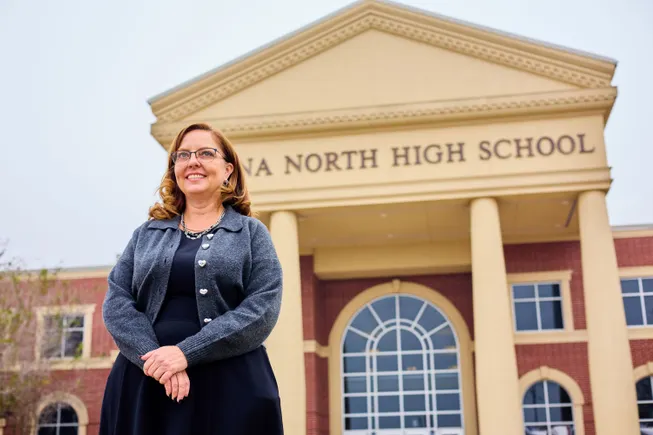
Donna Independent School District (ISD), situated in the Rio Grande Valley of South Texas, just north of the U.S.-Mexico border, is confronting a persistent trend of declining student enrollment, a situation exacerbated by a more significant than anticipated drop this current academic year. This demographic shift presents a complex set of challenges for the district, impacting its financial stability and necessitating strategic decisions regarding its educational infrastructure.
The district’s enrollment figures illustrate a clear downward trajectory. In approximately 2015, Donna ISD reached its peak enrollment, serving nearly 15,500 students. By the 2025-26 school year, this number had fallen to 12,500 students. This represents a substantial decrease of 3,000 students over a decade. Superintendent Angela Dominguez highlighted the demographic composition of the student body, noting that a significant majority, 95%, comes from economically disadvantaged backgrounds, and 56% are English learners. These figures underscore the district’s commitment to serving a population with specific educational and social support needs.
The sharp decline observed in the current school year is attributed, in part, to increased immigration enforcement in the region. Donna ISD had projected a reduction of 300 students for the academic year; however, the actual enrollment shortfall exceeded expectations, with a decrease of 487 students. This heightened enforcement environment can lead to a ripple effect within the community, impacting families and, consequently, school enrollment.
Beyond the immediate impact of immigration enforcement, Superintendent Dominguez identified other contributing factors to the enrollment decline. Falling birthrates, a national trend impacting many school districts, are also playing a role in Donna ISD. Furthermore, the competitive landscape of local charter schools has drawn some students away from the traditional public school system. Charter schools, often offering specialized programs or alternative educational models, present an additional option for families within the district’s service area.
In response to these mounting fiscal pressures, the Donna ISD Board of Trustees approved a plan in early 2025 to close two elementary schools. This measure, while difficult, was deemed necessary to mitigate a potentially more severe budget crisis. Without these consolidations, the financial fallout would have been significantly greater. The district estimates that these school closures will yield annual savings of at least $2.6 million. While the district committed to retaining all staff members impacted by the school closures, these positions will not be filled if attrition occurs. This decision comes in the wake of a substantial budget shortfall of approximately $3 million during the 2024-25 school year.
"It would have been an even greater financial hit this year if we hadn’t already been taking many of those measures and planning for the future," Superintendent Dominguez stated, emphasizing the proactive steps taken by the district leadership to address the unfolding fiscal challenges.
The National Context of School Consolidation
Donna ISD’s situation is not unique. Public school closures and consolidations are becoming an increasingly common phenomenon across the nation as declining enrollment forces districts to make difficult budget decisions. This trend is often met with community resistance, as local schools are frequently seen as integral to the fabric of a neighborhood. The decision to close a school can evoke strong emotional responses, particularly in communities where schools have served generations of families.
However, in the case of Donna ISD’s consolidation plan, the process unfolded with a notable absence of community pushback. According to Superintendent Dominguez, the boardroom was empty on the night the Board of Trustees approved the plan. She attributes this relatively smooth transition to several key factors: the unwavering support of the school board for her proposed plan, and the district’s commitment to transparency throughout the decision-making process. This approach stands in contrast to many other districts that have faced significant public opposition when announcing school closures.
Addressing the "Heart" of a School Community
During the period when Donna ISD was considering school consolidations, Superintendent Dominguez engaged in regular consultations with her mentor, Art Cavazos, a retired superintendent from Harlingen Consolidated Independent School District in Texas. Cavazos, who also serves as a superintendent in residence at The Holdsworth Center, a nonprofit organization dedicated to supporting and developing K-12 leaders, provided guidance to Dominguez.
Cavazos emphasized the importance of shifting the narrative around school closures from a purely deficit-driven financial discussion to one that highlights opportunities for positive transformation and alignment with the district’s broader priorities. He advocates for superintendents to move beyond solely citing budget balancing as the reason for closures.
"Your typical superintendent will talk about closing schools because we need to balance the budget," Cavazos explained. "But that doesn’t speak to the ‘heart’ of a school community. That’s not an emotional charge for me, other than a negative one."
Instead, Cavazos urged Dominguez to embrace her role as the district’s "chief inspiration leader," a title that encompasses being a chief communicator and strategist. He stressed that when district leaders face challenges like school closures, coaches at The Holdsworth Center encourage them to view their role as one of investing in the community and bolstering school culture, even during difficult times. Strong board relations are identified as a critical component in navigating these sensitive issues.
Innovating for the Future: Specialized Academies and Resource Reallocation
Concurrently with exploring consolidation options, Donna ISD was also focused on developing innovative educational opportunities for its students. Superintendent Dominguez shared that, following Cavazos’s advice, the district formed a committee comprising teachers, parents, and community members to explore these innovative avenues.
This proactive approach led to the announcement of three new specialized academies for preschool and elementary levels, slated to launch in the 2025-26 school year. These academies will focus on arts, science, and sports. The district, which currently operates 17 schools and already offers four specialized academies at the preschool to grade 8 levels, will expand its specialized offerings.
The consolidation of the two elementary schools is expected to free up resources that will be instrumental in launching these new academies. Donna ISD has allocated $50,000 in local funds and utilized federal funds for staff training and development related to the new academies. These academies are anticipated to provide students with expanded course offerings and enrichment opportunities. For instance, the new arts academy will offer students a choice of five electives, such as theater and folklórico dance, a significant increase from the district’s typical two elective offerings of physical education and music.
Dominguez acknowledged that parents and students often feel a deep emotional connection to schools that have been part of their families for generations. However, she believes that the announcement of the new specialized academies served to "soften the blow" of the school closures.
"I wanted to tell parents, ‘Look, your school’s closing and I know this is heartbreaking,’" Dominguez recounted. "’But now your child’s going to be able to have a fine arts education at our fine arts academy that we were never able to offer before, and they’re going to get these extended electives and enrichment courses and after-school opportunities.’"
Learning from the Past: Proactive Communication and Community Engagement
Another crucial lesson Superintendent Dominguez gleaned from her mentorship with Art Cavazos was the importance of learning from the missteps of other districts that have undergone school closures. As Donna ISD developed its Frequently Asked Questions (FAQ) website page, Dominguez and her team observed the communication gaps and public backlash experienced by other districts.
This analysis of past experiences allowed Dominguez to proactively identify and address potential community concerns regarding the closures. She stressed that a fundamental first step in any school closure process is to thoroughly educate the school board. This empowers board members to effectively communicate with and respond to concerned community members.
While Dominguez characterized the consolidation process as having gone as smoothly as possible, she candidly acknowledged that school closures remain "tough on a community." She also cautioned that the current enrollment trends suggest that further rounds of closures might be necessary in the future, given the evolving landscape of public education and ongoing demographic shifts.
The Imperative of Innovation in Public Education
As districts like Donna ISD continue to grapple with enrollment challenges, Superintendent Dominguez underscored the critical need for public schools to embrace innovation. Looking ahead, Donna ISD plans to introduce a virtual school option in the 2026-27 school year, further diversifying its educational delivery models.
"For public education, if we don’t learn to innovate, we’re going to become obsolete. We’ve got to keep up with the competitive times," Dominguez asserted. "Because I don’t see our birthrates getting any better."
This sentiment highlights a broader challenge facing public education: the necessity to adapt and evolve in response to changing societal needs and a competitive educational marketplace. By strategically reallocating resources, fostering community engagement, and embracing innovative educational models, Donna ISD is striving to navigate these complex challenges and ensure a robust educational future for its students. The district’s experience serves as a case study in how proactive leadership, strategic planning, and a focus on community needs can help mitigate the difficulties associated with school consolidation in the face of declining enrollment.