

The mastery of a foreign language is increasingly recognized not as an exhaustive memorization of an entire lexicon but as the strategic acquisition of high-frequency vocabulary that enables immediate and effective communication. Linguistic experts and pedagogical researchers suggest that a foundational understanding of the most common words in a target language allows learners to navigate daily life, describe their environment, and comprehend the core themes of complex conversations. In the context of the Turkish language—a primary tongue for over 80 million people globally—this approach serves as a critical entry point for students, travelers, and professionals seeking to engage with the Republic of Türkiye and the broader Turkic world. By categorizing essential vocabulary into functional groups such as nouns, adjectives, and verbs, learners can build a resilient linguistic structure that facilitates long-term fluency and cultural integration.
The Strategic Importance of High-Frequency Vocabulary
The concept of "lexical coverage" is central to modern language acquisition theory. Research indicates that the 1,000 most common words in a language typically account for approximately 75% to 80% of daily spoken communication. In Turkish, a language characterized by its agglutinative nature—where meanings are modified through the addition of suffixes—identifying these core "building blocks" is essential. This methodology prioritizes functional utility over rote memorization, allowing the speaker to participate in the "social fabric" of Turkish life almost immediately.
For the novice learner, the journey begins with greetings and polite expressions. These are not merely linguistic placeholders but are deeply rooted in Turkish hospitality and social etiquette. The distinction between formal and informal addresses, such as the difference between "Hoş geldin" (Welcome, informal) and "Hoş geldiniz" (Welcome, formal), reflects a societal emphasis on respect and hierarchy. Similarly, the use of "Nasıl-sınız?" (How are you?, formal) versus "Nasıl-sın?" (informal) demonstrates the speaker’s awareness of social dynamics, a crucial component of effective communication in both business and casual settings.
Cultural Context and Linguistic Evolution
To understand the importance of these words, one must consider the historical trajectory of the Turkish language. Following the foundation of the Republic of Türkiye in 1923, the Language Revolution (Dil Devrimi) led by Mustafa Kemal Atatürk in 1928 replaced the Arabic script with a Latin-based alphabet. This transition was designed to increase literacy and modernize the language, stripping away many Persian and Arabic loanwords in favor of Turkic roots. The resulting modern Turkish is highly phonetic and regular, making the common words listed in contemporary curricula particularly stable and reliable for learners.
In the realm of social politeness, the Turkish lexicon offers unique phrases that have no direct equivalent in English. For instance, "Kolay gelsin" (May it be easy for you) is a ubiquitous phrase used when encountering anyone engaged in work, from a shopkeeper to a colleague. Another culturally significant term is "Afiyet olsun" (Enjoy your meal), which is used both before and after eating. These phrases function as social lubricants, and their mastery is often viewed by native speakers as a sign of genuine respect for Turkish traditions.
Categorization of the Lexical Foundation: Nouns and Daily Life
The categorization of nouns into thematic groups—such as food, family, and places—is a proven mnemonic strategy. In Turkish, the vocabulary surrounding food is particularly vital due to the country’s world-renowned culinary heritage. Essential terms like "Ekmek" (Bread), "Su" (Water), and "Peynir" (Cheese) are foundational. However, learners must be wary of "false friends"—linguistic traps where a word in one language looks like a word in another but has a different meaning. A prominent example is the Turkish word "Pasta," which refers to cake, whereas the Turkish word for the Italian staple is "Makarna." Misidentifying these can lead to significant confusion in domestic or restaurant settings.
The Turkish approach to family terminology further illustrates the language’s depth. Unlike English, Turkish distinguishes between relatives based on the side of the family they belong to. A paternal uncle is "Amca," while a maternal uncle is "Dayı." Similarly, a maternal aunt is "Teyze," and a paternal aunt is "Hala." This specificity reflects the historical importance of kinship structures in Turkish society. By learning these distinctions, a student of the language gains insight into the cultural priority placed on family lineage and social roles.
Structural Mechanics: Verbs and the Agglutinative Nature of Turkish
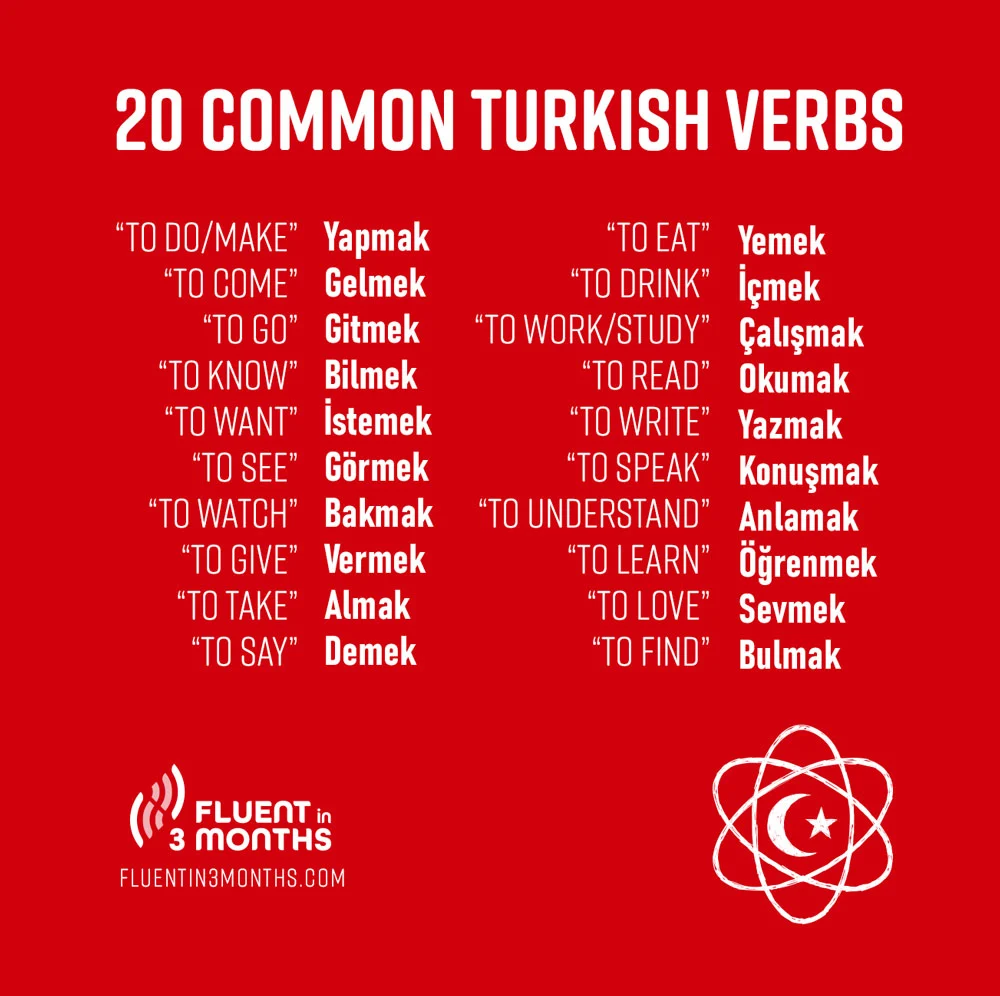
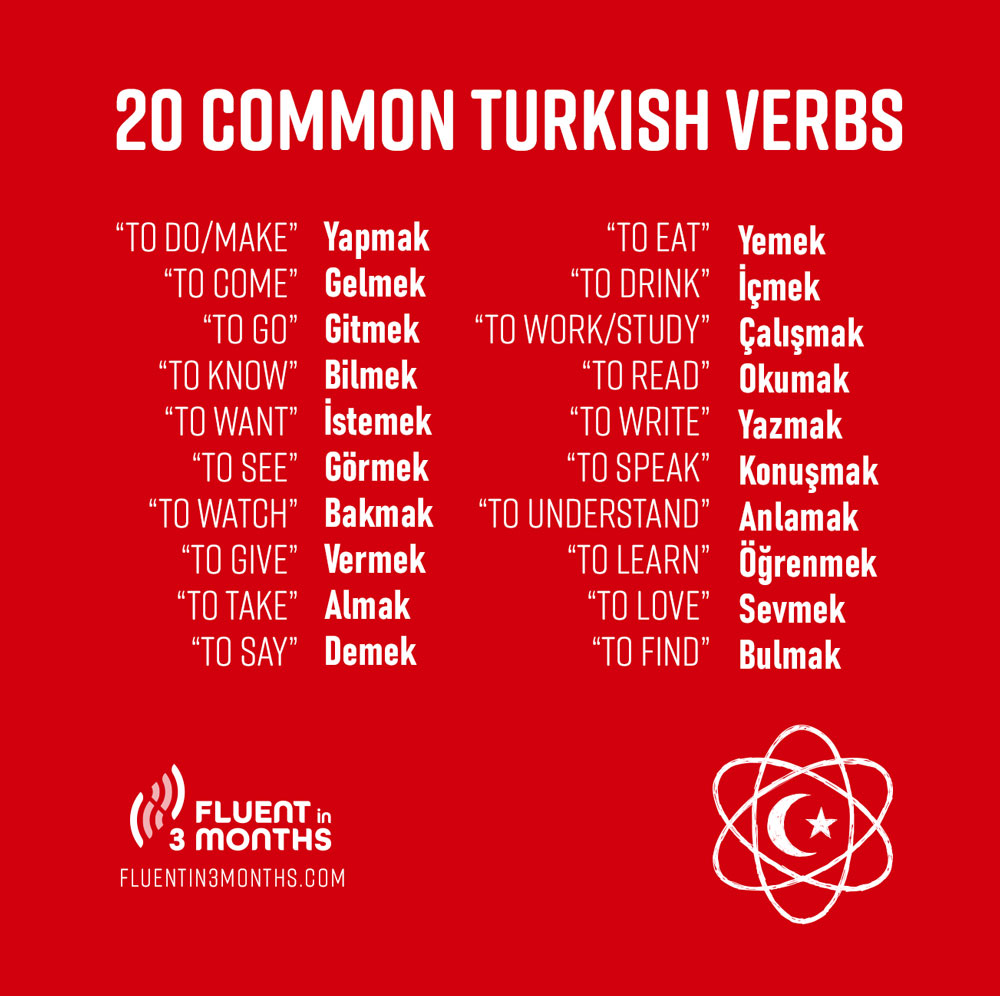
While nouns provide the "what" of a sentence, verbs provide the "action." The most common Turkish verbs, such as "Yapmak" (To do/make), "Gelmek" (To come), and "Gitmek" (To go), are the engines of the language. However, the application of these verbs requires an understanding of Turkish syntax, which follows a Subject-Object-Verb (SOV) order. In contrast to the English Subject-Verb-Object (SVO) structure, the Turkish verb almost invariably concludes the sentence. For example, "I am learning Turkish" translates to "Ben Türkçe öğreniyorum," where the verb "öğreniyorum" (I am learning) is placed at the end.
Furthermore, Turkish lacks separate words for "to be" or "to have." These concepts are expressed through suffixes or specific existential terms. To say "I have a cat," one uses the phrase "Benim bir kedim var," literally translating to "My one cat-my exists." The word "Var" (there is/exists) and its opposite "Yok" (there isn’t/doesn’t exist) are among the most frequently used words in the language, serving as the primary means of expressing possession and availability.
Descriptive Precision: Adjectives and the Visual Spectrum
To move beyond basic utility into descriptive fluency, the acquisition of adjectives is necessary. Turkish adjectives, such as "Büyük" (Big), "Küzel" (Beautiful), and "Yeni" (New), always precede the noun they modify. This provides a straightforward structure for learners to begin forming complex phrases, such as "Büyük ev" (Big house) or "Eski araba" (Old car).
Color vocabulary also plays a significant role in daily description. Terms like "Kırmızı" (Red), "Mavi" (Blue), and "Yeşil" (Green) are essential for identifying objects and providing directions. When combined with subject pronouns—"Ben" (I), "Sen" (You), "O" (He/She/It)—and conjunctions like "Ve" (And) or "Ama" (But), these descriptive tools allow for the construction of cohesive narratives and logical arguments.
Supporting Data: The Efficiency of the 1,000-Word Threshold
Statistical analysis of language usage supports the focus on a "common word" list. According to the "Zipf’s Law" in linguistics, the frequency of any word is inversely proportional to its rank in the frequency table. This means the most common words are used exponentially more often than the rest of the vocabulary. For the Turkish language, mastering the top 500 words can provide a learner with the ability to understand nearly 60% of all written and spoken texts.
Educational institutions, such as the Yunus Emre Institute (the global flagship for Turkish language instruction), utilize these frequency lists to structure their A1 and A2 level curricula. This data-driven approach ensures that students achieve "communicative competence" in the shortest possible timeframe, which is particularly beneficial for diplomats, international students, and the millions of tourists who visit Türkiye annually.
Global Impact and the "Soft Power" of Turkish Media
The global interest in learning Turkish has seen a significant surge over the last decade, largely driven by the international success of Turkish television dramas, known as "Dizi." These series are exported to over 150 countries, making Türkiye the world’s second-highest exporter of television content after the United States. Viewers often encounter "filler" words and emotional expressions that become part of their own vocabulary. Words like "Tamam" (Okay), "İnşallah" (God willing), and "Canım" (My dear) are frequently picked up by international audiences, serving as a form of cultural "soft power."
This media-driven exposure provides a unique "immersion-from-afar" experience. When learners combine the formal word lists found in educational articles with the naturalistic speech found in Turkish series, they develop a more nuanced and authentic speaking style. Phrases such as "Yok artık!" (No way!) or "Hadi!" (Come on!) add a layer of native-like flair to a student’s speech that goes beyond the classroom.
Conclusion and Broader Implications
The process of learning Turkish through its most common words is more than a linguistic shortcut; it is a strategic framework for understanding a complex and influential culture. As the geopolitical and economic importance of Türkiye continues to grow on the world stage, the ability to communicate in Turkish becomes an increasingly valuable asset.
By focusing on the building blocks of greetings, polite expressions, essential nouns, and core verbs, learners can bypass the initial intimidation of a foreign grammar system. This foundational knowledge acts as a catalyst for deeper study, allowing for a more profound connection with the Turkish people and their heritage. Whether for professional advancement or personal enrichment, the mastery of these essential words is the first step toward unlocking the rich cultural and historical tapestry of the Turkish-speaking world. In an era of global integration, such linguistic bridges are more necessary than ever, fostering mutual understanding and collaboration across borders.