



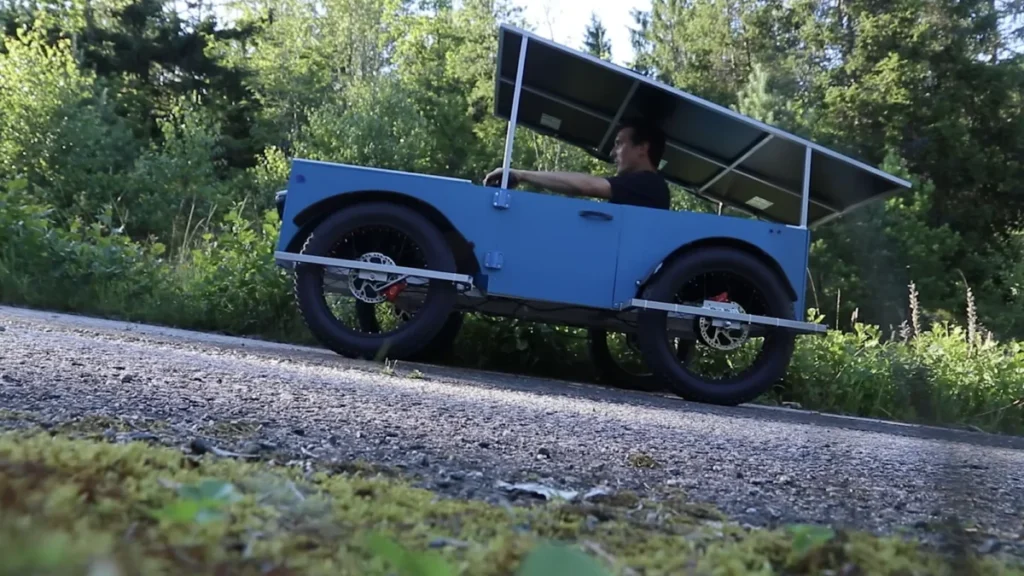
The dream of a vehicle that draws its entire propulsion from the sun has remained a persistent, if elusive, goal for automotive engineers and environmentalists for over half a century. While global energy grids increasingly incorporate photovoltaic arrays and residential solar installations become a standard feature of modern architecture, the automotive sector has struggled to bridge the gap between solar collection and the high energy demands of heavy, high-speed passenger vehicles. However, a recent project by Danish engineer and YouTuber Simon Sørensen has shifted the conversation from industrial-scale production to the burgeoning field of micro-mobility. By repurposing common e-bike components and utilizing a custom-fabricated chassis, Sørensen has demonstrated that while a solar-powered highway cruiser may remain a challenge, a functional, two-person solar-electric neighborhood vehicle is well within the reach of modern DIY engineering.
The Engineering Challenge of Solar Mobility
To understand the significance of Sørensen’s achievement, one must first consider the physical constraints that have historically stymied the solar car industry. A standard passenger electric vehicle (EV), such as a Tesla Model 3, requires significant energy to overcome rolling resistance and aerodynamic drag, often consuming between 150 and 250 watt-hours per mile. In contrast, even the most efficient commercially available solar panels produce roughly 15 to 20 watts per square foot under ideal conditions. For a standard-sized car, the surface area available for panels is simply insufficient to provide a meaningful charge during active driving.
Sørensen’s approach circumvents these limitations by pivoting toward the "micro-mobility" philosophy. By reducing the vehicle’s mass and utilizing high-efficiency hub motors, he has created a platform where the energy harvested from the sun represents a significant percentage of the total energy required for movement. This project serves as a practical case study in energy density and weight management, highlighting a path forward for short-range, sustainable transportation.
Design and Development: From E-Bikes to Four-Wheel Drive
The construction of the vehicle began with the dismantling of two high-performance e-bikes. These donor vehicles provided the essential powertrains, including the batteries, controllers, and motors. However, rather than simply mounting these components to a bicycle frame, Sørensen engineered a bespoke chassis from steel tubing. This frame was designed to provide the structural integrity of a car—offering a seated, side-by-side arrangement for two passengers—while remaining light enough to be propelled by electric bicycle hardware.
The most notable technical feat of the build is the integration of a four-wheel-drive (4WD) system. Sørensen utilized four 1,000-watt hub motors, one situated in each wheel. This configuration provides a total peak power output of 4,000 watts (approximately 5.3 horsepower). While this power figure is modest by automotive standards, it is immense for a vehicle of this weight class, providing the torque necessary for hill climbing and off-road navigation.
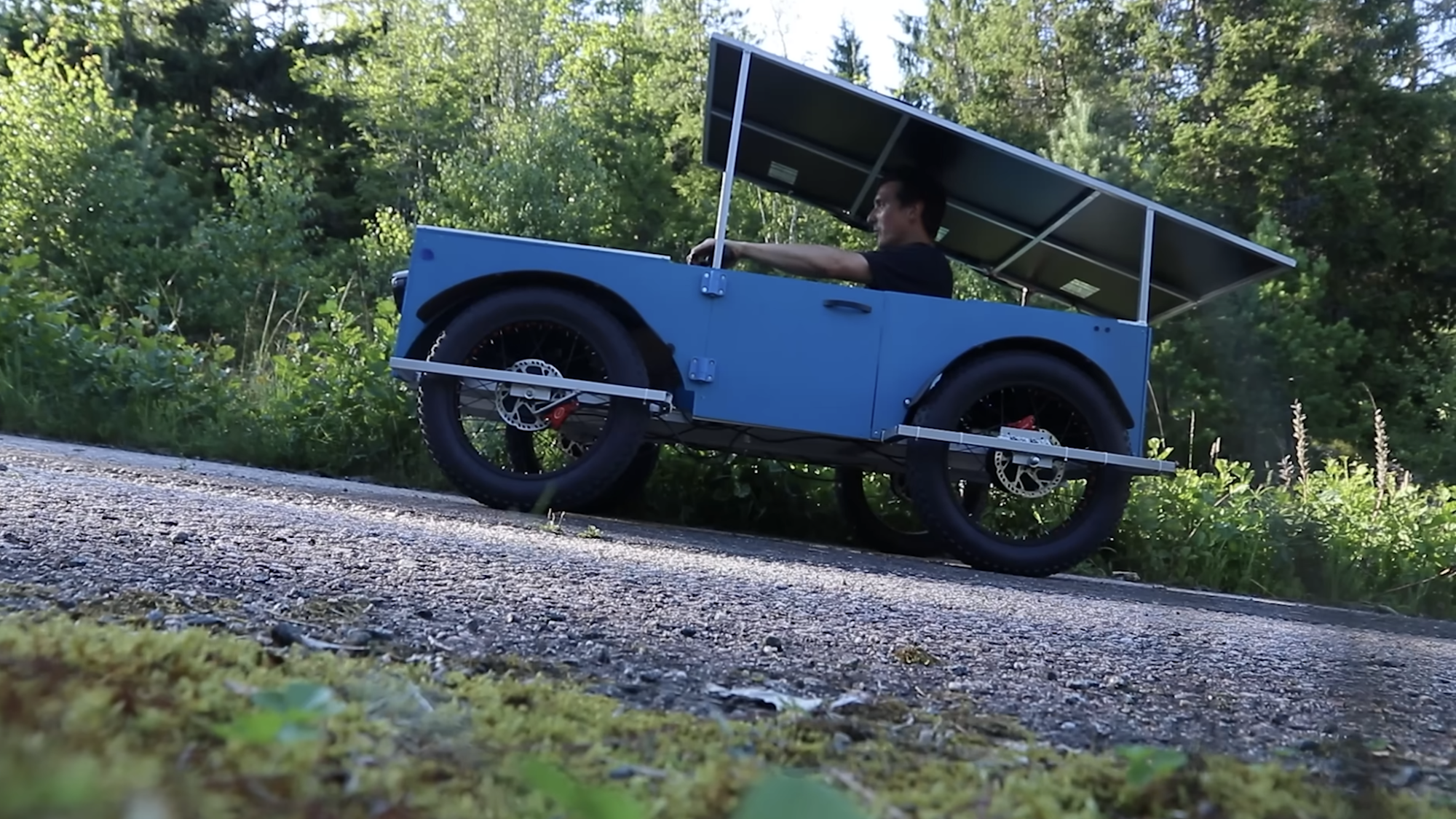
Furthermore, the vehicle features a sophisticated control system that allows the operator to toggle between front-wheel, rear-wheel, and four-wheel drive. This flexibility is not merely a novelty; it is a critical feature for energy management. By switching to two-wheel drive on flat, paved surfaces, the driver can reduce energy consumption, reserving the 4WD capability for demanding terrain or slippery conditions.
Precision Steering and the Legacy of Ackermann Geometry
A common pitfall in DIY vehicle builds is the simplification of steering mechanics, which often leads to poor handling and excessive tire wear. To avoid these issues, Sørensen implemented a steering system based on Ackermann geometry. This principle, patented by Rudolph Ackermann in 1818 (though originally devised by Georg Lankensperger), solves a fundamental problem in cornering: when a vehicle turns, the inner wheel follows a tighter radius than the outer wheel.
By arranging the steering linkages so that the inner wheel turns at a sharper angle than the outer wheel, Sørensen ensured that all four wheels rotate around a common center point during a turn. This reduces "scrubbing"—the lateral sliding of tires across the road surface—which is essential for maintaining efficiency in a low-power vehicle. The use of such a refined mechanical system, which is standard in Formula 1 and high-performance racing, underscores the professional-grade engineering underlying this backyard project.
Energy Harvesting and Real-World Performance
The "solar" component of the vehicle consists of three lightweight, semi-flexible solar panels mounted to the roof. These panels are capable of generating a combined 300 watts of power under optimal sunlight. This energy is fed through a charge controller into a 48-volt lithium-ion battery pack.
In the context of traditional EVs, 300 watts is negligible. However, for Sørensen’s lightweight build, it is transformative. During his testing phases, Sørensen reported that in favorable weather, the car can travel nearly 20 miles (32 kilometers) on solar power alone before the battery begins to deplete its stored reserves. When starting with a full battery and driving in sunny conditions, the total range extends significantly.
"The range, by the way, is about 50km [31 miles], but on a sunny day you can probably go upwards to 100km [62 miles]," Sørensen noted during a profile of the build.

Speed performance is equally impressive for a DIY build. The vehicle is capable of reaching a top speed of approximately 30 miles per hour (48 kilometers per hour). This places the vehicle in the same performance bracket as many Neighborhood Electric Vehicles (NEVs) or "L-category" quadricycles in Europe, making it a viable tool for suburban commuting or rural errands.
Chronology of the Build and Public Reception
The project was documented in a series of technical videos released throughout 2024, garnering millions of views and sparking discussions across engineering forums.
- Phase 1: Prototyping (Early 2024): Initial testing of the hub motors and the fabrication of the basic steel frame.
- Phase 2: Mechanical Integration (Spring 2024): Implementation of the Ackermann steering system and the installation of the four-motor drive system.
- Phase 3: Solar Integration (Summer 2024): Mounting the roof array and calibrating the 48V charging system.
- Phase 4: Field Testing (Late 2024): Real-world range tests and speed trials, culminating in the data showing the 100km potential range.
The reaction from the engineering community has been overwhelmingly positive. Observers have pointed out that while multi-million dollar startups like Lightyear and Aptera have struggled to bring solar cars to the mass market due to regulatory hurdles and high costs, Sørensen’s project highlights the "bottom-up" potential of the technology. By focusing on low-speed, lightweight applications, the "solar gap" is much easier to close.
Broader Implications: The Future of Micro-Solar
Sørensen’s solar car is more than just a successful DIY experiment; it is a proof of concept for a niche that the traditional automotive industry has largely ignored. As urban centers become more congested and the demand for carbon-neutral transport grows, the "last-mile" problem remains a significant hurdle. Standard EVs, while better than internal combustion engine (ICE) vehicles, still require massive amounts of energy and contribute to road wear due to their weight.
The implications of Sørensen’s build suggest several future trends:
- Decentralized Charging: If a vehicle can regain 20-30 miles of range just by sitting in a parking lot, the reliance on expensive public charging infrastructure is reduced.
- Simplified Manufacturing: The use of e-bike components suggests that the supply chain for small-scale solar transport is already mature. Standardized motors and batteries are becoming cheaper and more reliable every year.
- Regulatory Shifts: Projects like this may push regulators to create more robust categories for "lightweight solar vehicles," allowing them to operate on public roads with fewer of the bureaucratic hurdles faced by full-sized passenger cars.
While Simon Sørensen may not be looking to compete with major automakers, his four-wheel-drive solar creation serves as a reminder that innovation often happens outside the laboratory. By combining 19th-century steering geometry with 21st-century solar and battery technology, he has built a machine that is not only functional but points toward a more efficient, sun-powered future for personal mobility. As solar cell efficiency continues to improve—with perovskite cells promising even higher conversion rates in the near future—the "backyard solar car" may eventually move from a YouTube curiosity to a common sight in the world’s suburbs.