
The ability to navigate the numerical system of a foreign country is a fundamental pillar of linguistic integration and functional literacy, and in the Republic of Turkey, this skill serves as an essential gateway to daily commerce, social interaction, and administrative navigation. For the millions of expatriates, business travelers, and tourists who visit Turkey annually—a figure that exceeded 50 million in 2023 according to the Turkish Ministry of Culture and Tourism—the mastery of Turkish numbers is not merely an academic exercise but a practical necessity for tasks ranging from settling a restaurant bill in Istanbul’s Beyoğlu district to exchanging contact information with a colleague in Ankara. Turkish numerals are characterized by a highly logical, decimal-based structure that reflects the broader agglutinative nature of the Turkish language, offering a systematic approach that, once understood, allows for rapid progression from basic counting to complex financial and temporal expressions.
The Structural Framework of Turkish Counting: 1 to 10
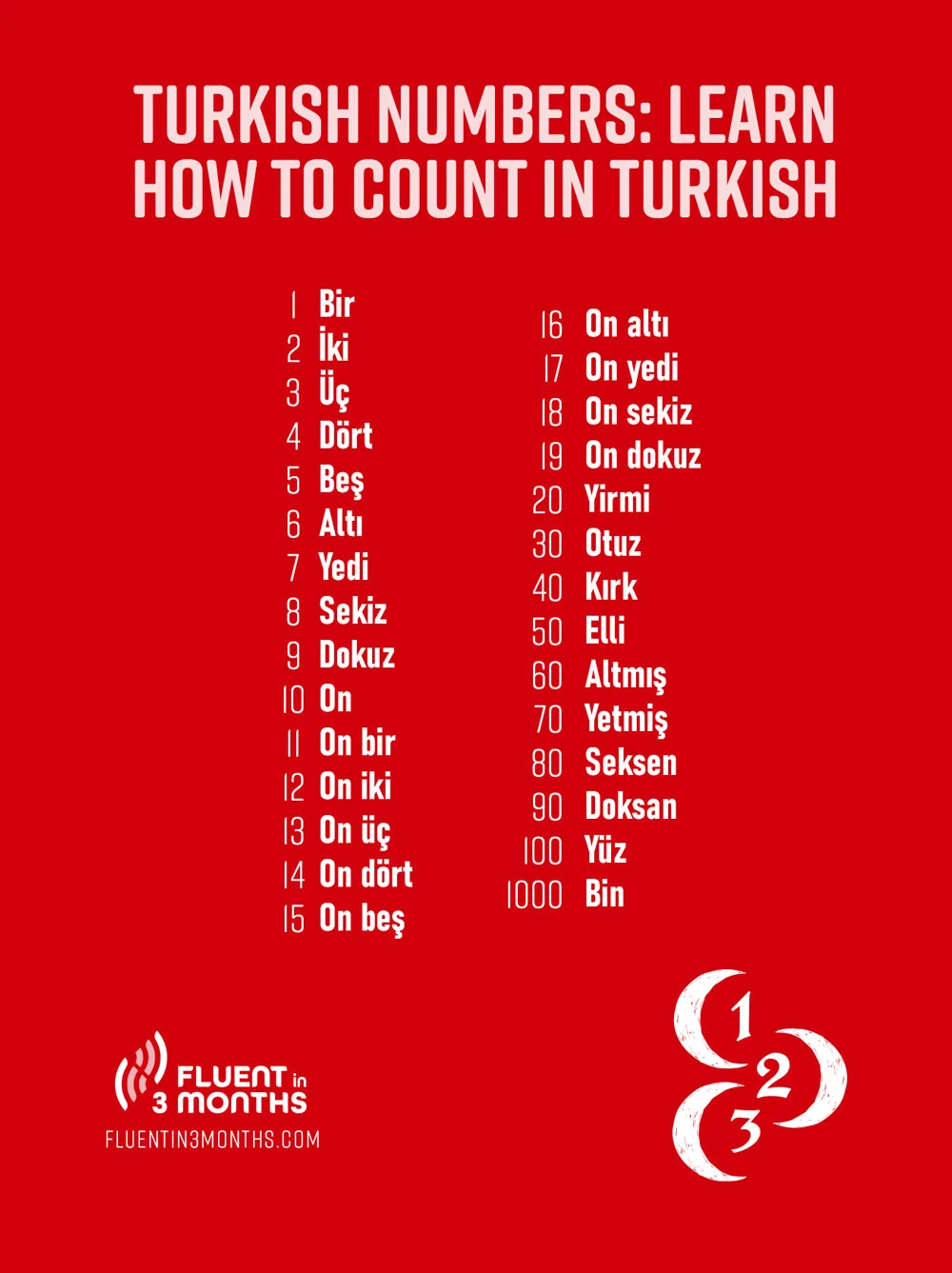
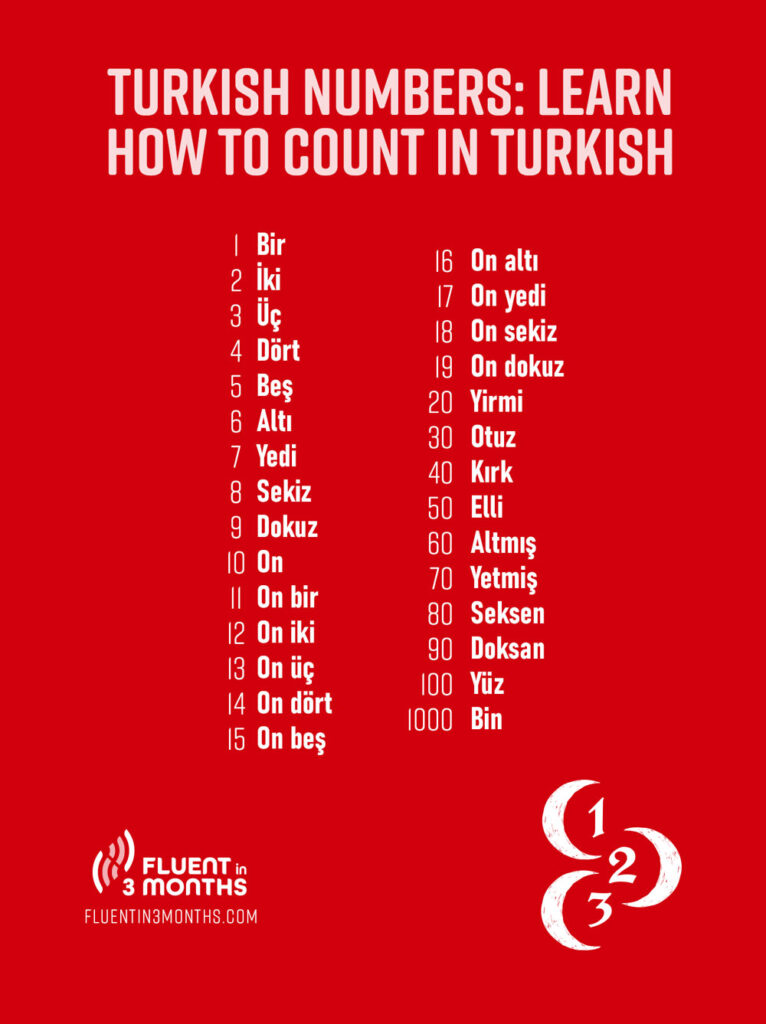
The foundation of the Turkish numerical system is built upon the primary digits from one to ten, which serve as the indispensable building blocks for all subsequent mathematical constructions. These roots are: bir (1), iki (2), üç (3), dört (4), beş (5), altı (6), yedi (7), sekiz (8), dokuz (9), and on (10). Linguists note that unlike many Indo-European languages which feature irregular stems for numbers like "eleven" or "twelve," the Turkish system maintains a strict adherence to its base-10 logic. This regularity significantly lowers the barrier to entry for adult learners. For instance, the transition from the single digits to the teens involves a simple additive process: the word for ten (on) is followed by the single digit. Thus, eleven becomes on bir, twelve becomes on iki, and nineteen becomes on dokuz. This transparency in construction is a hallmark of the 1928 Language Reform, which sought to streamline the Turkish language for the modern era.
Historical Evolution: From Ottoman Script to Modern Numerals
To understand the current state of Turkish numeracy, one must look back to the early 20th century. Before the "Alphabet Revolution" (Harf Devrimi) of 1928, the Ottoman Empire utilized the Ottoman Turkish script, which was based on Arabic characters and included the Abjad numeral system. Under the leadership of Mustafa Kemal Atatürk, the newly formed Republic of Turkey transitioned to the Latin alphabet and adopted the Western Arabic numeral system (1, 2, 3, etc.) as part of a broader suite of Westernizing reforms.
The Turkish Language Association (Türk Dil Kurumu or TDK), established in 1932, played a pivotal role in standardizing how these numbers are spoken and written. The TDK’s official stance emphasizes the use of Arabic numerals in most formal documents, though the phonetic spelling of numbers remains vital in legal contracts, checks, and academic texts to prevent ambiguity. This historical pivot was instrumental in increasing Turkey’s literacy rate, which climbed from roughly 10% in the late Ottoman period to over 97% in the modern day.
The Logic of Compound Numbers: 20 through 99
Moving beyond the first twenty numbers requires the memorization of the multiples of ten, which are distinct roots. These include yirmi (20), otuz (30), kırk (40), elli (50), altmış (60), yetmiş (70), seksen (80), and doksan (90). The construction of intermediate numbers follows the same additive principle used in the teens. For example, to express the number 45, one combines the word for forty (kırk) with the word for five (beş), resulting in kırk beş.
Linguistic analysts point out that this "Ten + Unit" structure is one of the most consistent in the world, lacking the "four-score" complexities of French or the "one-and-twenty" inversions found in German. This efficiency is a point of pride for Turkish educators. Dr. Selim Yılmaz, a specialist in Turkish as a Foreign Language, notes that "the mathematical symmetry of Turkish numerals allows students to reach a functional level of proficiency much faster than in languages with more idiosyncratic numerical histories."
Scaling the Heights: Hundreds, Thousands, and Millions
As the scale of numbers increases, the Turkish system introduces yüz for one hundred and bin for one thousand. A notable feature of Turkish is that for "one hundred" and "one thousand," the word for "one" (bir) is typically omitted unless emphasizing a specific count in a technical context; one simply says yüz or bin. However, for any multiple greater than one, the multiplier must precede the base. Therefore, two hundred is iki yüz, and five thousand is beş bin.
The system continues logically into higher denominations:
- 1,000,000: bir milyon
- 1,000,000,000: bir milyar
When constructing large, specific numbers, such as 1,923 (the year the Republic was founded), the components are stacked in descending order of magnitude: bin dokuz yüz yirmi üç. This linear progression ensures that even extremely large figures can be decoded by a listener who understands the basic vocabulary of the system.
Ordinality and the Complexity of Vowel Harmony
While cardinal numbers are straightforward, ordinal numbers (first, second, third) introduce one of the most iconic features of Turkish grammar: vowel harmony. To transform a number into an ordinal, a suffix is added—-ıncı, -inci, -uncu, or -üncü—depending on the final vowel of the number’s root.
- Bir (ends in ‘i’) becomes birinci (first).
- Dört (ends in ‘ö’) becomes dördüncü (fourth).
- Altı (ends in ‘ı’) becomes altıncı (sixth).
This system ensures a melodic flow to the language, but it requires learners to internalize the four-way vowel harmony rules. Ordinal numbers are ubiquitous in Turkish life, used for floor levels in shopping malls (e.g., birinci kat), rankings in sports, and centuries in historical discourse.
Practical Application: The Economic Context of the Turkish Lira
In the realm of commerce, understanding numbers is inextricably linked to the Turkish Lira (TRY). The currency is divided into 100 kuruş. When discussing prices, the word lira follows the number, while kuruş follows the decimal. For instance, 15.50 TL is expressed as on beş lira elli kuruş.
It is important to note the orthographic convention used in Turkey: the period (.) is used as a thousands separator, and the comma (,) is used as a decimal separator. This is the inverse of the system used in the United States and the United Kingdom. A price tag reading "1.250,00" signifies one thousand two hundred and fifty lira, not one lira and twenty-five cents. In an era of fluctuating inflation, where prices can change frequently, the ability to quickly process these figures is a vital survival skill for consumers in the Turkish market.
Temporal Navigation: Formal and Informal Timekeeping
Telling time in Turkey involves two distinct systems. The formal system, used in television broadcasts, flight schedules, and official announcements, utilizes the 24-hour clock. "The train departs at 14:00" would be Tren saat on dörtte kalkıyor.
In daily social conversation, however, the 12-hour clock is preferred, often supplemented by terms for "half" (buçuk) and "quarter" (çeyrek).
- 10:30 is on buçuk.
- 10:15 is onu çeyrek geçiyor (literally: it is passing ten by a quarter).
- 10:45 is on bire çeyrek var (literally: there is a quarter to eleven).
The informal system utilizes dative and accusative case endings, making it one of the more advanced applications of Turkish numbers. Mastering this reflects a high level of linguistic acculturation.
Communication and Connectivity: Phone Numbers and Measurements
The exchange of phone numbers is another area where numerical conventions are strictly observed. Turkish mobile numbers consist of ten digits (excluding the country code +90), and they are traditionally dictated in a specific grouping: a three-digit prefix, followed by another three digits, and then two sets of two digits (e.g., 5XX XXX XX XX). Instead of saying "five-five-five-one-two-three…" as one might in English, a Turk would say "five hundred fifty-five, one hundred twenty-three, forty-five, sixty-seven." Failure to follow this grouping can lead to confusion during the exchange of contact information.
In the culinary and industrial sectors, the metric system is the standard. Shopping at a local pazar (market) requires the use of kilo (kilogram) and gram. A customer might ask for iki kilo domates (two kilos of tomatoes) or beş yüz gram peynir (five hundred grams of cheese). In the construction and textile industries, metre and santimetre are the units of choice.
Institutional Support and Educational Perspectives
The Turkish government, through the Ministry of National Education, places a heavy emphasis on mathematics and numerical literacy from an early age. According to PISA (Programme for International Student Assessment) data, Turkey has shown significant efforts in improving its mathematics scores over the last decade, reflecting a national priority on quantitative skills.
For adult learners, institutions like TÖMER (Ankara University Turkish and Foreign Languages Research and Application Center) provide standardized curricula that prioritize numerical fluency. Experts at TÖMER argue that numbers are the "connective tissue" of the language. "You can survive a day without knowing how to conjugate a complex verb," says an instructor at the Istanbul branch, "but you cannot survive an hour without knowing how to handle numbers."
Broader Impact and Implications: A Bridge to the Future
As Turkey continues to position itself as a global hub for tourism, health services, and manufacturing, the importance of numerical communication cannot be overstated. With the rise of the "digital nomad" and the increasing number of international students choosing Turkish universities, the demand for accessible Turkish language education has spiked.
The systematic nature of Turkish numbers provides a sense of order in a language that can otherwise seem daunting due to its agglutinative structure. By mastering the sequence from bir to bin, learners do more than just count; they engage with a history of reform, a culture of precise commerce, and a society that values the logical progression of thought. Whether it is calculating the age of a historical monument in Ephesus or negotiating a contract in a skyscraper in Levent, Turkish numbers are the essential tool for anyone looking to navigate the vibrant and complex landscape of modern Turkey.