



Educational institutions worldwide are transitioning from the experimental phase of artificial intelligence to a period of deep integration, guided by the newly updated Microsoft Education AI Toolkit. This comprehensive resource, redesigned to address the practical challenges of moving from isolated pilot projects to institutional-scale implementation, provides primary schools, districts, and universities with a structured framework for responsible AI adoption. As the academic sector grapples with the rapid evolution of generative AI, the toolkit offers a roadmap centered on student success, operational efficiency, and rigorous security protocols.
The update comes at a critical juncture for the education sector. According to recent industry data, nearly 60% of educators are now using AI in some capacity, yet many institutions report a lack of cohesive strategy for long-term scaling. Microsoft’s revised toolkit seeks to bridge this gap by offering a streamlined navigation system organized across five core sections: Overview, AI Navigators, Plan, Implement, and Research. By focusing on actionable guidance rather than theoretical potential, the toolkit reflects a shift in the global educational landscape toward measurable impact and systemic transformation.
Strategic Framework for AI Transformation
The architecture of the updated toolkit is built upon three foundational themes that address the multifaceted needs of modern educational environments. These themes—Student Success, Institutional Innovation, and Simplify and Secure IT—serve as the pillars for any sustainable AI strategy.

In the realm of Student Success, the toolkit emphasizes the transition from basic AI interactions to sophisticated, AI-powered learning environments. This includes the deployment of tutoring-style support systems, automated assessment tools, and real-time feedback mechanisms designed to personalize the learning experience. Beyond the classroom, the framework focuses on "preparing" students for a workforce increasingly defined by AI proficiency, offering pathways to skills-based certifications and industry-recognized credentials.
Institutional Innovation targets the administrative and operational backbone of schools and universities. By utilizing AI-powered insights and automation, leaders can modernize aging infrastructure and improve the overall experience for faculty and staff. This move toward "Institutional Innovation" is exemplified by the use of data analytics to identify bottlenecks in student services or to streamline the creation of multilingual instructional materials, which has become a priority for diverse school districts.
The third pillar, Simplify and Secure IT, addresses the paramount concern of data privacy and system integrity. The toolkit provides specific guidance on utilizing tools like Microsoft Security Copilot for proactive threat detection. As schools become more frequent targets for cyberattacks, the integration of AI-enabled security and strict data governance practices is no longer optional but a prerequisite for trusted adoption.
Chronology of AI Integration in Education
The journey toward the current toolkit began in early 2023, following the mainstream emergence of large language models. Initially, the educational response was characterized by caution, with many districts implementing temporary bans on AI tools due to concerns over academic integrity. However, by late 2023, the narrative shifted toward "AI Literacy," led by organizations like Code.org and tech providers like Microsoft.

In 2024, the first iteration of the Microsoft Education AI Toolkit was released, focusing primarily on "AI Snapshots"—use cases for individual practitioners. Throughout the 2024-2025 academic year, feedback from global education leaders indicated a need for more robust, team-based strategies. This led to the Fall 2025 launch of "Hour of AI" and the subsequent 2026 redesign of the toolkit, which now prioritizes "AI Sparks"—a methodology for department-level and systemic innovation. This timeline illustrates a rapid maturation of the sector, moving from reactive policy-making to proactive, strategic planning.
From Individual Snapshots to Systemic Sparks
A significant addition to the updated toolkit is the distinction between "AI Snapshots" and "AI Sparks." While Snapshots are designed to empower the individual—such as a teacher using Microsoft 365 Copilot to generate accessible lesson plans—Sparks are designed to strengthen institutional capacity.
For example, a Spark might detail how a district-wide literacy team coordinates the use of Learning Accelerators, such as Reading Coach and Reading Progress, to improve early literacy outcomes across every K-3 classroom in the district. In a higher education context, a Spark would demonstrate how an IT department uses Microsoft Copilot Studio analytics to identify recurring helpdesk issues across a campus, allowing the institution to update resources proactively and reduce the volume of support tickets. This shift from "isolated experiments" to "coordinated transformation" is a central theme of the 2026 update, providing a blueprint for leaders who need to justify AI investments at the board or ministerial level.
The Emergence of Agentic AI and Autonomous Workflows
The toolkit introduces the concept of "Agentic AI," representing the next frontier in educational technology. Unlike traditional AI, which requires constant human prompting for every step, agentic systems are designed to operate with a degree of autonomy to complete multi-step tasks. These tools can automate complex administrative workflows, such as routing student inquiries to the correct departments or managing scholarship application queues, based on governance rules set by the institution.

The toolkit outlines two primary pathways for implementing agentic AI:
- Microsoft Copilot Studio: A low-code/no-code environment that allows staff to create custom AI agents rapidly.
- Microsoft Azure AI Foundry: A more advanced platform for developers to build sophisticated, high-scale custom solutions.
A featured case study from the University of Leicester highlights the practical application of this technology. By deploying an AI-powered digital coach, the university successfully reduced staff workload while providing students with 24/7 access to critical information. This implementation serves as a primary example of how agentic AI can move an institution from "assistance" to "autonomy," freeing up human staff for more complex, high-touch student interactions.
Supporting Data and Industry Response
Market research conducted in mid-2025 suggests that the "implementation gap" remains the biggest hurdle for educational AI. While 85% of university administrators believe AI will be "transformative," only 22% have a formal implementation plan in place. Microsoft’s introduction of "Action-ready Checklists" in the toolkit is a direct response to this data. These checklists turn high-level guidance into assignable tasks, ensuring that fundamental steps—such as stakeholder alignment and security audits—are not overlooked in the rush to adopt new tools.
Educational leaders have largely welcomed the structured approach. Dr. James Anderson, a specialist in educational technology policy, noted that "the transition from pilot to impact is where most digital transformations fail. By providing a research-backed framework that includes both the ‘how-to’ and the ‘why,’ this toolkit minimizes the risk of fragmented adoption."

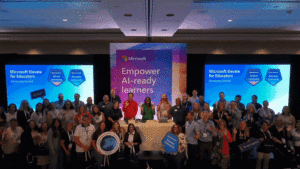
Furthermore, the toolkit’s integration with "Microsoft Elevate for Educators" provides a social and professional layer to the technological rollout. By merging the Microsoft Showcase Schools and Microsoft Innovative Educator Expert (MIEE) programs, the company is fostering a global network of practitioners who can share real-world successes and failures, effectively crowdsourcing the best practices for AI implementation.
Research-Driven Strategy and Future Implications
The Research section of the toolkit has been significantly bolstered to provide a foundation for evidence-based decision-making. Resources are now categorized to help teams address specific concerns, whether they are presenting to a school board or addressing faculty anxieties regarding job displacement or academic honesty.
By grounding the AI strategy in current research, the toolkit helps institutions validate their approach with data on student outcomes and operational savings. The long-term implications of this structured scaling are profound. As institutions move toward "systemic change," the potential for AI to close the digital divide becomes more tangible. Multilingual tools can support English Language Learners (ELL) at scale, and personalized AI tutors can provide high-quality support to students in under-resourced areas.
The updated Microsoft Education AI Toolkit represents a move away from the "hype cycle" of artificial intelligence and toward a period of sustainable, responsible utility. By providing the frameworks, checklists, and research necessary for institutional-wide adoption, the toolkit serves as a critical resource for any educational leader aiming to navigate the complexities of the modern digital landscape. As the sector continues to evolve, the ability to scale these technologies effectively will likely define the gap between institutions that merely survive the AI transition and those that thrive within it.