


The Turkish numerical system serves as a foundational pillar for navigating the country’s socioeconomic landscape, providing the essential framework for commerce, social interaction, and administrative navigation. For international residents, tourists, and business professionals, proficiency in Turkish numbers is not merely a linguistic milestone but a functional necessity for tasks ranging from settling financial transactions and exchanging contact information to interpreting public transport schedules. Unlike many Indo-European languages that feature irregular formations for certain values—such as the English "eleven" or the French "soixante-dix"—the Turkish system is characterized by a highly logical, agglutinative, and consistent mathematical structure. This architectural clarity allows learners to construct complex figures once a small set of base roots is mastered.
Historical Context and the Evolution of Modern Turkish Numerals
The current Turkish numerical system is inextricably linked to the sweeping linguistic reforms of the early 20th century. Following the establishment of the Republic of Turkey in 1923, Mustafa Kemal Atatürk initiated the "Harf Devrimi" (Alphabet Reform) in 1928, which transitioned the nation from the Arabic-based Ottoman script to a modified Latin alphabet. This shift was accompanied by the "Dil Devrimi" (Language Reform), aimed at "purifying" the Turkish language of excessive Persian and Arabic loanwords.
While the core roots of Turkish numbers have ancient Turkic origins, the standardization of their spelling and usage was overseen by the Türk Dil Kurumu (Turkish Language Association, or TDK), founded in 1932. The TDK established the formal rules that govern how numbers are written and spoken today, ensuring a uniform system across the Republic. Historically, the transition to the Latin script and the adoption of Western-style Arabic numerals (1, 2, 3) facilitated Turkey’s integration into global markets and standardized its educational and financial sectors.
The Foundational Tier: Cardinal Numbers 1 through 10
The Turkish counting system is built upon ten primary digits. These monosyllabic or disyllabic roots are the essential building blocks for all subsequent numerical values. Linguistic experts categorize these as the "primary set," which must be memorized before moving to more complex structures.
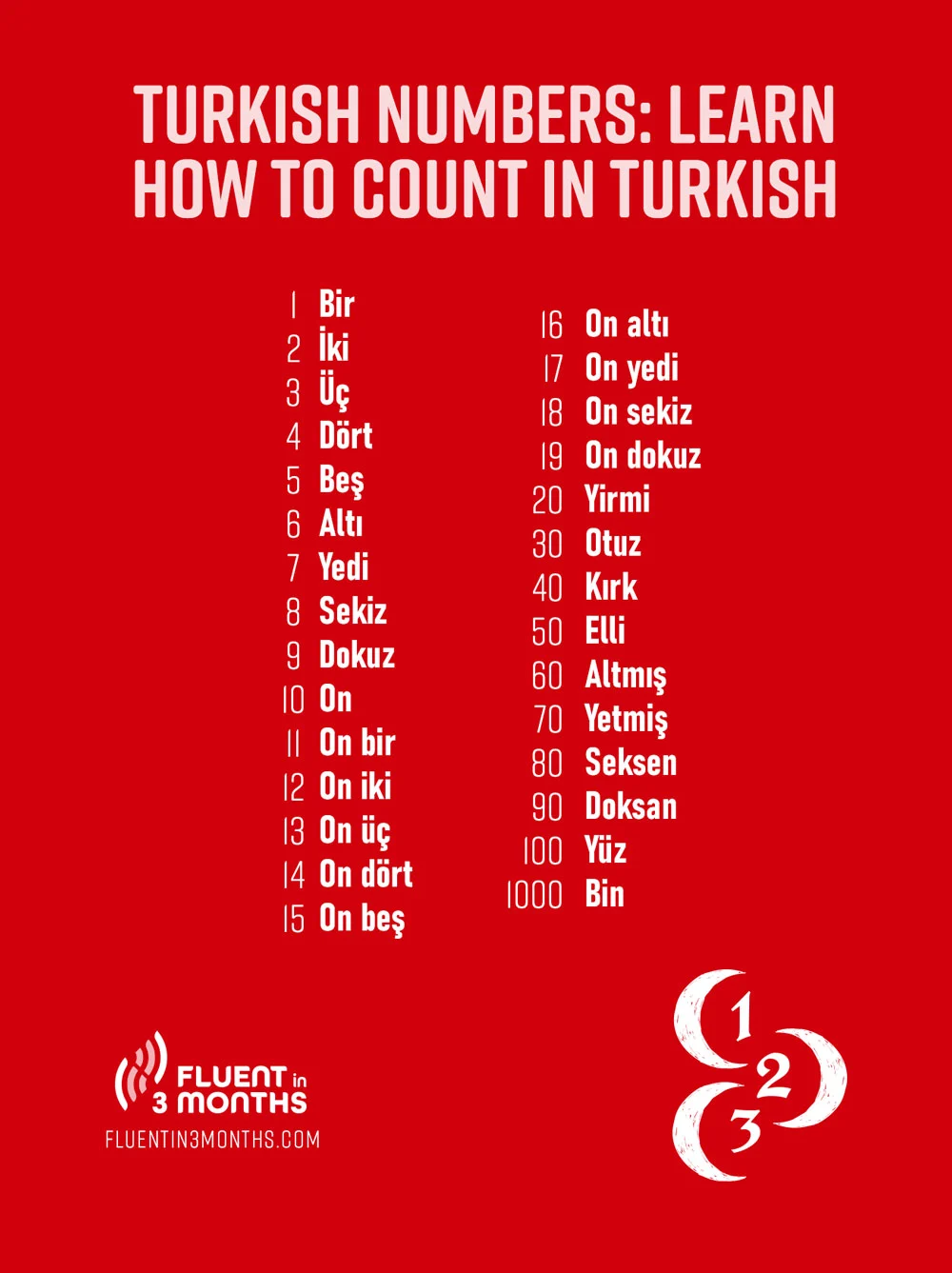
The primary digits are:
- 1: Bir
- 2: İki
- 3: Üç
- 4: Dört
- 5: Beş
- 6: Altı
- 7: Yedi
- 8: Sekiz
- 9: Dokuz
- 10: On
In practical application, the number one (bir) also functions as an indefinite article equivalent to "a" or "an" in English, though its placement in a sentence determines its specific role as either a quantity or a descriptor.
Structural Logic: Construction of Numbers 11 through 99
Turkish employs an additive logic for numbers between 11 and 19. Unlike English, which utilizes unique terms like "eleven" and "twelve," Turkish simply places the word for ten (on) before the single digit. This creates a predictable pattern:
- 11: On bir (Ten one)
- 12: On iki (Ten two)
- 13: On üç (Ten three)
- 19: On dokuz (Ten nine)
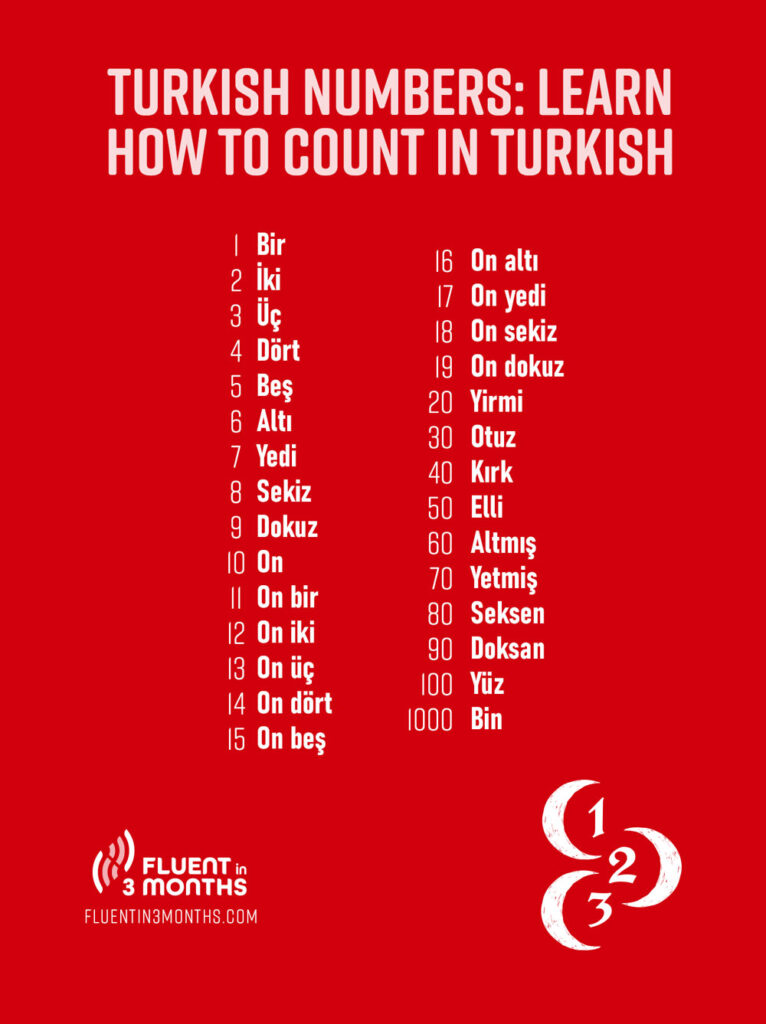
To progress beyond twenty, one must learn the specific terms for the multiples of ten. These terms are distinct and do not always follow a simple derivative pattern from the single digits, though some similarities exist:
- 20: Yirmi
- 30: Otuz
- 40: Kırk
- 50: Elli
- 60: Altmış
- 70: Yetmiş
- 80: Seksen
- 90: Doksan
Once these decades are mastered, any number between 20 and 99 is formed by stating the decade followed by the single digit. For example, 45 is rendered as kırk beş, and 87 is seksen yedi. According to TDK guidelines, when writing these numbers in text (outside of financial documents), each word should be written separately to maintain clarity.
Expanding the Scale: Hundreds, Thousands, and Beyond
The construction of larger numbers in Turkish follows a multiplicative logic that is arguably more consistent than the English system. The term for one hundred is yüz. To express multiples of one hundred, one simply places the multiplier before the word yüz.
- 100: Yüz (Note: One does not usually say "bir yüz" for 100, just "yüz")
- 200: İki yüz
- 500: Beş yüz
- 900: Dokuz yüz
For more granular numbers, the components are listed in descending order of magnitude:
- 150: Yüz elli
- 365: Üç yüz altmış beş
This logic extends to thousands (bin).
- 1,000: Bin
- 5,000: Beş bin
- 10,000: On bin
- 500,000: Beş yüz bin
In 2005, Turkey underwent a significant monetary redenomination, removing six zeros from the Turkish Lira. Prior to this, transactions involving millions and billions were commonplace for everyday items. Today, while the currency has stabilized, the terms milyon (million) and milyar (billion) remain standard for macroeconomic data and large-scale commerce.
Ordinal Numbers and the Rule of Vowel Harmony
Ordinal numbers (first, second, third) are essential for discussing sequences, floor levels in buildings, or dates. In Turkish, these are formed by adding the suffix -ıncı, -inci, -uncu, or -üncü to the cardinal number. The choice of suffix is dictated by the "Four-Way Vowel Harmony" rule, a cornerstone of Turkish phonology.
The rules are as follows:
- If the last vowel is a/ı, use -ıncı (e.g., altıncı – 6th)
- If the last vowel is e/i, use -inci (e.g., birinci – 1st)
- If the last vowel is o/u, use -uncu (e.g., dokuzuncu – 9th)
- If the last vowel is ö/ü, use -üncü (e.g., üçüncü – 3rd)
If the number ends in a vowel (like iki or yedi), the initial vowel of the suffix is dropped to prevent a vowel clash: ikinci (2nd), yedinci (7th).
Practical Applications in Contemporary Turkish Society
Financial Transactions and the Lira
The Turkish Lira (TL) is divided into 100 kuruş (kr). When discussing prices, the whole number is followed by "lira" and the decimal by "kuruş."
- Example: 15,50 TL is spoken as on beş lira elli kuruş.
In formal writing, such as on bank checks, numbers are often written without spaces (e.g., onbeşliraellicuruş) to prevent fraudulent alterations, a practice officially sanctioned by the Turkish Banking Association.
Temporal Awareness: Telling Time
Turkey officially uses the 24-hour clock for formal schedules (flights, government notices), but the 12-hour clock is preferred in conversation.
- Formal: 14:00 is saat on dört.
- Informal: 14:30 is saat iki buçuk (two and a half).
- Quarter intervals: 14:15 is saat ikiyi çeyrek geçiyor (quarter past two).
Telecommunications and Formatting
Turkish phone numbers consist of a three-digit area or carrier code followed by a seven-digit number. When reciting phone numbers, Turks typically group them as follows: 0 (XXX) XXX XX XX.
- Example: 0532 123 45 67 is spoken as: sıfır beş yüz otuz iki, yüz yirmi üç, kırk beş, altmış yedi.
Demographic and Commercial Measurements
In the retail sector, particularly in traditional bazaars (pazar), quantities are often expressed in kilograms (kilo) or grams (gram).
- "Two kilos of tomatoes": İki kilo domates.
- "Half a kilo": Yarım kilo.
Age is expressed using the phrase yaşındayım (I am … years old). For instance, otuz yaşındayım translates to "I am thirty years old."
Official Standards for Numerical Notation
A critical distinction for those accustomed to the US or UK systems is the use of punctuation in large figures. In Turkey:
- The period (.) is used as a thousands separator.
- The comma (,) is used as a decimal separator.
Therefore, "One thousand point five" is written as 1.000,5 in Turkey. Misinterpreting this can lead to significant errors in legal contracts or financial transfers.
Broader Socio-Economic Impact
Numerical literacy in Turkish is a significant factor in the successful integration of the growing expatriate and refugee populations within the country. According to data from the Turkish Statistical Institute (TÜİK), the ability to navigate local commerce and banking systems directly correlates with the economic self-sufficiency of non-native residents.
Furthermore, the consistency of the Turkish numerical system is often cited by linguists as a reason for the relatively high rate of mathematical literacy in early childhood education within Turkey. The transparent nature of the base-10 structure reduces the cognitive load on students during the initial stages of arithmetic learning.
In conclusion, the Turkish numerical system is more than a list of words; it is a logically engineered tool that reflects the country’s drive for modernization and structural clarity. By mastering these numbers, one gains more than the ability to count; one gains the keys to participating fully in the vibrant daily life and robust economy of the Republic of Turkey. Whether negotiating a price in Istanbul’s Grand Bazaar or filing tax documents in Ankara, the precision of bir, iki, üç remains an indispensable asset.