

The Turkish language has emerged as a significant tool for international communication, particularly as Turkey strengthens its position as a transcontinental hub for trade, tourism, and media. While mastery of any language requires years of dedicated study, linguistic experts and cultural attachés highlight that a core set of high-frequency words—ranging from basic greetings to essential nouns and verbs—serves as the primary catalyst for effective communication and social integration. In an era where Turkish soft power is expanding globally through television dramas and a robust tourism sector, understanding these linguistic building blocks has transitioned from a niche academic pursuit to a practical necessity for millions of travelers and professionals.
The Strategic Value of High-Frequency Vocabulary
Linguistic research suggests that a learner does not need to master the entirety of the Turkish lexicon to communicate effectively. Instead, a targeted approach focusing on the most common words allows individuals to navigate daily life, describe their environment, and grasp the primary themes of complex conversations. These basic words function as foundational building blocks, facilitating the transition from a novice learner to a functional speaker. By categorizing these words into nouns, adjectives, verbs, and social markers, learners can develop a structured mental map of the language, which is essential for both retention and real-time application.
A Chronology of the Turkish Language Evolution
To understand the current state of Turkish vocabulary, one must look at the historical trajectory of the language. The modern Turkish language underwent a radical transformation in the early 20th century, which significantly shaped the vocabulary used today.
- 1928: The Alphabet Revolution: Under the leadership of Mustafa Kemal Atatürk, Turkey transitioned from the Arabic script to the Latin-based Turkish alphabet. This move was designed to increase literacy and align the nation with Western linguistic structures.
- 1932: Establishment of the Turkish Language Association (TDK): The TDK was founded to "purify" the language, replacing many Arabic and Persian loanwords with Turkic roots. This created the modern "Öztürkçe" (Pure Turkish) vocabulary that forms the basis of the words studied by learners today.
- Late 20th Century: Globalization and Technical Terms: As Turkey integrated into the global economy, the language began adopting international technical and commercial terms, though the core daily vocabulary remained steadfastly Turkic.
- 2010s to Present: The "Dizi" Influence: The global explosion of Turkish television series (Dizi) has introduced Turkish phonetics and common phrases to audiences in over 150 countries, creating a surge in demand for language learning resources.
Foundational Social Interactions: Greetings and Etiquette
The first point of contact in any cultural exchange is the greeting. In Turkish culture, hospitality (misafirperverlik) is a cornerstone of social life, and the use of correct greetings is often viewed as a sign of respect and education.
Standard greetings such as "Merhaba" (Hello) and the more informal "Selam" (Hi) are ubiquitous. However, the Turkish language places a high premium on the time of day and the level of formality. "Günaydın" (Good morning) and "İyi akşamlar" (Good evening) are essential for polite daily interactions. Furthermore, the distinction between "Hoş geldin" (Welcome, informal) and "Hoş geldiniz" (Welcome, formal/plural) reflects the broader grammatical trend of distinguishing between social hierarchies.
In addition to greetings, polite phrases serve as social lubricants. Beyond the standard "Teşekkür ederim" (Thank you), Turkish contains unique cultural idioms that lack direct English equivalents but are essential for authentic interaction. For instance, "Geçmiş olsun" is used for any misfortune, from a minor cold to a major life setback, while "Afiyet olsun" (Enjoy your meal) is an indispensable part of Turkish culinary culture.
Two particularly descriptive phrases often noted by linguists are "Elinize sağlık" (Health to your hands), used to thank a cook or artisan, and "Kolay gelsin" (May it be easy for you), a polite acknowledgement of someone’s work or effort. These phrases illustrate the deep-seated cultural value placed on labor and hospitality.
Navigating the Material World: Essential Nouns
Nouns related to food, family, and places constitute the majority of a learner’s daily output. In the context of Turkey’s massive tourism industry—which saw over 50 million visitors in 2023—proficiency in these areas is highly practical.
In the realm of food and drink, words like "Ekmek" (Bread), "Su" (Water), "Çay" (Tea), and "Kahve" (Coffee) are the most frequently used. However, learners are often cautioned about "false friends." A notable example is the word "Pasta," which in Turkish refers to "cake," while "Makarna" is the word for pasta. Misunderstanding this distinction is a common rite of passage for international students and tourists alike.
The Turkish vocabulary for family members reveals a complex social structure. Unlike English, Turkish distinguishes between relatives on the maternal and paternal sides. For example, a paternal uncle is "Amca," while a maternal uncle is "Dayı." Similarly, a paternal aunt is "Hala," and a maternal aunt is "Teyze." This specificity highlights the importance of lineage and family roles in Turkish society.
Structural Logic: Verbs and Agglutination
The Turkish verbal system is the engine of the language, yet it operates on a logic fundamentally different from Indo-European languages. Turkish is an agglutinative language, meaning that meanings are built by adding suffixes to a root word.
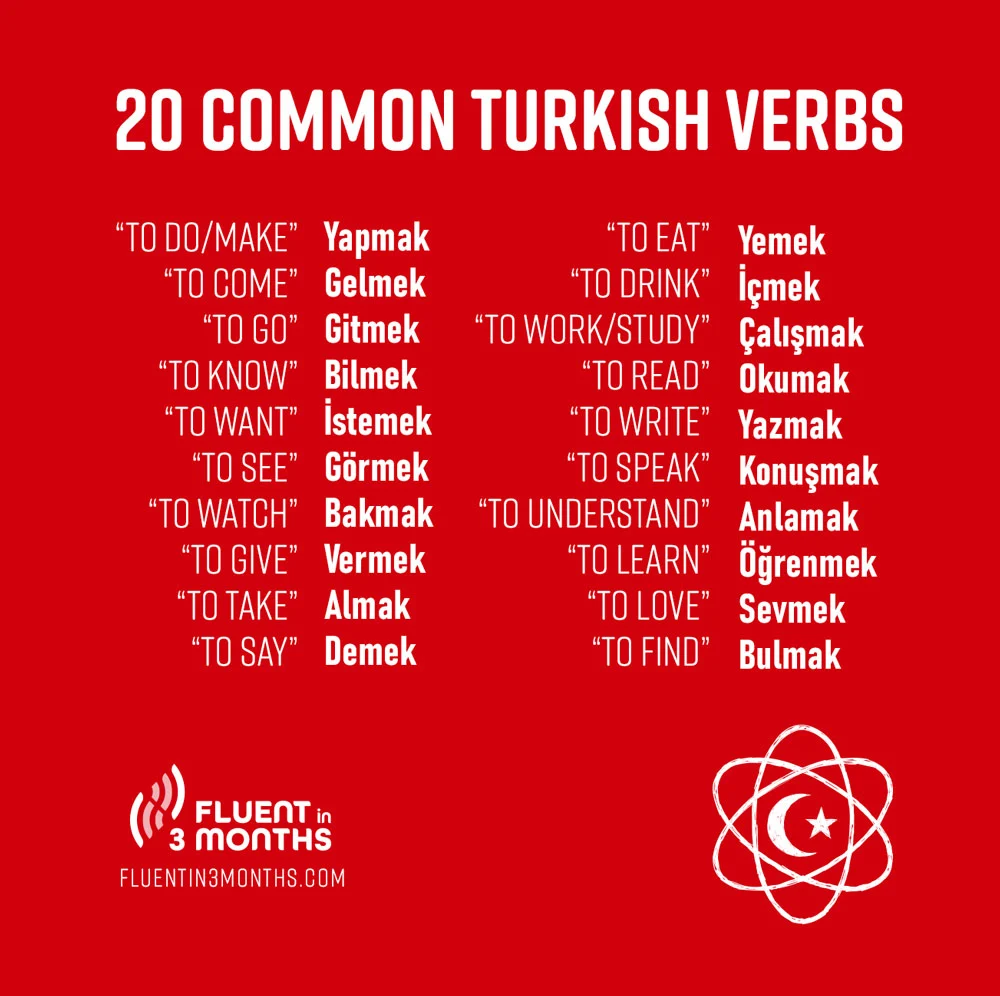
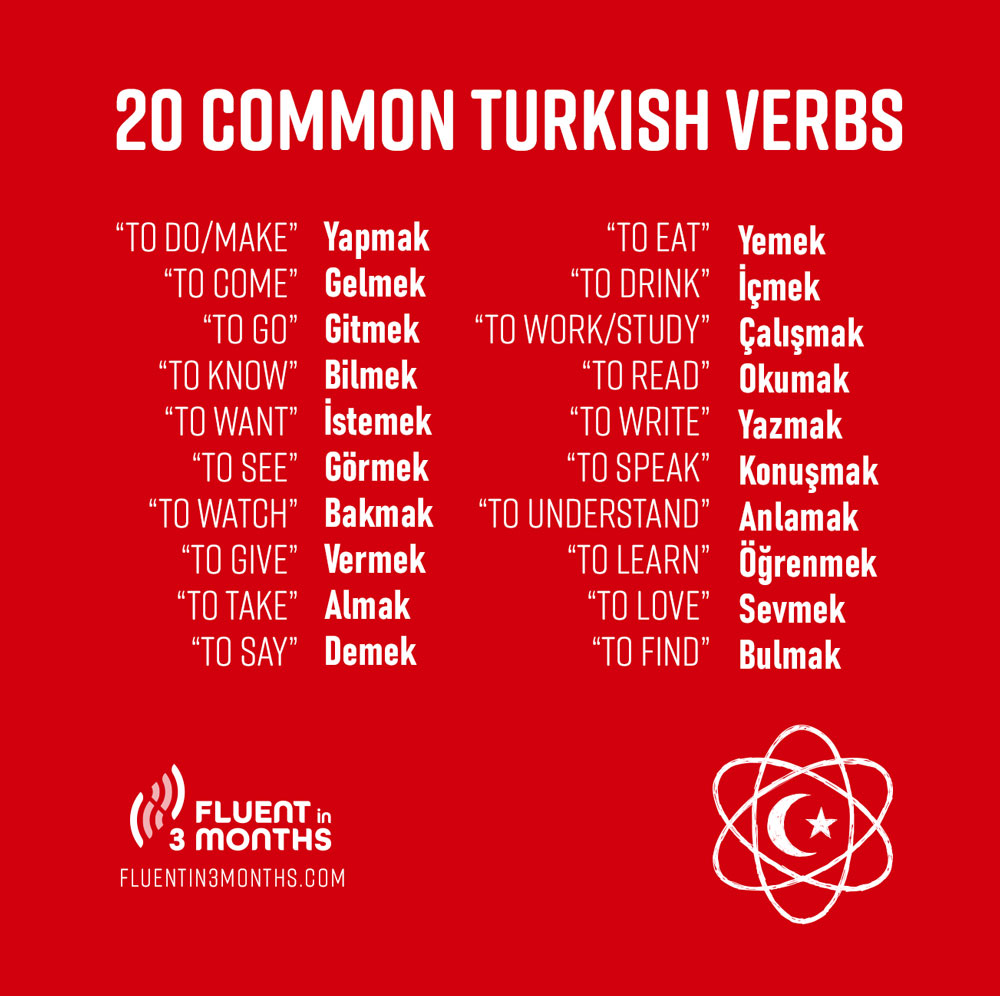
Common verbs such as "Yapmak" (To do/make), "Gelmek" (To come), and "Gitmek" (To go) are essential. However, the most striking feature for new learners is the absence of separate words for "to be" or "to have." These concepts are expressed through suffixes. For example, to say "I am a teacher," one takes the word for teacher (Öğretmen) and adds a suffix: "Öğretmenim." To express possession, the words "var" (there is/exists) and "yok" (there is not/does not exist) are utilized.
Furthermore, Turkish follows a Subject-Object-Verb (SOV) word order. In a standard sentence, the verb is positioned at the end. For instance, "Ben Türkçe öğreniyorum" literally translates to "I Turkish am learning." This structural difference requires a cognitive shift for English speakers, who must wait until the end of a sentence to understand the action being described.
Descriptive Power: Adjectives and Connectors
Adjectives provide the necessary detail for effective communication. In Turkish, adjectives always precede the noun they modify, similar to English. Pairs of opposites such as "Büyük/Küçük" (Big/Small), "Güzel/Çirkin" (Beautiful/Ugly), and "Yeni/Eski" (New/Old) are among the first words taught in linguistic programs.
Color vocabulary also plays a vital role in daily descriptions. "Kırmızı" (Red), "Mavi" (Blue), and "Yeşil" (Green) are high-frequency terms. Interestingly, the word "Siyah" (Black) and "Beyaz" (White) are frequently used, though their Turkic counterparts "Kara" and "Ak" still appear in geographical names and formal contexts, reflecting the language’s layered history.
Connectors and conjunctions, though seemingly minor, are the "glue" of the language. Words like "Ve" (And), "Ama" (But), and "Çünkü" (Because) allow speakers to move from simple sentences to complex narratives. Question words—"Ne" (What), "Kim" (Who), "Neden" (Why), and "Nasıl" (How)—are equally critical for those seeking clarification in a foreign environment.
Supporting Data and Global Trends
Data from the Yunus Emre Institute, Turkey’s official cultural organization, indicates a steady increase in Turkish language learners globally. As of 2024, the institute operates over 60 centers worldwide, with a significant concentration of students in the Middle East, the Balkans, and Western Europe.
- Learning Motivation: Approximately 40% of learners cite Turkish television series as their primary motivation for studying the language.
- Economic Impact: Turkey’s trade volume with the European Union and the MENA region has necessitated a rise in bilingual professionals, with "Business Turkish" becoming a sought-after skill in logistics and textile sectors.
- Demographics: With an estimated 80 to 90 million native speakers, Turkish is one of the most widely spoken languages in the world, serving as a gateway to other Turkic languages in Central Asia.
Official Responses and Expert Analysis
Linguists emphasize that the "immersion" provided by modern media has changed the way Turkish is learned. Dr. Selin Aksoy, a specialist in Turkic languages, notes, "The barrier to entry for Turkish has lowered. While the grammar remains challenging due to its agglutinative nature, the global familiarity with Turkish sounds and basic phrases through pop culture provides a psychological advantage to new learners."
Official representatives from the Turkish Ministry of Culture and Tourism have also remarked on the role of language in diplomacy. They argue that even a rudimentary knowledge of Turkish among visitors fosters a deeper sense of mutual respect and significantly enhances the tourist experience, leading to higher rates of repeat visits.
Broader Impact and Implications
The mastery of basic Turkish vocabulary carries implications far beyond simple travel convenience. It serves as a tool for cultural diplomacy and economic integration. In the professional world, the ability to use "filler" words and culturally specific markers—such as "Tabii ki" (Of course), "Maalesef" (Unfortunately), and "İnşallah" (God willing)—can build rapport in ways that a translator cannot.
As Turkey continues to play a pivotal role in international affairs, the language serves as a bridge between the East and the West. For the individual learner, these words are not merely sounds but keys to unlocking a rich history, a vibrant culinary tradition, and a complex social fabric. The strategic acquisition of common Turkish words represents the most efficient path to participating in the cultural and economic life of one of the world’s most dynamic nations.