



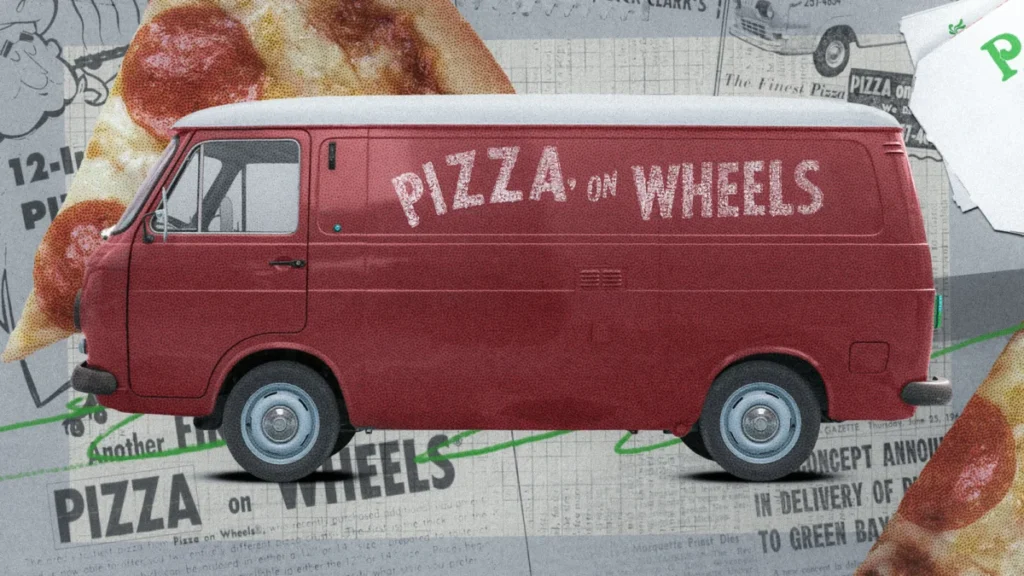
In the early 1960s, the residents of eastern Wisconsin were introduced to a culinary concept that seemed plucked from a science fiction novel: a restaurant-quality pizza baked entirely while in transit to the customer’s front door. Long before the era of smartphone applications and GPS-tracked couriers, a startup known as Pizza on Wheels attempted to revolutionize the food industry by bridging the gap between the kitchen and the consumer. While modern audiences might associate "bake-on-the-go" technology with high-profile Silicon Valley failures like Zume, the roots of this innovation stretch back over half a century to the Midwestern suburbs of Kenosha and Madison.
The emergence of Pizza on Wheels in 1962 was not merely a local curiosity but a significant, albeit forgotten, chapter in the evolution of American convenience culture. It represented a bold attempt to solve the perennial problem of food delivery: the degradation of quality during the "last mile" of transport. By placing the oven inside the delivery vehicle, the company promised a product that was not just warm, but fresh-from-the-oven at the moment of arrival.
The Post-War Pizza Boom and the Rise of Convenience
To understand the audacity of Pizza on Wheels, one must first look at the socio-economic landscape of post-World War II America. Before the 1940s, pizza was largely confined to Italian-American enclaves in cities like New York, New Haven, and Chicago. However, the return of American soldiers from the Italian theater of war catalyzed a national craving for the dish. By the 1950s, pizza had transitioned from an ethnic specialty to a mainstream staple.
According to data from the United States Department of Agriculture (USDA), approximately 11 percent of the American population consumes pizza on any given day. This massive market began to take shape in the mid-20th century as the "convenience revolution" took hold. The rapid expansion of the suburbs, the proliferation of the automobile, and the ubiquity of the home telephone created a perfect storm for the food delivery industry.
Carol Helstosky, a prominent pizza historian at the University of Denver, notes that while pizza has always been inherently mobile—dating back to 18th-century Neapolitan pizzaiolos who sold pies from insulated copper boxes—the formalization of delivery in the 1950s was often underwhelming. Early delivery services struggled with insulation; by the time a pie traveled five miles in a standard passenger car, the crust was often soggy and the cheese congealed.
Dennis J. Sheahan and the Engineering of the Mobile Oven
The catalyst for Pizza on Wheels was Dennis J. Sheahan, an entrepreneur based in Reedsville, Wisconsin. Sheahan was not a traditional restaurateur; his background was in the development of radio dispatch systems for commercial bus lines. This technical expertise allowed him to view the "pizza problem" through the lens of logistics and communication.
Sheahan’s innovation was two-fold. First, he redesigned the delivery vehicle itself. He purchased a fleet of vans and outfitted them with the "facilities of a modern restaurant." Each mobile kitchen was equipped with:
- Stainless steel counters and sinks for preparation.
- Onboard water tanks and refrigeration units for ingredient storage.
- A heavy-duty, double-decker gas-powered oven.
- A sophisticated two-way radio system.
The second part of the innovation was the workflow. When a customer called the central headquarters, a dispatcher would use a radio to contact the truck nearest to the customer’s neighborhood. The driver would receive the order, and a chef stationed in the back of the van would begin preparing the pizza while the vehicle was in motion. The goal was to time the baking process so that the pizza reached its peak temperature exactly as the van pulled into the customer’s driveway.
Technical Hurdles and the "Cirque du Soleil" of Cooking
Despite the visionary nature of the business, the practical application of cooking in a moving vehicle presented immense engineering and safety challenges. Noel Brohner, a professional pizza consultant and founder of Slow Rise Pizza, suggests that the logistical requirements of such a system in the 1960s would have been staggering.
"Refrigeration on a moving vehicle in 1962 is a massive hurdle," Brohner told researchers. "You’re dealing with gas-powered generators or heavy-duty battery arrays that were far less efficient than what we have today. Then you have a tank of propane or gas sloshing around near a high-heat oven in a moving van."
Furthermore, the physical act of "stretching dough" and "loading a pie" requires stability. Scott Wiener, founder of Scott’s Pizza Tours and a leading expert on pizza history, points out that the movement of a vehicle creates a hostile environment for a delicate pizza. "Topping and loading a pizza is already a fragile process," Wiener explained. "If the van hits a pothole or takes a sharp turn while the cheese is in its liquid state, you end up with a disaster."

Industry analysts suggest that for Pizza on Wheels to function, the "chefs" likely had to operate with the precision of acrobats. This high degree of difficulty is perhaps why most modern food trucks choose to park before they ignite their ovens, rather than baking while driving.
The Expansion and Eventual Liquidation
For a brief period, Sheahan’s gamble appeared to pay off. Following the 1962 launch in Kenosha, Pizza on Wheels expanded into Madison in 1963 with a three-truck fleet. By 1964, the service had reached Green Bay. Sheahan’s marketing was aggressive; he ran full-page advertisements in local newspapers, emphasizing that his pizzas were "never pre-baked" and "never cold."
By the mid-1960s, Sheahan was eyeing a franchise model, offering to finance and staff trucks for local operators across eight more Midwestern cities. However, by 1967, the momentum began to stall. Classified advertisements in Wisconsin newspapers started appearing, offering the specialized Pizza on Wheels trucks for sale. While some notices cited the ill health of local operators as the reason for liquidation, economic historians suggest the model was simply not scalable.
The rise of national chains like Domino’s and Pizza Hut in the late 1960s changed the competitive landscape. These companies focused on "fixed-location" efficiency and the development of better insulation technology—such as the corrugated cardboard box—rather than the expensive and dangerous prospect of mobile ovens. By 1971, Pizza on Wheels had effectively vanished from the public record.
A Comparative Analysis: Pizza on Wheels vs. Zume
The story of Pizza on Wheels gained renewed relevance in 2016 when the Silicon Valley startup Zume launched with a nearly identical premise. Zume utilized advanced robotics and "smart ovens" inside delivery trucks to cook pizzas en route. Backed by $445 million in funding, primarily from SoftBank, Zume was hailed as the future of food technology.
However, Zume encountered the same physical limitations that likely plagued Sheahan in the 1960s. Even with modern suspension and automated leveling systems, Zume struggled with "gravity issues," where toppings would slide off the dough during transit. Furthermore, the cost of maintaining a fleet of mobile kitchens far outweighed the marginal benefit of increased freshness.
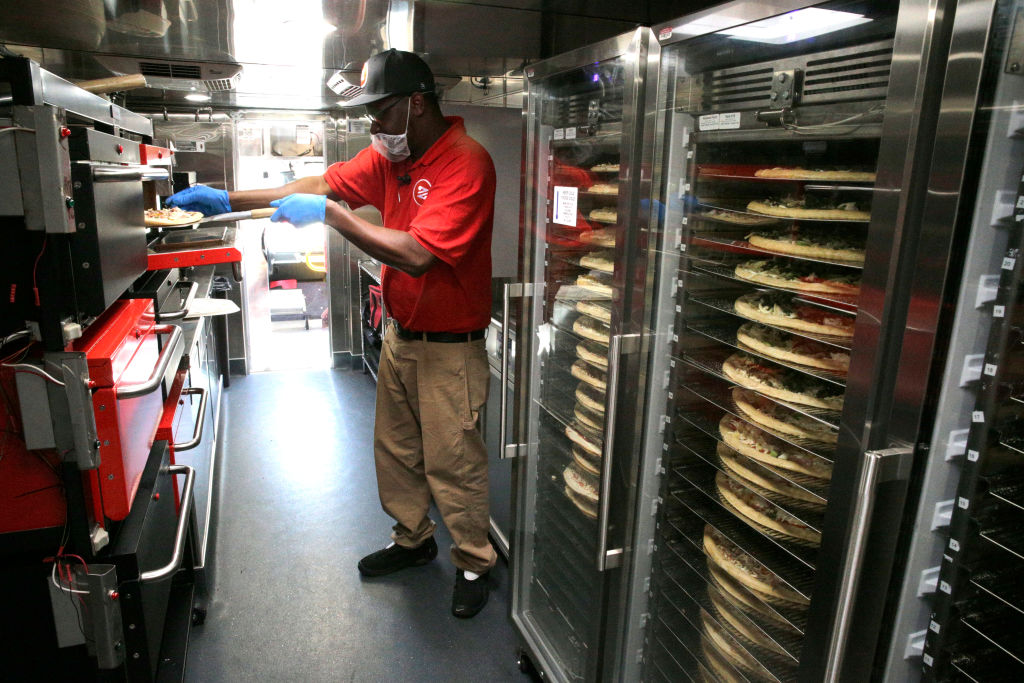
Zume ultimately pivoted away from pizza in 2019, focusing on sustainable packaging before shuttering entirely in 2023. The failure of a half-billion-dollar tech giant to master the "mobile oven" concept highlights just how ambitious Dennis Sheahan’s 1962 venture truly was. While Zume focused on the technology, Pizza on Wheels focused on the service, yet both were defeated by the harsh realities of thermodynamics and vehicular motion.
The Legacy of Freshness and the Evolution of Delivery
While Pizza on Wheels is now a footnote in culinary history, its spirit lives on in the modern "ghost kitchen" and specialized delivery sectors. The company’s failure helped define the boundaries of the industry. It proved that while consumers value freshness, they value consistency and price even more.
The eventual "winner" of the delivery wars was not the mobile oven, but the specialized pizza box. Developed and refined in the 1960s and 70s, the corrugated box allowed steam to escape while retaining heat, making the 30-minute delivery window a viable standard. This innovation, combined with sophisticated routing software, achieved 90% of what Pizza on Wheels intended at a fraction of the operational cost.
Today, as the food industry experiments with autonomous delivery robots and drone drops, the story of the 1962 Wisconsin pizza truck serves as a cautionary tale. It remains a testament to a brief, optimistic era of Midwestern innovation—a time when entrepreneurs believed that no technological hurdle was too high to ensure that a family in the suburbs could enjoy a perfectly timed, piping-hot slice of pizza. Though the company faded, the "pie in the sky" dream of total freshness continues to drive the multi-billion-dollar food-tech industry today.