


The question of whether artificial intelligence will usher in an era of widespread job displacement has dominated public discourse and corporate boardrooms for years. Initial predictions from some of the technology’s most prominent pioneers painted a stark picture, comparing AI’s potential impact to that of industrial automation, where machines fundamentally reshaped labor markets by eliminating roles dependent on human strength. However, a closer examination of real-world applications and evolving statements from these very leaders suggests a more nuanced reality: AI appears to be transforming work rather than simply eradicating it.
The Initial Automation Alarm: A Looming "Jobs Apocalypse"
In the nascent stages of widespread AI adoption, the rhetoric from tech magnates was often characterized by bold and sometimes alarming forecasts. Dario Amodei, CEO of Anthropic, a leading AI safety and research company, repeatedly suggested that AI-based tools would automate as much as half of all entry-level white-collar jobs. His statements underscored a prevailing fear that the cognitive tasks previously thought immune to automation—those requiring intellect and problem-solving—were now squarely in AI’s crosshairs.
Similarly, Mustafa Suleyman, CEO of Microsoft AI and co-founder of DeepMind, made headlines in February with an even more ambitious prediction. He asserted that AI would achieve "human-level performance on most if not all professional tasks" within a remarkably short timeframe of twelve to eighteen months. Such pronouncements fueled widespread anxiety among the workforce and prompted urgent discussions about the future of employment across various sectors, from legal and finance to creative industries and administration. The parallels drawn to historical industrial revolutions, where mechanization led to significant societal upheaval and the obsolescence of certain skills, seemed to suggest an inevitable "jobs apocalypse."
A Shifting Narrative: From Displacement to Transformation
Yet, as AI technologies have matured and moved from theoretical potential to practical implementation, a notable shift in tone has emerged from these same industry leaders. This evolution in perspective reflects a growing understanding of AI’s actual integration into the economy, moving away from a simple automation model towards a more complex paradigm of augmentation and transformation.
A significant turning point in this narrative came two weeks ago when Sam Altman, CEO of OpenAI, the company behind ChatGPT, publicly stated his "delight" at being "wrong" about the prospect of AI creating a "jobs apocalypse." Speaking at a conference in Australia, Altman’s remarks signaled a tempering of earlier, more dire predictions. His revised outlook suggested that the catastrophic job losses many had feared were not materializing at the anticipated pace or scale.
Further reinforcing this shift, Dario Amodei, previously a proponent of the "automate half" thesis, has also refined his position. He now posits that AI will not replace entire jobs but rather replace large parts of existing jobs. This distinction is crucial; it implies that human workers will continue to be central to their roles, but the nature of their daily tasks and responsibilities will evolve, with AI handling specific components. This revised perspective moves away from wholesale displacement towards a model where AI acts as a sophisticated co-pilot or assistant, altering the scope and execution of human labor.
The "Vibe Code" Economy: A New Analogy for AI Integration
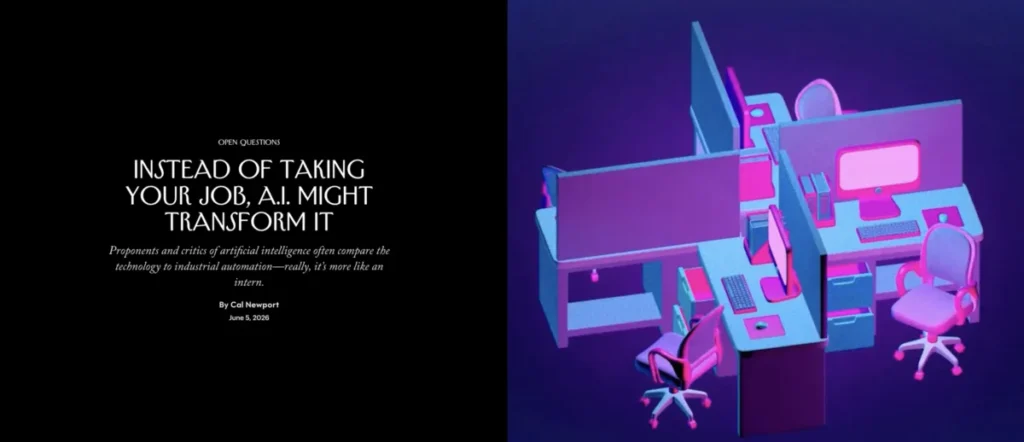
The conventional analogy of AI as industrial automation—a digital power loom rendering human labor superfluous—is increasingly being challenged. Instead, a more fitting parallel might be found in the ad-hoc, problem-solving approach exemplified by early web development. This perspective, explored in a recent article for The New Yorker titled "Instead of Taking Your Job, A.I. Might Transform It," draws on a personal anecdote from the author’s high school experience.
During a summer job at a corporate office park, the author programmed custom web-based applications for internal use at a management consulting firm. These weren’t polished, enterprise-level software solutions; they were "quick-and-dirty tools" hacked together to solve annoying, specific problems—an application for managing timesheets, another for tracking IT inventory. These bespoke solutions, though rudimentary, significantly simplified daily operations for the consultants.
Fast forward to the present, and interviews with small business owners heavily leveraging AI reveal a strikingly similar pattern. These entrepreneurs are not deploying AI to replace their workforce entirely but are instead using it to "vibe code" quick-and-dirty tools. They are integrating AI to simplify various operational facets, streamline workflows, and address specific pain points within their businesses. This involves using AI for tasks like generating initial drafts of marketing copy, analyzing customer feedback, automating data entry, or even creating basic code snippets for internal tools.
As the article articulates, "These examples were not the digital equivalent of a power loom, making large numbers of human jobs superfluous. Turns out, A.I. was assisting these small businesses in roughly the same way that my teen-age self had helped that consulting company—by hacking together whatever was useful." This analogy highlights AI’s role not as a substitute for human intellect but as an enhancer, enabling individuals and small teams to accomplish more, often by automating the mundane or accelerating initial stages of complex tasks.
Supporting Data and Economic Context: Resilience Amidst Evolution
Despite the initial alarms, macroeconomic data largely supports the evolving narrative of job transformation rather than mass extinction. While certain tasks are undeniably susceptible to automation, the overall labor market has shown remarkable resilience. Unemployment rates in many developed economies remain low, and job growth continues in various sectors, including those leveraging AI.
Reports from institutions like the World Economic Forum (WEF) and the International Monetary Fund (IMF) have increasingly emphasized job augmentation over outright displacement. For instance, the WEF’s "Future of Jobs Report 2023" predicted that while AI would displace some jobs, it would also create new ones, leading to a net positive creation of 69 million new jobs by 2027, even as 83 million are eliminated. This suggests a dynamic reallocation of labor and skills rather than a shrinking workforce.
Economists also point to concepts like the Jevons Paradox, which Dario Amodei himself has referenced. Originally observed in the context of coal consumption, the paradox states that increasing the efficiency with which a resource is used can lead to an increase, rather than a decrease, in its overall consumption. Applied to AI and labor, making certain tasks easier or cheaper through AI might not lead to fewer tasks being performed, but rather to an increase in the overall scope and ambition of projects. If AI makes research faster, companies might undertake more extensive research, still requiring human oversight, analysis, and strategic direction. This increased demand for higher-level work could, in turn, create new roles or deepen existing ones.
Furthermore, the "productivity paradox" of new technologies is also relevant. Historically, it takes time for revolutionary technologies to translate into measurable productivity gains and significant economic restructuring. The internet, for example, took decades to fully permeate industries and fundamentally alter work processes. AI, still in its relatively early stages of broad adoption, may be following a similar trajectory, with its full economic impact yet to be fully realized and measured.
The Emergence of "Freestyle Work" and New Skill Demands
The shift towards job transformation is giving rise to new operational strategies within companies, one of which has been termed "freestyle work." This concept describes employees using AI tools in an ad-hoc, personalized manner to enhance their specific workflows, much like the author’s high school "hacks." Rather than top-down deployment of monolithic AI systems, "freestyle work" empowers individual knowledge workers to integrate AI into their daily routines to solve immediate, localized problems. This might involve using AI to brainstorm ideas, draft emails, summarize documents, or analyze small datasets, thereby streamlining personal productivity and contributing to overall organizational efficiency.
This decentralized approach to AI adoption has profound implications for skill development. While initial fears centered on the obsolescence of existing skills, the reality is creating a demand for new competencies. "Prompt engineering"—the art and science of crafting effective queries for AI models—has become a burgeoning skill. Beyond technical proficiency, uniquely human capabilities are gaining renewed importance. Critical thinking, creativity, complex problem-solving, emotional intelligence, and interpersonal communication are becoming more valuable as AI handles routine and analytical tasks. The ability to collaborate effectively with AI, to discern its limitations, and to apply human judgment to its outputs is paramount.
Reactions and Broader Implications
The evolving understanding of AI’s impact is also shaping responses from various stakeholders. Economists are increasingly focusing on the quality of jobs, not just their quantity. Will AI make jobs more engaging by automating tedious tasks, or will it lead to a deskilling of the workforce, pushing human labor towards less rewarding roles? The current trend suggests the former, with AI augmenting human capabilities rather than replacing them, allowing professionals to dedicate more time to strategic thinking, creativity, and complex decision-making.
Labor organizations, while cautiously optimistic about the potential for augmentation, continue to advocate for robust reskilling and retraining programs to ensure workers can adapt to the changing landscape. They also raise concerns about equitable access to AI tools and the potential for increased surveillance or algorithmic management in the workplace.
Policymakers, too, are grappling with the implications. Discussions around universal basic income (UBI), once seen as a potential necessity in a robot-dominated economy, are now less urgent but remain part of the long-term dialogue. Instead, the focus has shifted towards investments in education, lifelong learning initiatives, and infrastructure to support a dynamic labor market capable of absorbing technological change. Governments are exploring policies to foster innovation while ensuring ethical AI development and a just transition for workers.
Conclusion: A Collaborative Future, Not a Conquering One
The initial specter of a workforce hollowed out by artificial intelligence appears, for now, to be receding. The prevailing evidence and the revised outlooks from AI’s leading proponents suggest a future where AI acts as a transformative partner rather than a replacement. The knowledge sector, far from being conquered, is being reshaped in ways that are both "weirder and less dire" than once predicted.
The trajectory points towards a collaborative future, where human ingenuity, creativity, and critical judgment are amplified by AI tools. Just as the author’s summer job many years ago didn’t put consultants out of work but instead made their efforts "a little deeper," AI today is enabling a similar deepening of professional capabilities. The challenge ahead lies in effectively harnessing AI’s power to augment human potential, foster continuous learning, and ensure an equitable transition for all workers, embracing a future where technology serves to enrich human endeavor.