

In the contemporary corporate landscape, the disconnect between learning initiatives and bottom-line performance has become an increasingly untenable liability. Research sponsored by the Association for Talent Development (ATD) underscores a definitive shift in executive priorities, revealing that 96 percent of Fortune 500 CEOs identify business impact as the primary metric for evaluating talent development programs. This mandate for accountability places return on investment (ROI) as the secondary, yet equally critical, benchmark for success. As organizations navigate economic volatility, the pressure on learning and development (L&D) departments to move beyond traditional metrics—such as course completion rates or trainee satisfaction—has reached an inflection point.
The Evolution of Performance Measurement
The traditional logic model of corporate training has its roots in the mid-20th century. While the foundational concepts of organizational performance measurement trace back to the 1800s, the structured approach popularized by Raymond Katzell in 1952 provided the framework that Don Kirkpatrick later adapted to categorize learning outcomes. However, modern expectations have evolved beyond mere educational attainment. Today’s C-suite demands that L&D programs function as strategic assets, contributing directly to organizational KPIs such as output, quality, cost reduction, and time-to-market efficiency.

This shift signifies a transition from viewing training as a cost center to treating it as a performance driver. When an organization asks whether a program aligns with its core business, the answer is invariably affirmative. Consequently, the central purpose of any development program must be its impact—the "why" behind the investment. By adopting a "start with the end in mind" methodology, practitioners are better positioned to ensure that every educational initiative is tethered to tangible business results.
The ROI Methodology: A Twelve-Step Framework
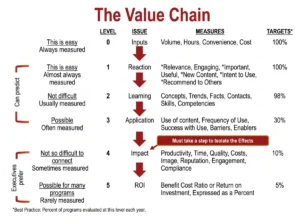
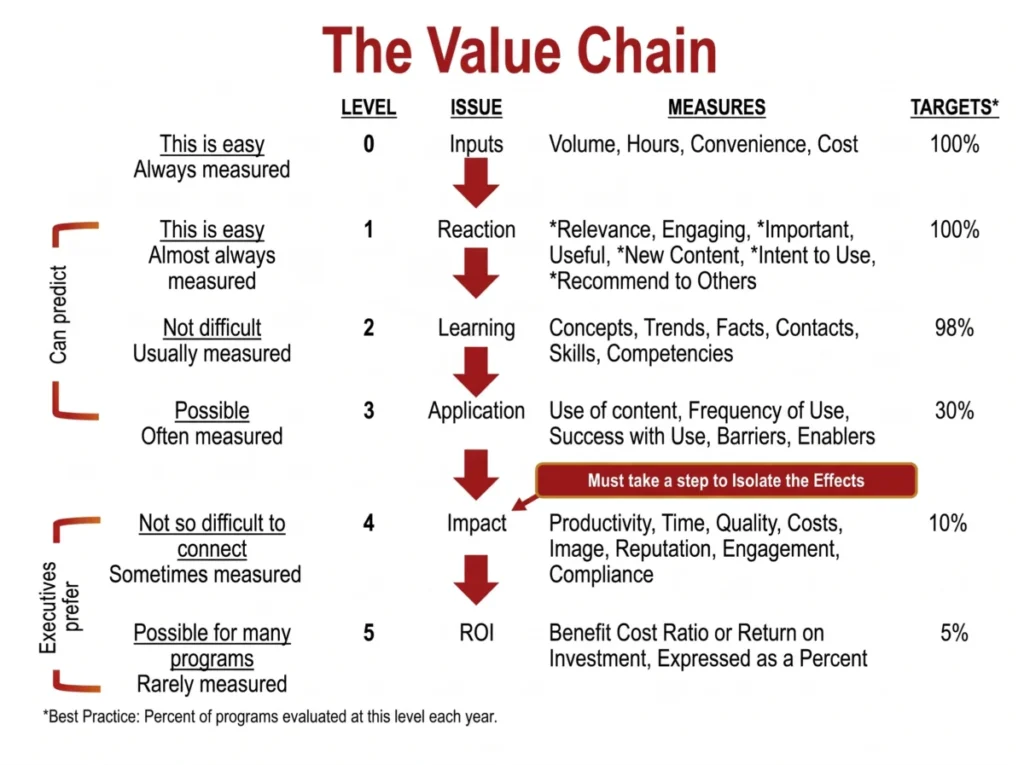
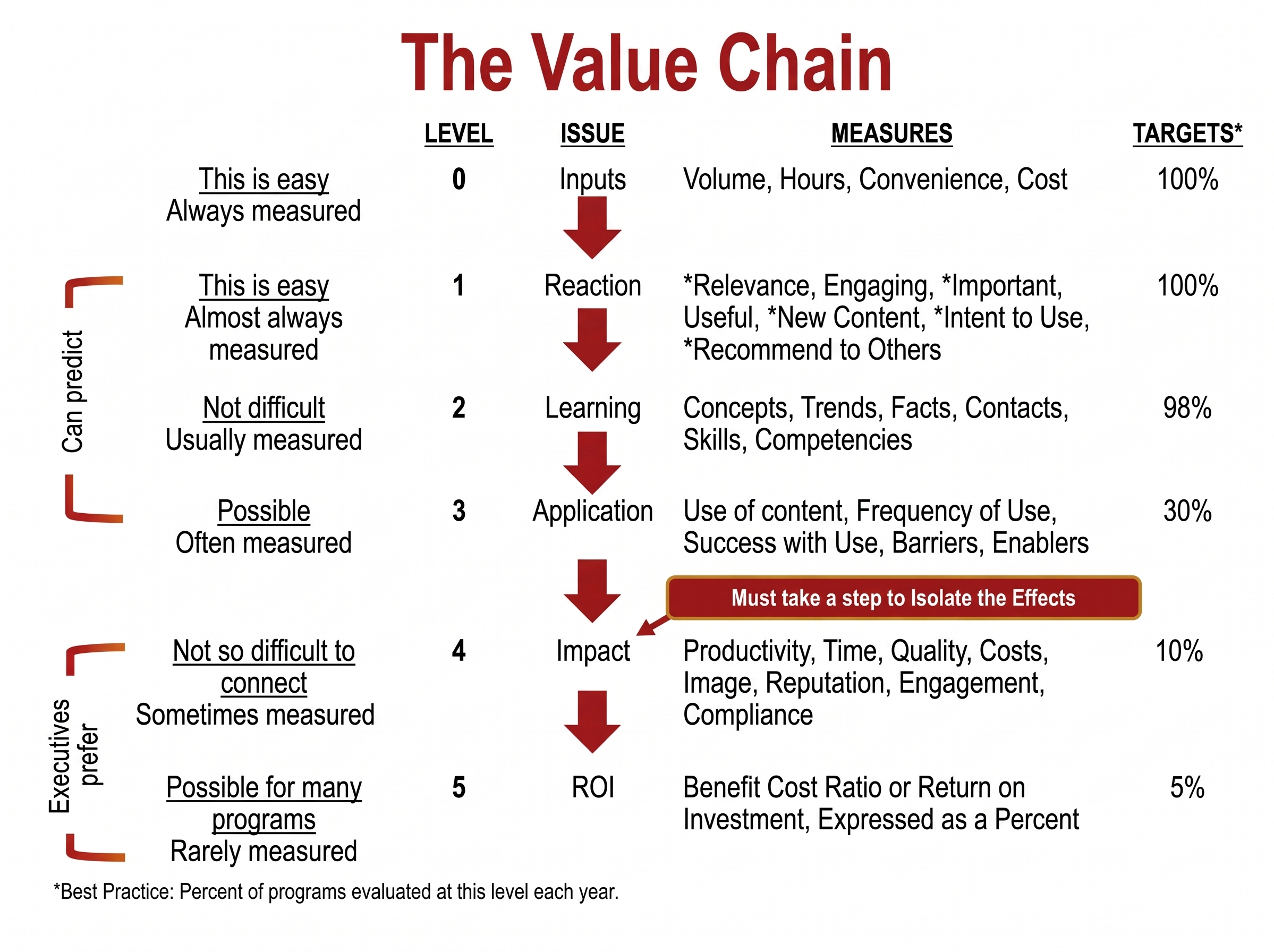
The most widely adopted framework for achieving this alignment is the ROI Methodology. Utilized by over 10,000 organizations globally, this twelve-step system provides a rigorous, data-driven pathway for designing, delivering, and evaluating programs. The methodology is structured around the "value chain," a logic model that establishes how different datasets connect to build a narrative of success.
The value chain begins at Level 0, which captures input data—participants, time, and costs. This is followed by five progressive levels of outcomes:

- Level 1: Reaction: Assessing the participant’s perception of the program’s relevance and importance. Adverse feedback at this stage can signal potential failure before a program gains traction.
- Level 2: Learning: Measuring the acquisition or enhancement of skills and knowledge.
- Level 3: Application: Tracking the actual use of new skills, including frequency, success rates, and the identification of barriers or enablers within the workplace.
- Level 4: Impact: Measuring the consequences of application, specifically how it alters business metrics like quality or cost.
- Level 5: ROI: The final step, which converts impact data into monetary benefits, compared against total program costs to determine the benefit-cost ratio.
Planning and Execution: The Strategic Foundation
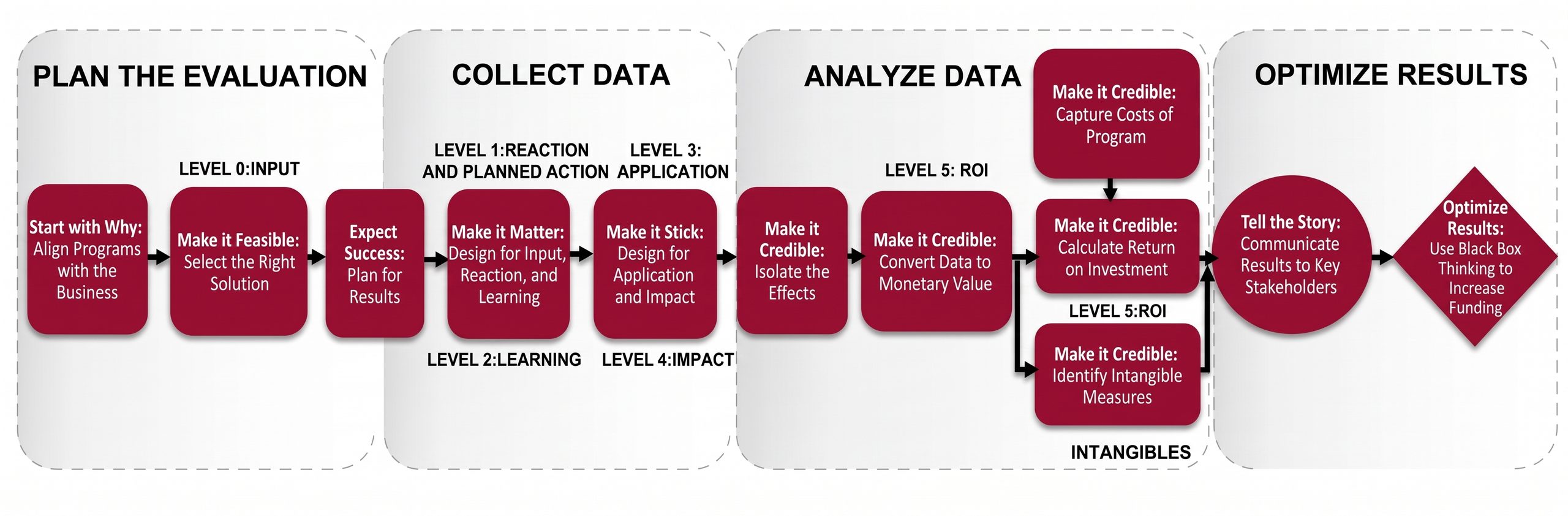
The effectiveness of the ROI Methodology lies in its rigorous planning phase, which consists of three critical steps designed to ensure success from the outset. First, practitioners must align the program with a specific business problem or opportunity. If a problem exists, the team must identify the exact metrics that reflect it. Second, they must validate the solution. Not every performance challenge requires a training intervention; ensuring that the proposed program is the correct remedy is essential for efficiency. Third, designers must cultivate an expectation of success, incorporating design thinking to ensure the initiative is structured to yield measurable outcomes.
Following this planning, the data collection process moves beyond traditional surveys. While reaction and learning data are collected routinely, the methodology places significant emphasis on capturing application and impact data. Without these, training remains an abstract activity rather than a business contribution.
Navigating the Credibility Challenge
One of the primary hurdles in program evaluation is securing the trust of senior leadership and the CFO. To address this, the ROI Methodology employs a series of analytical steps focused on credibility.

A cornerstone of this approach is the isolation of the program’s effects. Given that business performance is influenced by numerous variables, simply tracking changes is insufficient. Certified ROI professionals use techniques ranging from control group comparisons to expert estimations to isolate the impact of the training itself. These methods are designed to withstand the scrutiny of financial controllers, ensuring that results are defensible.
Furthermore, the process of converting impact data into monetary values adheres to the conservative principle of "when in doubt, leave it out." By opting for conservative estimates, the methodology maintains transparency and avoids the appearance of inflated benefits. Conversely, when capturing costs, the principle is "when in doubt, leave it in," ensuring that all direct and indirect expenses—including participant time—are accounted for. This creates a comprehensive view of the true financial investment versus the realized return.
Intangibles and the Art of Storytelling
Not all business benefits can be readily converted into currency. Intangible measures, such as enhanced employee engagement, improved organizational culture, or better customer relationships, remain vital components of an organization’s success. While they may not appear in the final ROI calculation, they are documented as essential qualitative indicators that provide depth to the program’s overall value.
The culmination of the twelve-step process involves using these data sets—reaction, learning, application, impact, ROI, and intangibles—to construct a compelling narrative. This is not merely a reporting exercise; it is a strategic tool for stakeholders. By synthesizing these six data sets, L&D leaders can communicate a persuasive story to executives, justifying current expenditures and securing the resources necessary for future growth.
Broader Implications and Future Outlook
The adoption of a standardized, rigorous evaluation methodology has profound implications for the future of the talent development profession. As organizations continue to face pressure to demonstrate value in a competitive global market, those that fail to align their L&D efforts with core business objectives risk marginalization.
The shift toward data-driven accountability represents a maturation of the talent development field. By treating human capital as a strategic investment that requires the same level of financial rigor as capital expenditures, organizations can better justify the costs associated with training. Furthermore, this approach fosters a culture of continuous improvement, where feedback loops allow for the iterative optimization of programs.
In conclusion, the twelve steps of the ROI Methodology provide more than just an evaluation rubric; they offer a comprehensive framework for organizational success. By focusing on business impact, ensuring credibility through conservative analysis, and utilizing storytelling to bridge the gap between data and strategy, L&D professionals can secure their position as indispensable partners in the pursuit of long-term business performance. For those tasked with leading talent development in the coming decade, the message is clear: success is no longer defined by how many people attend a course, but by how effectively that course moves the business forward.