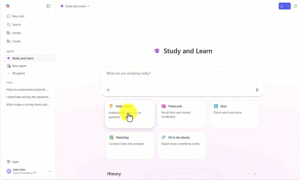




Artificial intelligence has officially crossed the threshold from experimental novelty to institutional utility within the global education sector. According to the Microsoft 2026 AI in Education report, the adoption curve has accelerated dramatically, with 92% of surveyed students and education leaders, alongside 88% of surveyed educators, reporting the active use of artificial intelligence for school-related purposes. This widespread embrace signals that the foundational question for academic institutions is no longer whether to experiment with emerging technologies, but rather how to transition from isolated, individual productivity gains to secure, institution-wide infrastructures capable of supporting teaching, learning, research, and campus operations at scale.
The imperative to scale artificial intelligence across an entire educational enterprise, however, introduces unprecedented operational complexities. Modern schools, colleges, and universities are multifaceted ecosystems. A single institution must seamlessly coordinate instruction, continuous assessment, academic advising, financial aid distribution, advanced research initiatives, campus safety protocols, and complex information technology infrastructures. Each of these functional domains operates on disparate legacy systems, maintains distinct records, and enforces rigorous, specialized access requirements. When layered alongside stringent student privacy obligations—such as the Family Educational Rights and Privacy Act (FERPA) in the United States and global equivalents—as well as uncompromising expectations surrounding academic integrity, it becomes clear why general-purpose, consumer-grade artificial intelligence models frequently fall short. These standalone tools routinely lack the necessary institutional context, granular data controls, and compliance guardrails required for secure academic deployment.
Closing this operational gap demands a sophisticated integration of relevant institutional context paired with robust safeguards governing how sensitive data is accessed, processed, and retained. Platforms such as Microsoft 365 Education have been architected specifically to address these challenges, serving as a technological bridge that enables academic institutions to transition away from fragmented, ad-hoc experimentation toward practical, governance-driven implementation. By embedding intelligence directly into the digital environments where educators and students already work, technology providers are attempting to reconcile the immense promise of automation with the strict accountability demanded by educational leadership.
The Evolution of Classroom Support Through Agentic AI
To understand the practical friction points of modern teaching, one must examine the daily realities of an educator’s schedule. Lesson planning, differentiated instruction, and student assessment typically exist in isolated digital silos. Curricula may live in one repository, grading rubrics in another, and diagnostic assessment data in a third. Crucially, these legacy systems were rarely designed to communicate with one another. The resulting administrative overhead generates a relentless accumulation of repetitive operational tasks that interpose themselves between teachers and their primary mission: direct student engagement and instruction.
This administrative bottleneck is precisely where agentic artificial intelligence aims to alter the educational landscape. Unlike conventional software applications that require users to open distinct interfaces and manually transfer data, classroom agents operate fluidly across the existing enterprise tools educators already rely on. By functioning as a continuous operational fabric, these agents streamline planning, differentiation, and assessment as a unified workflow rather than a series of disjointed chores. For instance, an educator can prompt an agent to draft multiple differentiated versions of a lesson tailored to varying reading levels, automatically assemble supplemental materials aligned with specific curriculum units, and synthesize recent assessment results to instantly identify which students require targeted intervention.
Industry analysts emphasize that the true metric of success for educational automation is not the mere elimination of keystrokes, but rather the qualitative redistribution of time. By absorbing routine administrative burdens, agentic support returns valuable hours to educators, enabling them to focus more deeply on direct instruction, mentorship, and personalized student support. This represents the realization of artificial intelligence purpose-built for pedagogy, grounded firmly in authentic instructional workflows rather than generic enterprise productivity metrics.
Harmonizing the Student Experience Across Campus
Beyond the classroom, fragmented information systems frequently create profound navigational hurdles throughout the broader student journey. Modern students frequently find themselves traversing a labyrinth of specialized campus services—including academic advising, financial aid processing, accessibility services, and remedial learning support—where they are repeatedly forced to restate their personal and academic histories to different departments. Each additional administrative handoff introduces friction, creating vulnerabilities precisely when timely, coordinated institutional support is most critical to student retention and academic success.
By establishing a shared context across disparate student service platforms, academic institutions can fundamentally transform the support experience. Under an integrated framework, students encounter significantly fewer bureaucratic handoffs, receiving timely assistance that reflects their current academic standing and historical engagement, from initial campus orientation through critical milestones where specialized intervention may be required. Behind the scenes, academic advisors, financial aid officers, and support staff are equipped with a unified informational context, enabling them to coordinate rapid, multidisciplinary responses. This administrative cohesion not only reduces institutional friction but also fosters a more supportive, responsive campus culture.
Institutional leaders note that the ultimate objective extends far beyond operational efficiency. The strategic goal is to dismantle internal administrative silos, empowering staff to deliver proactive, coordinated support that directly correlates with improved student persistence, engagement, and graduation rates.
The Triad of Foundation: Intelligence, Governance, and Trust
Deploying artificial intelligence across an entire academic enterprise requires far more than a powerful underlying model. Sustainable, institution-ready deployments demand three non-negotiable pillars: relevant contextual intelligence, comprehensive governance, and clearly defined human oversight.
Intelligence provides the foundational context necessary to make artificial intelligence actionable within an educational setting. Systems such as Microsoft IQ serve as the overarching intelligence layer across Microsoft’s technological ecosystem, while Work IQ securely draws upon the specific Microsoft 365 data, interpersonal relationships, and authorized workflows accessible to an individual user. This contextual awareness empowers tools like Microsoft 365 Copilot and specialized agents to surface precise, relevant information from localized repositories—including institutional files, email threads, collaborative messages, and recorded meetings—strictly within the boundaries of the institution’s secure cloud environment.
Governance is seamlessly inherited from the existing administrative architecture of the Microsoft 365 platform already managed by the institution. Core enterprise controls governing user identity, granular permissions, regulatory compliance, and robust data protection are applied consistently across both Copilot experiences and custom agents. Crucially, the institutional knowledge that feeds these intelligence models remains the exclusive property of the school or university, operating under strict local control and governance policies.
Trust represents the essential mechanism that renders the first two pillars viable within a school setting. Leveraging established Microsoft 365 permissions and security controls, institutions can strictly limit information access to data that the individual user is explicitly authorized to view. Furthermore, educational leadership retains the authority to configure, continuously monitor, and systematically review Copilot and agent interactions to ensure absolute alignment with institutional privacy policies, cybersecurity mandates, and academic integrity standards.
When combined, these elements fulfill the core demands that the education sector places on emerging technology: that artificial intelligence be purposefully engineered for teaching and learning, that it operate naturally within the existing flow of academic life rather than as an isolated digital destination, and that it deliver a trusted, auditable experience that institutions can proudly stand behind.
Aligning Technological Capability with Institutional Readiness
Academic institutions vary widely in their digital maturity and organizational readiness for artificial intelligence adoption. Recognizing this disparity, platforms like Microsoft 365 Education offer a flexible continuum of deployment options, enabling institutions to scale their technological footprint over time based on specific strategic priorities, licensing frameworks, governance maturity, and technical infrastructure.
Many institutions begin their deployment journey with Microsoft 365 Copilot Chat, an entry-level, secure artificial intelligence experience included within existing Microsoft 365 licenses that provides educators and administrative staff with a reliable, everyday conversational assistant. As institutional confidence and technical readiness expand, organizations can transition to full Microsoft 365 Copilot deployments. This advanced tier integrates artificial intelligence directly into the native productivity applications where teaching, research, and campus operations naturally occur, while also unlocking the capability to delegate complex, multi-step workflows to specialized agents tailored to specific departmental needs.
This graduated adoption model is strategically significant. It allows educational leaders to make targeted investments where technological capability is most urgently required, scaling up infrastructure as institutional governance and user proficiency mature, rather than forcing a disruptive, universal rollout.
A parallel philosophy governs the approach to underlying artificial intelligence models. Modern enterprise platforms increasingly recognize that model selection is a critical administrative consideration. In supported Microsoft 365 Copilot environments, institutional administrators retain the administrative flexibility to leverage different models optimized for distinct operational tasks, subject to regional availability and strict governance controls. Consequently, the most pertinent operational question for IT leadership is no longer which model represents the newest industry release, but rather which supported experience precisely aligns with a given pedagogical task, satisfies the institution’s compliance requirements, and complies with applicable data-processing agreements.
Strategic Roadmap and Future Implications
Implementing institution-wide artificial intelligence does not necessitate an immediate, resource-intensive enterprise rollout. Successful adoption strategies typically begin with focused pilot programs within specific departments—such as streamlining administrative workflows in financial aid or enhancing curriculum planning within a single academic faculty—before expanding horizontally across the campus.
The inherent complexity of the modern educational landscape should not be viewed as an obstacle to be avoided, but rather as the foundational reality for which artificial intelligence must be designed. By unifying relevant institutional context, rigorous administrative controls, and flexible deployment pathways, technology providers are enabling schools and universities to explore the frontiers of artificial intelligence on terms that rigorously respect their unique operational needs, ethical responsibilities, and public trust.