



The rapid integration of artificial intelligence into daily student life has forced educational institutions worldwide to confront a difficult reality: while learners enthusiastically adopt AI for academic support, the vast majority of available tools are engineered for speed rather than genuine cognitive development. Designed primarily as general-purpose chatbots, many commercial platforms prioritize giving students the final answer over helping them understand the underlying concepts. In response, schools and universities have frequently resorted to banning or heavily restricting AI access entirely. This regulatory vacuum has created a persistent tension between student behavior and institutional trust, leaving administrators searching for safe, pedagogically sound alternatives.
To bridge this gap, Microsoft Corporation has officially rolled out the Study and Learn Agent, a specialized, first-party AI tool integrated directly into Microsoft 365 Copilot. Generally available at no additional cost for all existing education customers, the new agent is explicitly designed for students aged 13 and older. Rather than functioning as a shortcut around homework and exam preparation, the Study and Learn Agent is built around a singular foundational philosophy: the learner must do the thinking. By replacing the traditional "answer bot" dynamic with guided, step-by-step coaching, the platform aims to restore institutional confidence in educational technology while fostering independent critical thinking among students.
The arrival of the Study and Learn Agent marks a significant evolution in how software developers approach the educational technology market. For decades, ed-tech tools have vacillated between rigid, programmed computer-aided instruction and overly permissive generative models. The launch of Microsoft’s new agent signals a pivot toward adaptive, conversational pedagogical agents that respect institutional compliance requirements while leveraging advanced large language models. The software is accessible directly within the existing Microsoft 365 Copilot app via enterprise-grade secure channels, ensuring that schools do not need to procure, vet, or manage separate third-party software licenses.
Background Context and the Evolution of AI in Classrooms
The journey of artificial intelligence in education has accelerated dramatically since the widespread public release of generative AI models in late 2022. Initially met with widespread academic panic over cheating, plagiarism, and the potential erosion of foundational writing and mathematical skills, the initial phase of AI adoption was characterized by strict prohibition. School districts across North America, Europe, and Asia rushed to block generative AI tools on institutional networks and school-issued devices. However, educators quickly realized that network-level blocks were largely ineffective, as students routinely bypassed restrictions using personal smartphones, home networks, and external applications.
Recognizing that outright prohibition was unsustainable, educational policymakers and technology developers began shifting toward a framework of guided integration. The core challenge, however, remained technical: most commercial LLMs are optimized for general productivity, coding, and creative writing, lacking the instructional scaffolding required by modern learning science. Recognizing this market gap, Microsoft began developing education-specific iterations of its core productivity suite. The introduction of the Study and Learn Agent builds upon previous Microsoft education initiatives, including the rollout of Microsoft Copilot with enterprise data protection and specialized reading and math coaching tools, culminating in a unified ecosystem designed specifically for the realities of modern classrooms.

Chronology of Deployment and Administrative Control
The rollout of the Study and Learn Agent follows a carefully structured deployment timeline designed to give IT administrators granular control over institutional data and student safety. For K-12 educational accounts, Copilot Chat—the gateway through which students access the Study and Learn Agent—is disabled by default. This default-off posture represents a deliberate effort by Microsoft to respect local district policies, allowing school boards and IT departments to review compliance frameworks, privacy agreements, and pedagogical implications before granting student access.
To activate the feature, IT administrators must manually enable Copilot Chat via the Microsoft 365 admin center using specific tenant identifiers. Once administrative permission is granted, eligible students gain immediate access to the Study and Learn Agent directly within the native Copilot interface, eliminating the need for separate logins, profile creations, or external software downloads. The agent is currently optimized for English-language curricula in the United States, with a planned regional and multilingual expansion scheduled to roll out across international markets in the coming weeks. For higher education institutions and K-12 districts alike, the tool integrates seamlessly with existing Microsoft Entra ID school credentials, ensuring compliance with federal and international student data privacy regulations.
Pedagogical Foundation: Grounded in Learning Science
What fundamentally distinguishes the Study and Learn Agent from standard conversational AI assistants is its explicit grounding in established learning science and cognitive psychology. Rather than retrieving and displaying raw text or mathematical solutions, the agent’s prompt engineering and interactive loops are structured around four core pedagogical principles designed to promote long-term retention and conceptual mastery.
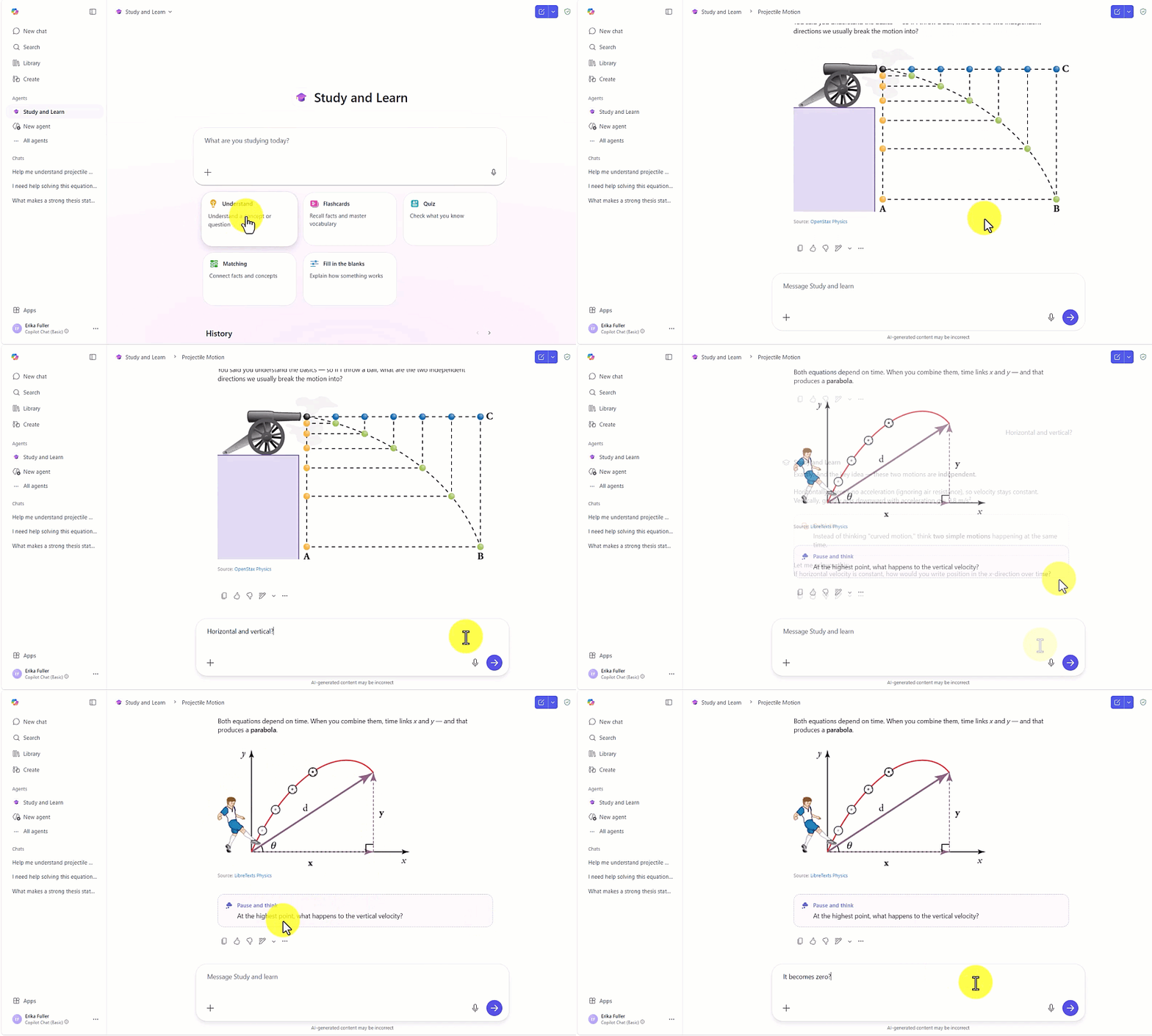
First, the platform emphasizes active retrieval practice. Instead of summarizing a chapter or providing a direct answer to a review question, the agent prompts the student to recall information from memory, generating custom flashcards, interactive matching exercises, and targeted self-quiz sessions on the spot. Second, the system employs scaffolding and guided inquiry. When a student struggles with a complex calculus problem or a difficult scientific concept, the agent breaks the problem down into manageable cognitive chunks, asking probing questions that guide the student toward the solution independently.
Third, the agent incorporates adaptive feedback mechanisms. By analyzing the student’s real-time responses, the software dynamically adjusts its tone, complexity level, and instructional strategies to match the learner’s current comprehension state. Fourth, the platform integrates multimodal learning supports, allowing students to search for and examine visual illustrations, diagrams, and conceptual maps across diverse academic subjects. Together, these elements move students away from passive consumption and into active engagement, ensuring that the cognitive heavy lifting remains firmly with the learner.

Transforming the Student Experience Across Disciplines
The practical application of the Study and Learn Agent spans a wide array of academic disciplines, fundamentally altering how students utilize AI for homework help, exam preparation, and essay composition. In STEM fields, such as biology or chemistry, a student preparing for an examination can use the agent to generate customized practice sets, review cellular processes, or walk through chemical equations step-by-step without ever receiving the direct answer key. If a student is stuck on a difficult physics problem, the agent provides conceptual hints rather than numerical solutions, encouraging analytical problem-solving.
In humanities and language arts, the agent functions as an interactive writing coach. Rather than writing an essay or generating a thesis statement for the student, the Study and Learn Agent engages in a Socratic dialogue, asking clarifying questions about the student’s central argument, structural flow, and evidentiary support. This conversational drafting process sharpens the student’s critical thinking and refines their prose, reinforcing good academic habits rather than bypassing them. Whether working within the desktop application or via web browsers, students access the agent conveniently from the left-hand navigation bar of the Copilot interface.
A Broader Ecosystem: Integrating Teach and Study and Learn
The launch of the Study and Learn Agent is not an isolated product release, but rather a core component of Microsoft’s broader, long-term strategic vision for a unified educational AI ecosystem. Microsoft’s approach centers on developing specialized, first-party AI agents built to support every distinct participant within the educational environment, moving away from the assumption that a single, generalized tool can adequately serve educators, administrators, and students alike.
Within this overarching framework, the Study and Learn Agent pairs directly with companion tools like the Teach agent, creating a comprehensive technological infrastructure tailored to modern schooling. While the Study and Learn Agent focuses on student-facing, inquiry-driven coaching, educator-facing tools are designed to assist teachers with lesson planning, differentiated instruction, and administrative workflows. By housing both systems within the familiar Microsoft 365 Education suite, Microsoft is attempting to create a cohesive operational environment where AI supports institutional workflows without compromising data security or pedagogical integrity.
Implications for School Administrators and IT Decision-Makers
For school superintendents, principals, chief technology officers, and IT administrators, the introduction of the Study and Learn Agent addresses several long-standing barriers to digital transformation. Institutional decision-makers have repeatedly cited three primary concerns regarding generative AI: the lack of learning-focused design, the absence of robust administrative guardrails, and anxieties regarding data privacy and regulatory compliance.
By embedding the Study and Learn Agent within the established Microsoft 365 Education infrastructure, Microsoft provides schools with enterprise-grade security, robust data privacy protections, and strict adherence to responsible AI governance models. Student data processed within the application is shielded by institutional compliance agreements, preventing commercial data harvesting and ensuring that school districts retain full oversight of their digital environments. Furthermore, because the tool is provided at no additional cost to existing licensees, cash-strapped school districts can deploy a cutting-edge educational AI solution without expanding their software budgets.
Fact-Based Analysis and Future Outlook
Industry analysts view the release of the Study and Learn Agent as a defining moment in the maturation of the educational technology sector. As generative AI becomes an permanent fixture of modern society, educational institutions can no longer rely on prohibitive strategies to manage student engagement with new technologies. The challenge facing schools is no longer whether students will use AI, but how to ensure that AI is utilized in a manner that enhances, rather than degrades, human cognition and academic integrity.
By enforcing the principle that the learner must do the thinking, Microsoft’s new agent offers a viable middle ground between outright bans and uncritical adoption. However, the ultimate success of the Study and Learn Agent will depend heavily on effective professional development for educators, clear communication with parents, and proactive guidance from school administrators. As the platform expands beyond its initial English-language release in the United States to encompass multilingual support in the coming months, it will serve as a critical test case for whether purpose-built pedagogical AI can successfully reshape the contemporary classroom.