



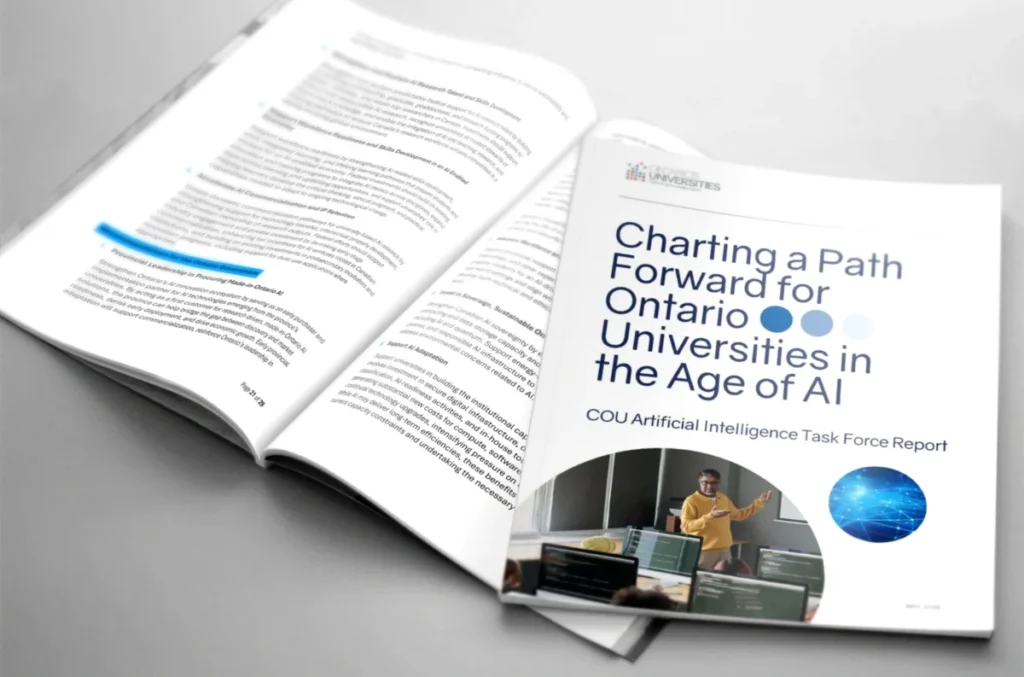
A comprehensive new report from the Council of Ontario Universities (COU) asserts that Ontario’s higher education institutions must urgently enhance their artificial intelligence (AI) literacy and foster robust collaboration, both internally and across sectors, to effectively navigate and capitalize on the burgeoning AI revolution rather than being passively overwhelmed by it. The 29-page document, titled Charting a Path Forward for Ontario Universities in the Age of AI, emphasizes that AI represents a fundamental structural transformation, not a transient trend, necessitating coordinated action across all institutional levels to harness its benefits while steadfastly upholding the core mission and values inherent to higher education.
This pivotal report was meticulously crafted by a seven-member task force comprising executive and senior university leaders from across Ontario, many of whom possess specialized portfolios in digital technologies. Its overarching aim is to provide a strategic roadmap for the province’s universities, guiding them toward the safe, ethical, and strategic integration of AI technologies. Crucially, it seeks to ensure that graduates are not only well-versed in AI but are also equipped to effectively collaborate with AI tools throughout their professional careers in an increasingly AI-driven economy.
The urgency of this directive was underscored by task force chair Vivek Goel, who also serves as president and vice-chancellor of the University of Waterloo. Speaking at a May 29 luncheon hosted by The Empire Club of Canada at Toronto’s Fairmont Royal York hotel, which drew an audience of 470 influential figures, Dr. Goel articulated the rapid and often disorienting pace of AI’s advancement within academic settings. "AI is moving so fast, it’s confusing, and everyone’s trying to keep up," he stated, highlighting the critical need for collective institutional effort.
Dr. Goel elaborated on the benefits of such collaboration, stating, "If we work together as institutions, one: we can share what we’re learning, what the impact on pedagogy, research, operations looks like; but we can also share in either developing or procurement of the different tools. We can share in the literacy programs that we need to develop." In a fitting nod to the report’s theme, he acknowledged that the task force itself utilized AI tools to effectively monitor and synthesize the overwhelming volume of emerging research and reports pertaining to AI in higher education.
A Strategic Framework for AI Adaptation
The report is structured to offer a multifaceted approach to AI integration. It begins with reflections on the potential future trajectories for universities in an AI-dominated landscape and their prospective roles within these scenarios. This is followed by a candid assessment of the current state of AI readiness and "adaptation"—a term the report favors over mere "adoption" to signify a deeper reimagining of existing practices and structures—within Ontario’s universities. The core of the report then presents guiding principles and strategic imperatives for this adaptation, culminating in a set of concrete recommendations for both universities and the federal and provincial governments. The report’s emphasis on "adaptation" signifies a proactive and transformative approach, advocating for a fundamental re-evaluation of how universities operate and deliver education in response to AI’s transformative potential.
Universities as Anchors Amidst AI Disruption
The report posits that universities are uniquely positioned to serve as vital "anchors" during periods of AI-induced disruption and unpredictable change. To achieve this, institutions are advised to implement several key measures. These include developing comprehensive strategic plans that account for both gradual and rapid AI-driven shifts, redesigning academic assessments to prioritize critical thinking, judgment, and creativity, and reinforcing transparency and reproducibility in research methodologies. Furthermore, universities are encouraged to double down on their distinctive human contributions, such as fieldwork and community engagement, and to invest in shared infrastructure and the capacity to convene diverse partners across various sectors.
On a broader scale, universities can function as "economic and cultural anchors" by embedding AI competencies across all academic programs. This involves offering robust experiential learning opportunities and accessible lifelong learning pathways to ensure that the workforce’s skills remain relevant in an evolving job market. Moreover, universities are called upon to contribute their academic expertise to shape public discourse surrounding AI’s capabilities and limitations. The report specifically recommends the development of tiered AI training programs for students, staff, and faculty. These programs would aim to progressively enhance AI literacy over time, with a particular focus on critical skills such as bias detection in AI outputs, identifying misinformation, and understanding ethical AI usage. The report also speculates on universities leveraging their expertise and facilities to accelerate AI adoption and facilitate cross-sectoral collaborations aimed at addressing complex societal challenges, many of which could be tackled or even solved through AI.
A crucial element of this adaptation, the report stresses, is ensuring that all AI-related decisions reinforce academic integrity and remain aligned with institutional missions and responsibilities. The deployment of AI should demonstrably enhance, rather than diminish, human judgment and expertise. Additionally, universities are urged to assume accountability for the environmental footprint of the technologies they adopt and to actively contribute to strategies for reducing this impact.
Navigating Financial, Privacy, and Academic Integrity Concerns
A significant concern highlighted in the report is the potential for smaller institutions, often operating with more limited budgets, to be left behind in the AI race. These institutions may struggle to develop the necessary infrastructure to support AI adaptation, which could ultimately hinder their ability to expand programs and services. This disparity underscores the critical need for shared service models and sector-wide collaboration to ensure equitable progress.
The task force’s extensive consultations and surveys revealed that universities are largely in the nascent stages of AI adaptation. Current efforts are primarily focused on building foundational AI competency and familiarity among faculty and staff, as well as establishing and investing in institutional structures and infrastructure to support and provide access to secure AI tools. Financing emerged as a substantial barrier to widespread AI adoption. Alongside financial constraints, universities expressed significant concerns regarding transparency in AI deployment, the protection of sensitive data and privacy, and the potential implications of AI for the university workforce.
The report forecasts a period of substantial growth in AI utilization within universities over the next three years. Among the identified opportunities, institutions cited the potential for more personalized learning experiences, enhanced insights into student learning through advanced analytics, and tools that can accelerate and refine research processes. AI is also seen as a valuable asset for supporting institutional compliance with policies and government regulations, as well as for bolstering general risk management. However, these opportunities are counterbalanced by considerable risks. These include threats to data privacy, security, and control; potential violations of copyright and intellectual property rights; AI-enabled security threats targeting institutional systems; and a potential loss of institutional autonomy due to reliance on market-dominant technology platforms. Furthermore, there are ongoing questions about the applicability of existing policies to AI use and practices, although the task force noted that universities are currently adapting existing policy frameworks rather than creating entirely new, AI-specific regulations.
The protection of academic integrity has become an increasingly prominent concern. In response, the report observed a renewed interest among universities in adopting alternative assessment methods, such as oral examinations, and in implementing "declaration-based practices." Under these practices, students are permitted to use generative AI in their coursework, provided they meticulously disclose the specific ways in which AI was utilized. To better prepare graduates for the evolving demands of an AI-infused economy, the report suggested integrating "AI experts across disciplines" into the curriculum.
Recommendations for Governments and Universities
The task force’s recommendations directed at government bodies cover several well-established priorities. These include calls for increased investment in graduate, post-doctoral, and research funding to attract and retain top AI research talent. Additionally, there are appeals for enhanced funding for work-integrated learning, experiential learning opportunities, and broader AI skills development initiatives. The federal government is specifically urged to invest in critical AI infrastructure and to streamline the commercialization process for university-developed AI research through improved technology transfer mechanisms and robust support for intellectual property development. The Ontario government, in turn, is advised to stimulate broader commercialization by acting as an early adopter of AI technologies emerging from its provincial universities. The provincial government is also encouraged to provide backing for collaborative procurement efforts among universities seeking to acquire AI tools.
The most extensive set of recommendations, however, is directed at the universities themselves. Of the 12 recommendations, many emphasize the importance of sharing best practices in AI-related training, pedagogy, leadership, and quality assurance. Collaboration across the university system, as well as with external partners and international institutions, is strongly advocated.
The task force specifically recommends leveraging sector-wide organizations, such as the Ontario University Council of Chief Information Officers (OUCCIO), to explore the feasibility of shared AI platforms and to investigate potential cost recovery models. The report also suggests exploring pooled infrastructure investments and joint service delivery mechanisms. In furtherance of these objectives, it is proposed that the Council of Senior Administrative Officers and OUCCIO establish a joint working group. This group will focus on identifying how AI can be harnessed to improve operational efficiency, including through the implementation of shared data centers and collaborative procurement strategies. Dr. Goel reiterated the report’s central thesis: while individual universities may opt for independent AI strategies, their likelihood of success will be significantly enhanced through collective action and shared endeavor.
Looking ahead, Dr. Goel expressed a measured optimism: "I’m optimistic that our institutions are going to be at the leading edge of figuring out how to use these technologies in a responsible way and really focus in on the human skills that our students are going to need in the world going forward." This forward-looking perspective underscores the report’s dual emphasis on embracing technological advancement while safeguarding and cultivating uniquely human capabilities.