



The Greek language, an independent branch of the Indo-European family with a documented history spanning over 3,400 years, remains a cornerstone of Western civilization and a vital tool for contemporary international engagement. As Greece continues to solidify its position as a premier global tourism destination—hosting upwards of 32 million visitors annually according to recent data from the Bank of Greece—the demand for functional linguistic competency has shifted from a niche academic pursuit to a practical necessity for travelers and expatriates. Understanding the fundamental lexicon of Modern Greek (Dimotiki) is not merely an exercise in rote memorization but a strategic gateway to navigating the socio-economic landscape of the Hellenic Republic.
Historical Context and the Evolution of Modern Greek
To understand the current linguistic environment, one must observe the chronology of the language. Greek has evolved through several distinct stages: Mycenaean Greek (16th to 11th century BC), Ancient Greek (9th to 6th century BC), Koine Greek (the Hellenistic period), Medieval Greek, and finally Modern Greek. A significant milestone in this timeline occurred in 1976 when the Greek government officially adopted Dimotiki (the "people’s language") as the standard for education and administration, ending a long-standing "diglossia" where a formal, archaic version known as Katharevousa was used in official capacities.
Today, Modern Greek is spoken by approximately 13.5 million people globally. For the modern traveler, the language serves as a primary tool for "Philoxenia"—the Greek concept of hospitality toward strangers. While English is widely spoken in urban centers like Athens and Thessaloniki, as well as on popular islands like Mykonos and Santorini, the use of basic Greek phrases by foreigners is statistically correlated with higher levels of service and deeper cultural integration.
The Foundational Lexicon: Social Etiquette and Greetings
In the Greek social hierarchy, language is used to denote respect and familiarity through the "T-V distinction" (informal vs. formal address). Utilizing the plural or formal form when speaking to elders or professionals is a critical component of local etiquette.
Core Essential Vocabulary
| English | Greek | Transliteration | Contextual Usage |
|---|---|---|---|
| Hello (Formal/Plural) | Γεια σας | Yassas | Used for strangers, elders, or groups. |
| Hello (Informal) | Γεια σου | Ya sou | Used for friends, children, or peers. |
| Yes | Ναι | Ne | Often confused by English speakers as "No." |
| No | Όχι | Ochi | Pronounced with a soft ‘ch’ sound. |
| Please / You’re welcome | Παρακαλώ | Parakalo | A multi-purpose polite term. |
| Thank you | Ευχαριστώ | Efcharisto | Derived from the root for "grace." |
| Sorry / Excuse me | Συγγνώμη | Signomi | Essential for navigating crowded spaces. |
| How are you? (Informal) | Τι κάνεις; | Ti kanis? | Common daily inquiry. |
| How are you? (Formal) | Τι κάνετε; | Ti kanete? | Standard professional inquiry. |
Linguistic experts suggest that the pronunciation of "Ne" (Yes) is one of the most significant hurdles for Western travelers, as the phonetic sound closely resembles the English "Nay" or "No," frequently leading to transactional misunderstandings in hospitality settings.
Temporal Greetings and Partings
Greek culture places a high value on the time of day, with specific greetings assigned to morning, afternoon, and night. "Kalimera" (Good morning) is generally used until midday, after which "Kalispera" (Good evening) becomes the standard.
- Good morning: Καλημέρα (Kalimera)
- Good evening: Καλησπέρα (Kalispera)
- Have a good afternoon: Καλό απόγευμα (Kalo apogevma)
- Welcome (Singular): Καλώς ήρθες (Kalos irthes)
- Welcome (Plural/Formal): Καλώς ήρθατε (Kalos irthate)
- Goodbye: Αντίο (Adio)
- Good night: Καληνύχτα (Kalinihta)
- See you later / Speak soon: Τα λέμε (Ta leme)
Logistics and Survival: Navigating the Greek Infrastructure
As tourism accounts for approximately 20% of Greece’s Gross Domestic Product (GDP), the infrastructure is designed to accommodate non-native speakers. However, in the "Blue Economy" sectors—transportation, maritime travel, and local dining—functional phrases are indispensable. According to the Greek National Tourism Organization (GNTO), travelers who can ask for directions or the bill in the local tongue report a 15% higher satisfaction rate in their overall travel experience.
Essential Travel Phrases
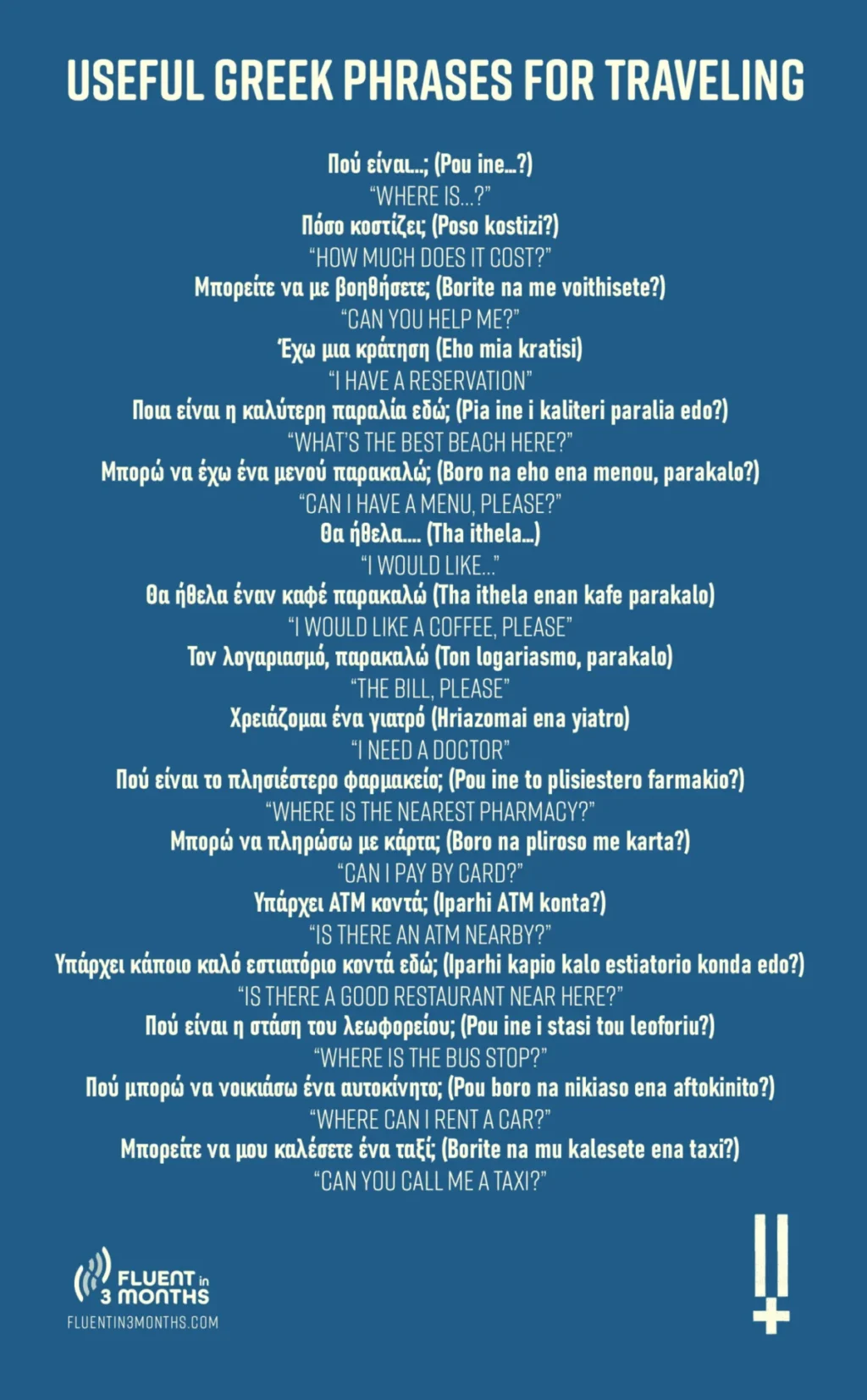
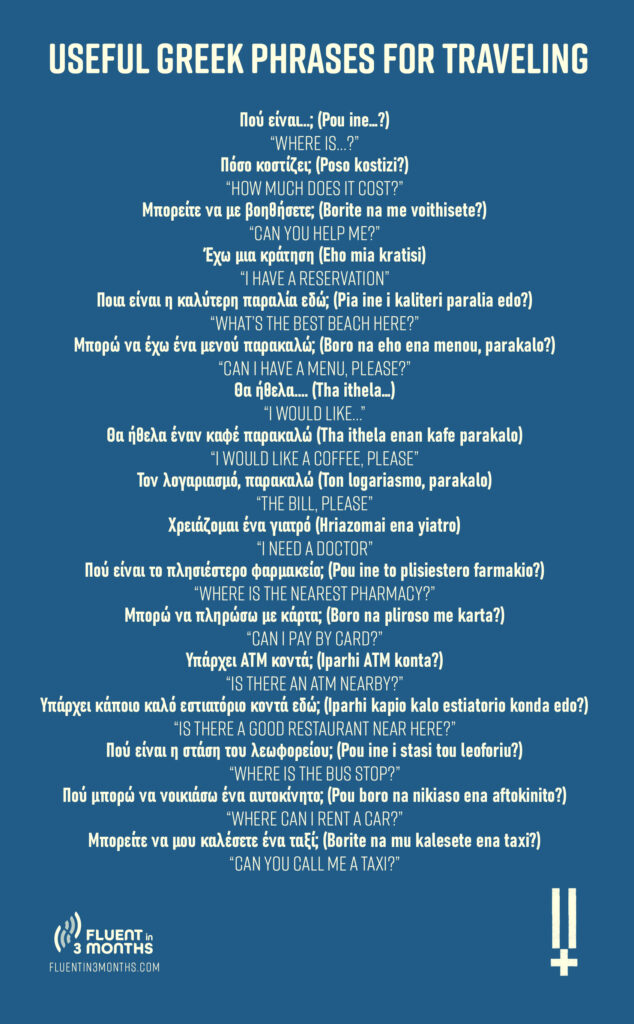
- Where is the bathroom? Πού είναι η τουαλέτα; (Pou ine i tualeta?)
- How much is it? Πόσο κάνει; (Poso kani?)
- Do you speak English? Μιλάτε αγγλικά; (Milate anglika?)
- Can I have the bill, please? Μπορώ να έχω τον λογαριασμό, παρακαλώ; (Boro na eho ton logariasmo, parakalo?)
- Can I pay by card? Μπορώ να πληρώσω με κάρτα; (Boro na pliroso me karta?)
- I have a reservation: Έχω μια κράτηση (Eho mia kratisi)
- Where is the bus stop? Πού είναι η στάση του λεωφορείου; (Pou ine i stasi tou leoforiu?)
In the context of the Greek dining experience, "Kali orexi" (Enjoy your meal) is the equivalent of "Bon appétit," while "Yamas" (To our health) is the ubiquitous toast used during the consumption of wine, ouzo, or tsipouro.
Personal Interaction and Identity
For expatriates or long-term visitors, the ability to self-identify and describe one’s origins is the first step toward building communal ties. Greek social circles, particularly in rural villages (horia), are built on lineage and occupation.
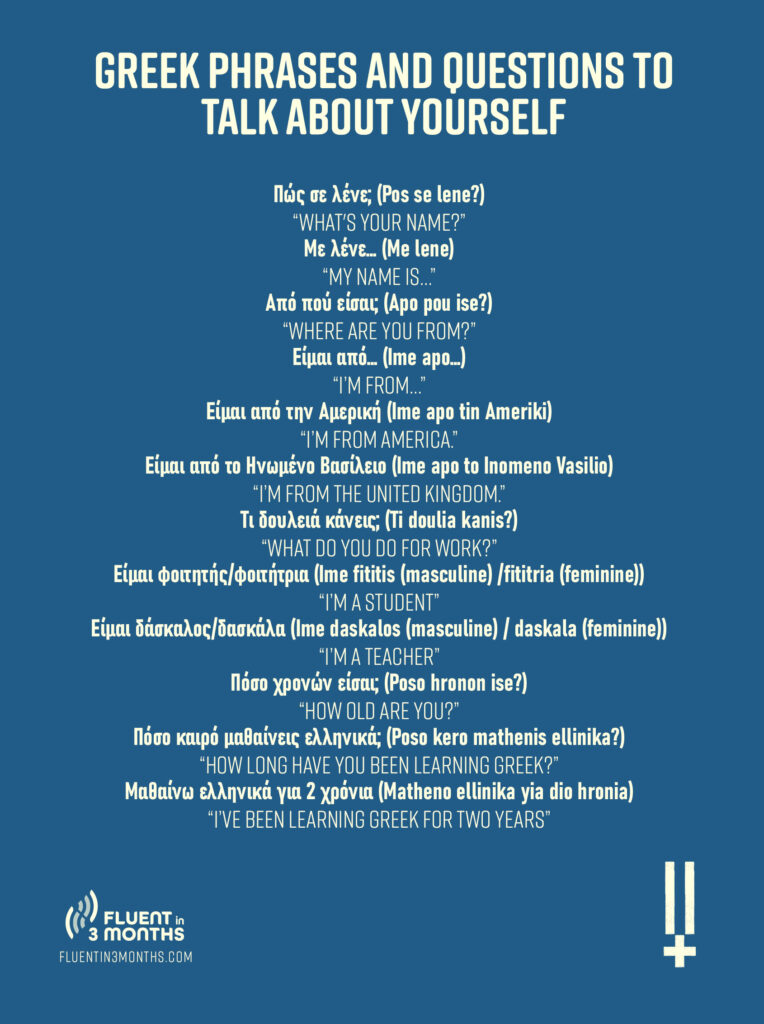
- What’s your name? Πώς σε λένε; (Pos se lene?)
- My name is… Με λένε… (Me lene…)
- Where are you from? Από πού είσαι; (Apo pou ise?)
- I’m from America: Είμαι από την Αμερική (Ime apo tin Ameriki)
- I’m from the UK: Είμαι από το Ηνωμένο Βασίλειο (Ime apo to Inomeno Vasilio)
- I’m a student: Είμαι φοιτητής/φοιτήτρια (Ime fititis/fititria)
The Vernacular: Slang and Informal Communication
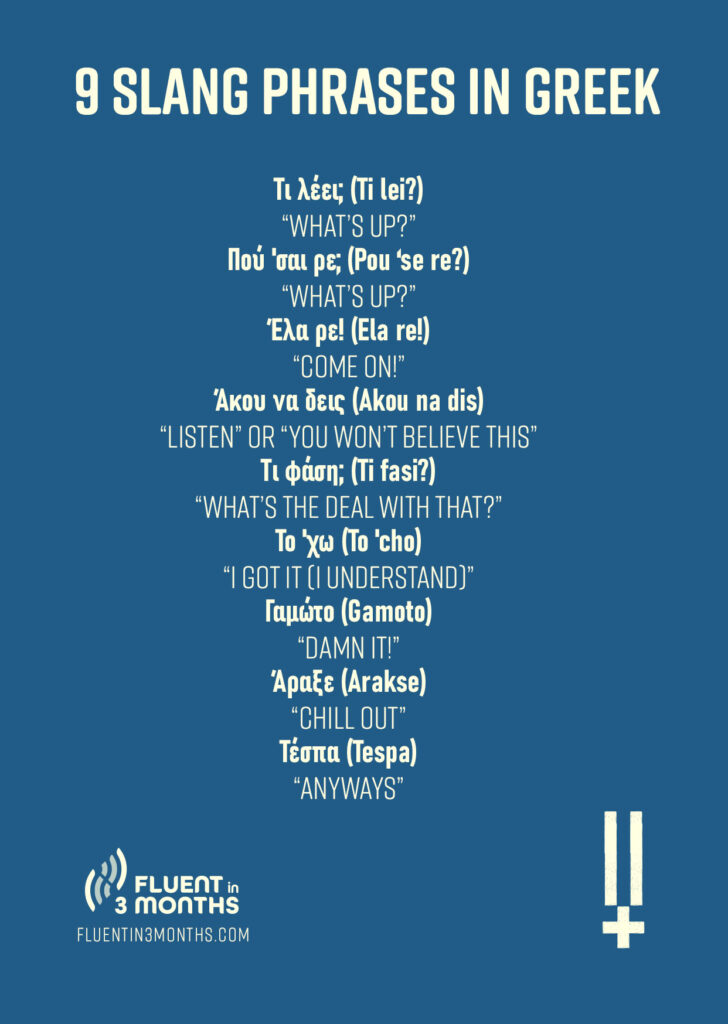
Modern Greek is a living language, characterized by a vibrant slang culture that reflects the resilience and humor of the population. While "Malaka" is internationally recognized—often used among close friends as a term of endearment, despite its literal meaning as a vulgarity—other terms are more useful for blending into local social environments.
- Ti lei? (Τι λέει;): Literally "What does it say?", used as "What’s up?"
- Ela re! (Έλα ρε!): A versatile expression meaning "Come on!" or "No way!" depending on the intonation.
- Arakse (Άραξε): "Chill out" or "Relax."
- Tespa (Τέσπα): A shorthand for "telos panton," meaning "anyway" or "whatever."
- Gamoto (Γαμώτο): A common exclamation used when something goes wrong ("Damn it").
Linguists caution that while these terms increase "street fluency," they should be avoided in formal settings, such as government offices (KEP) or high-level business meetings, where traditional decorum remains strict.
Proverbial Wisdom: The Cultural Philosophy
The Greek language is inextricably linked to Hellenic philosophy. Proverbs (Paroimies) are frequently used in daily conversation to convey complex moral or practical advice. These phrases offer a window into the Greek psyche, emphasizing patience, caution, and the value of experience.
- "Kallio pente kai sto heri, para deka kai karterei" (Better five in the hand than ten and waiting). This reflects a pragmatic approach to life and economics, prioritizing immediate security over speculative gain.
- "Opoios viazetai skoftatei" (He who hurries, trips). A critique of the modern fast-paced lifestyle, emphasizing the traditional Mediterranean "siga-siga" (slowly-slowly) approach.
- "Emathe o kalogeros ta grammata" (The monk learned his letters). Used sarcastically when someone finally understands something that should have been obvious.
- "Mazi milame kai horis na katalavainomaste" (We are speaking together but without understanding each other). A common refrain in Greek politics and family debates.
Broader Impact and Implications for Global Communication
The preservation and promotion of the Greek language have significant geopolitical and economic implications. The Greek Ministry of Foreign Affairs, through the General Secretariat for Greeks Abroad, actively promotes Greek language programs to maintain ties with the massive Hellenic diaspora in the United States, Australia, and Germany.
From a data perspective, language learning apps have seen a 20% year-over-year increase in Greek language learners, a trend attributed to the digital nomad movement. As Greece introduces "Digital Nomad Visas," the linguistic integration of foreign remote workers is becoming a focal point of urban planning in Athens.
Furthermore, the European Union recognizes Greek as one of its 24 official languages, ensuring that all legislative documents are translated into Greek. This status provides the language with a level of institutional protection that prevents it from being overshadowed by more dominant global languages.
Conclusion: The Strategic Value of Linguistic Proficiency
Mastering basic Greek phrases is more than a polite gesture; it is a functional tool for navigating one of the world’s most historically significant and geographically strategic regions. Whether for the purpose of tourism, business, or cultural appreciation, the transition from "xenos" (stranger) to "filos" (friend) begins with the spoken word. As the Greek economy continues to diversify beyond traditional tourism into technology and renewable energy, the ability to communicate within the local linguistic framework will remain a high-value asset for global citizens.
For those embarking on this linguistic journey, resources ranging from the Ministry of Culture’s digital archives to modern immersive tutoring platforms provide a comprehensive pathway. The consensus among educators and travel experts is clear: while the Greek alphabet may appear daunting, the phonetic consistency and logical structure of the language make basic proficiency an attainable and rewarding goal.